3-5 Layer Bubble Film Extrusion Machine: Key Equipment Features
2026-09-03
Protective packaging has moved far beyond simple single-layer cushioning. As global supply chains carry increasingly fragile, high-value, and regulated goods—from precision electronics to pharmaceutical components—the equipment used to produce bubble film must deliver more than basic protection. A modern bubble film extrusion machine built around 3 to 5 layer co-extrusion technology represents a fundamental shift in how manufacturers approach material performance, production consistency, and operational efficiency.
Where Traditional Bubble Film Production Falls Short
Single-layer or basic two-layer production lines were built for a simpler era of packaging demand, and their limitations become obvious under today's requirements. A film made from one homogeneous resin layer forces manufacturers into a compromise: they can optimize for tensile strength, cushioning softness, or moisture resistance, but rarely all three at once. For industries shipping sensitive electronics or moisture-sensitive components, that tradeoff translates directly into higher damage rates and customer complaints.
Melt consistency presents a second recurring obstacle. Extruders with insufficient torque or uneven screw design struggle to maintain uniform melt distribution, particularly as layer count increases. The result is inconsistent bubble wall thickness, irregular cell formation, and a higher rate of ruptured bubbles during high-speed operation—problems that compound quickly on continuous production lines running around the clock.
A third challenge lies in automation gaps. Production lines that depend heavily on manual perforation, cutting, or winding introduce bottlenecks that limit throughput and increase labor costs. Without integrated digital control over temperature, line speed, and pressure, operators are left relying on manual adjustment and experience-based judgment, which makes it difficult to reproduce the same film quality batch after batch. For manufacturers competing on both cost and consistency, these gaps directly affect profitability.
The Role of Bubble Film Across Modern Industries
Bubble film has become a foundational material across a wide range of supply chains precisely because so few alternatives combine its lightweight structure with reliable cushioning. Electronics and precision instrument manufacturers rely on it to absorb shock during transit, where even minor vibration damage can render a component unusable. Automotive parts suppliers and hardware distributors use it to prevent surface scratching and impact damage on metal and coated components during long-distance shipping.
Pharmaceutical and personal care companies depend on bubble film for cushioning that also meets cleanliness and traceability expectations tied to regulatory audits. Meanwhile, the rapid growth of e-commerce fulfillment has placed new pressure on packaging suppliers to deliver lightweight, cost-efficient materials at high volume without sacrificing protective performance. As environmental regulations tighten around packaging waste and material sourcing, the equipment used to manufacture bubble film increasingly determines whether a converter can meet these evolving standards at all.
Core Equipment Features That Address These Demands
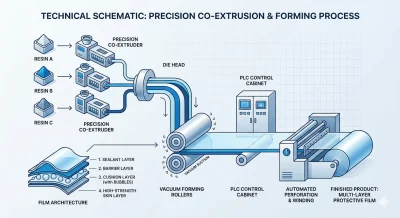
A 3 to 5 layer bubble film extrusion machine is engineered specifically to close the gap between what traditional lines can deliver and what modern supply chains require, with each core component tied directly to a practical application.
| Equipment Component | Core Function | Primary Application Benefit |
|---|---|---|
| Precision Extruders | High-torque screws ensure uniform melt quality and consistent distribution across 3-5 layers | Enables layer-specific functions (e.g. strong outer layer + soft cushioning core) for electronics packaging |
| Vacuum Bubble Forming Rollers | Specialized vacuum suction creates uniform cell structure across film width | Consistent cushioning for fragile goods like glass, ceramics, and precision instruments |
| PLC Cabinet Control System | Centralized control of temperature, speed, and pressure with recipe storage | Batch-to-batch repeatability for regulated industries (pharmaceutical, personal care) |
| Automated Perforation & Winding | Continuous, hands-off perforation, cutting, and winding workflow | Shorter changeover times and lower labor costs for high-volume e-commerce fulfillment |
| Multi-Layer Architecture | Assigns specific performance properties to specific layers instead of relying on excess thickness | Stronger film using less raw material, improving weight-to-performance ratio for exporters |
High-torque precision extruders form the foundation of the system, ensuring uniform melt quality and consistent material distribution across every layer. This allows manufacturers to assign distinct functions to each layer—for example, a higher-strength outer layer paired with a softer cushioning core—rather than settling for a single compromised formulation. For electronics packaging converters, this layered approach means the finished film can simultaneously resist puncture during handling and absorb shock during drops, addressing the exact tradeoff that single-layer production could never solve.
Vacuum bubble forming rollers use specialized suction technology to create a uniform cell structure across the width of the film. Consistent cell formation is what separates dependable cushioning from unpredictable performance, and it matters most when the packaged goods themselves are fragile. Glass, ceramics, and precision instrument shipments benefit directly from this uniformity, since inconsistent bubble height or wall thickness in even a small percentage of cells can create weak points where impact damage occurs.
An integrated PLC cabinet control system governs the entire production line, giving operators precise command over temperature zones, line speed, and forming pressure from a centralized interface. This level of digital control does more than simplify operation—it makes production repeatable across shifts and batches, which is essential for manufacturers supplying pharmaceutical or personal care packaging where consistency is often verified through supplier audits and quality documentation. Recipe storage and process visualization further reduce the dependency on individual operator experience, helping plants maintain stable output even as staff or shift patterns change.
Automated perforation, cutting, and winding units complete the production sequence, transforming what was once a labor-intensive final stage into a continuous, largely hands-off workflow. For e-commerce fulfillment centers and packaging converters processing high order volumes, this automation translates into shorter changeover times, reduced labor costs, and the ability to keep pace with fluctuating demand without expanding headcount.
Beyond individual components, the layered architecture itself delivers a material efficiency advantage that single-layer production cannot match. By assigning specific performance properties to specific layers rather than relying on excess material thickness to compensate for weak points, manufacturers can produce stronger film using less raw resin overall. This improved weight-to-performance ratio matters increasingly to exporters and logistics companies managing freight costs, as well as to brands responding to sustainability expectations from their own customers.
Built for Scalable, Future-Ready Production
This 3 to 5 layer platform is only one point on a much wider equipment spectrum, which extends up to high-speed 7-layer flagship systems for manufacturers running continuous, large-batch output, and down to medium-speed lines built for smaller or more specialized production runs. That range matters because film requirements rarely stay static: a converter supplying automotive parts packaging may need the layer density and output volume of a higher-tier system, while a supplier focused on e-commerce mailers or lighter-duty cushioning may be better served by a leaner, lower-speed configuration. Rather than forcing every customer onto a single fixed specification, this equipment spectrum allows manufacturers to select a machine sized to their actual order volume and film complexity—avoiding the capital inefficiency of running an oversized line at partial capacity, or the output ceiling of a line that's undersized for growing demand.
For manufacturers evaluating an upgrade to their packaging production capability, a well-engineered bubble film extrusion machine offers a clear path to solving the material performance, consistency, and automation challenges that limit older equipment. From precision multi-layer co-extrusion to integrated PLC control and fully automated winding, every component is designed to help converters meet the protection standards, material efficiency targets, and regulatory expectations that define modern packaging supply chains. Manufacturers ready to move beyond the limitations of single-layer production will find that investing in 3 to 5 layer extrusion technology delivers measurable improvements in both film quality and operational reliability—positioning their production line to meet global packaging standards well into the future.