In the protective packaging industry, manufacturers must supply wider and more reliable cushioning materials to meet the demands of modern logistics, e-commerce distribution, and industrial transportation. As product dimensions expand and packaging standards tighten, wide-format air bubble film is vital for safeguarding furniture, automotive components, electronic equipment, and other valuable goods during handling and shipment.
However, producing wide bubble film consistently is not simply a matter of increasing machine speed or enlarging die width. The extrusion system must maintain stable melting, uniform material distribution, and consistent pressure throughout the production process. On a bubble film extrusion machine, the extruder screw diameter plays a pivotal role in determining material conveying capacity, melt quality, and overall line throughput.
Challenges of Wide Format Bubble Film Production
Wide-format bubble film production places greater demands on extrusion technology compared to standard-width film production. When film width increases from 1600 mm to 3000 mm or more, the extrusion system must deliver a significantly larger volume of molten polymer while maintaining uniform flow across the entire die width.
Traditional extrusion systems with smaller screw diameters falter under elevated throughput demands. If screw capacity is insufficient, operators often compensate by ramping up rotational speed. This approach introduces severe process instabilities, such as unstable melt pressure, excessive shear heating, and degraded melt homogeneity.
For bubble film production, these instabilities directly compromise bubble formation and film performance. Uneven material distribution causes gauge variation, inconsistent bubble cell strength, and increased scrap rates.
Therefore, wide-format production requires an extrusion system designed around an optimal screw diameter, screw geometry, and processing conditions rather than relying solely on elevated RPMs.
The Relationship Between Screw Diameter and Extrusion Capacity
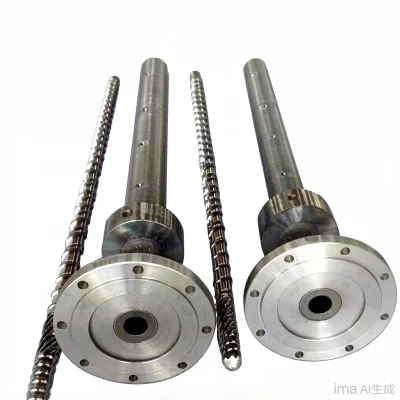
The screw is the primary conveying and plasticizing component of an extrusion system. Its diameter determines the available processing volume inside the barrel and directly influences the volume of material transported and melted during per rotation.
In extrusion engineering, the output capacity of a screw increases significantly as diameter increases. A larger screw provides greater flight volume, allowing more polymer to be conveyed with each revolution. In practice, screw diameters on wide-format bubble film lines typically span from around Φ65mm on compact, lower-output configurations up to Φ120mm or more on high-throughput, extra-wide lines.
This principle is vital for bubble film lines designed for wide-width production. A larger screw diameter enables the extrusion system to achieve the required output while maintaining a conservative screw speed. Compared to operating a smaller screw at higher speeds, this approach provides better control over melting conditions and reduces mechanical and thermal stress on the polymer.
For example, when producing wide bubble film using LDPE and LLDPE, the extrusion system must balance output requirements with melt stability. An appropriately sized screw ensures that the material receives sufficient mixing and melting time before reaching the die head.
Maintaining Stable Melt Quality Through Proper Screw Design
The quality of bubble film depends heavily on the uniformity of the molten polymer prior to entering the die. During processing, polymers must undergo heating, melting, mixing, and pressure stabilization. Any instability during these stages compromises web integrity and cell uniformity.
An improperly sized screw diameter forces the system outside its optimal processing range. Excessive screw speed generates excessive shear forces inside the barrel, causing thermal temperature fluctuations and inconsistent melt homogeneity.
A properly sized screw enables processing at conservative RPMs. The polymer undergoes gradual thermal transition, thorough mixing, and is delivered to the die at consistent pressure. This is particularly vital for wide bubble film, where minor variations in melt distribution are amplified across the web width.
Advanced screw designs also optimize parameters including compression ratio, length-to-diameter(L/D) ratio, and resin rheology. These parameters synergistically enhance plasticating efficiency and ensure reliable processing across diverse resin blends.
Screw Diameter and T-Die Pressure Stability
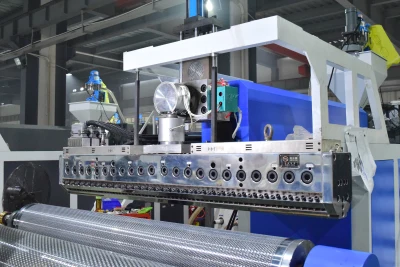
The T-die distributes molten polymer into a flat sheet prior to the bubble forming process. For wide-format bubble film production, maintaining uniform melt pressure across the width of the die is essential.
The extrusion screw functions as a continuous material delivery system. If the screw cannot deliver stable output, melt pressure surges propagate before the polymer enters the T-die. These pressure variations directly compromise gauge control and induce inconsistencies in bubble formation.
A optimally sized screw diameter ensures a steady melt supply, enabling the T-die to operate under consistent head pressure. As a result, manufacturers realize superior thickness uniformity and consistent bubble structures.
Consequently, screw diameter does not act in isolation. It integrates synergistically with barrel design, thermal management system, T-die structure, and control system to determine the overall performance of a bubble film line.
Supporting the Demand for Wider Protective Packaging Materials
The development of large-format bubble film is directly driven by evolving global packaging requirements. Many industries now require packaging materials that can safeguard oversized items while reducing manual wrapping time and maximizing operational throughput.
Wide bubble film delivers key operational advantages by enabling large-format products to be wrapped with fewer overlaps and seams. This is critical for sectors including furniture manufacturing, industrial equipment transport, warehouse logistics, and export packaging.
However, realizing these benefits requires uncompromising manufacturing consistency. A wider film width demands tighter control of extrusion uniformity because defects or gauge variations directly compromise the overall protection performance of the packaging material.
Our Bubble Film Line with Optimized Extrusion Configuration
Our bubble film extrusion machine is engineered for optimal extrusion stability, processing efficiency, and consistent film quality in wide-format production. The extrusion system integrates precisely synchronized screw diameter, screw geometry, barrel structure, and advanced temperature control technology to ensure homogeneous polymer melting and stable material delivery during continuous high-throughput operation.
By optimizing the screw and barrel configuration, the machine delivers uniform melt flow and precise pressure control before the material enters the T-die. This enables producers to achieve tight consistent film thickness tolerances, reliable bubble formation, and maximized operational efficiency across different film widths.
The equipment can be tailored to specific production requirements, including film width, output capacity, and raw material rheology. Whether producing standard-width packaging materials or large-format bubble film for industrial applications, a properly engineered screw design provides the foundation for reliable performance, empowering manufacturers to establish a more competitive protective packaging production line.