Enhance Order Response Efficiency with Advanced Bubble Film Extrusion Machine
2026-09-03
In the fast-evolving logistics industry, the ability to fulfill orders rapidly has become a core competitive advantage, often outweighing price as the deciding factor for retaining high-volume customers. As e-commerce and industrial supply chains push toward same-day and next-day fulfillment, packaging materials can no longer be treated as a static inventory item ordered weeks in advance. A modern bubble film extrusion machine is increasingly positioned not just as production equipment, but as a strategic tool for compressing the entire order-to-shipment timeline.
The Hidden Costs of Relying on External Bubble Film Supply
Facilities that rely on purchasing finished bubble film from third-party suppliers routinely face lead times of seven to fourteen days between placing an order and receiving usable material. That gap may be manageable during predictable demand periods, but it becomes a serious liability whenever order volume spikes unexpectedly or a customer requests packaging specifications outside a supplier's standard inventory. External supply chains simply cannot flex fast enough to match the pace that modern fulfillment operations require.
A second recurring obstacle involves changeover flexibility. Many production setups were designed around long, uninterrupted runs of a single film specification, which makes switching between bubble heights, film densities, or gauge thicknesses a slow and often manual process. For facilities handling a diverse mix of small-batch and high-volume orders simultaneously, this rigidity forces a choice between efficiency and responsiveness—rarely both at once.
Warehouse space adds a third layer of friction. Finished bubble film rolls are bulky relative to their weight, consuming significant floor space and requiring dedicated handling equipment to move between storage and packaging stations. Every additional step in that internal movement chain adds time to the order fulfillment process, even before a shipment ever leaves the building.
Why In-House Production Capability Matters for Logistics Operations
Bubble film remains one of the most widely used cushioning materials across e-commerce, electronics, and industrial shipping precisely because it delivers reliable protection at low weight and cost. But as fulfillment expectations shift toward same-day processing, the strategic value of bubble film is no longer just the material itself—it's how quickly a facility can produce it on demand. Operations that manufacture their own cushioning material internally gain a level of supply chain independence that external sourcing simply cannot match, particularly during peak shipping seasons when third-party lead times tend to stretch even longer. This shift toward on-site, on-demand production is becoming a defining factor in which facilities can consistently meet aggressive fulfillment targets.
How Equipment Design Translates Into Faster Order Response
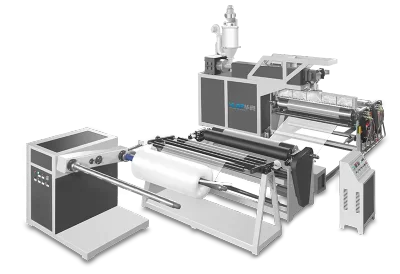
Order response efficiency is rarely the result of a single upgrade—it comes from several pieces of equipment design working together across different stages of the production and fulfillment cycle. Facilities running a 7-layer high-speed bubble film machine or a 3-5 layer high-speed bubble film machine can generate premium cushioning material on-site the moment an order is received, rather than waiting on external procurement cycles. This shift from "purchase and wait" to "produce on demand" is what allows same-day order processing to become a realistic operational standard rather than an occasional exception.
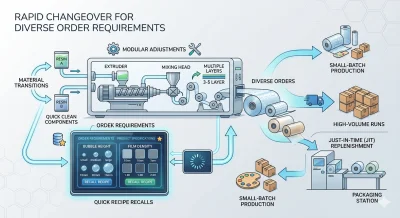
Order responsiveness, however, depends on more than raw output—it depends on how quickly a line can pivot between specifications. A 2-layer medium-speed bubble film machine or 3-5 layer medium-speed bubble film machine is built around quick recipe recall, allowing operators to adjust bubble height and film density rapidly to match a specific customer's requirements. Modular adjustment capability further minimizes downtime during material transitions, so that a facility handling a mix of small-batch specialty orders and larger standard runs doesn't have to sacrifice one to serve the other. This is particularly valuable for just-in-time replenishment models, where packaging stations need to stay continuously supplied without waiting on deliveries from outside vendors.
For facilities facing sudden surges in order volume, sustained high-speed output becomes the deciding factor in whether production capacity turns into a bottleneck. High-speed lines paired with automated dual-turret winding systems and flying knife cutover technology are designed to support extended continuous operation, keeping material flowing through peak demand periods without relying on manual intervention at every roll change. That combination of throughput and automation is what allows a facility to keep pace with order volume during the exact periods when fulfillment pressure is highest.
None of this responsiveness matters if the film itself is defective, since a failed run simply shifts the delay further down the production timeline. Across the equipment range—including 2-layer and 3-5 layer low-speed configurations—precision PID temperature control plays a central role in avoiding that outcome. Reaching optimal extrusion temperatures quickly supports faster startup stability, meaning production can begin sooner after a changeover rather than requiring an extended warm-up period. Consistent temperature control throughout the run also reduces bubble collapse and thickness variation, which are two of the most common causes of rejected material and time-consuming re-runs. For operations under time pressure, eliminating avoidable quality disputes is as important as raw production speed.
Order response efficiency also depends on how efficiently a facility manages its internal workflow, not just how fast it can extrude film. High-speed machines built around raw LDPE pellet input allow facilities to replace bulky pre-made bubble wrap rolls with compact resin storage, freeing up floor space that would otherwise be dedicated to finished-roll inventory. This reduction in physical footprint also cuts down on the internal handling steps required to move material from storage to the packaging line, removing friction from the order-to-shipment workflow at a stage that's often overlooked in efficiency discussions.
Building an Order-Responsive Packaging Operation
Compressing the order-to-shipment timeline requires more than a single upgrade—it depends on production capability, changeover flexibility, sustained throughput, quality consistency, and warehouse efficiency all working together. A well-engineered bubble film extrusion machine addresses each of these dimensions simultaneously, giving fulfillment operations the internal capacity to respond to orders at the pace modern logistics demands rather than remaining dependent on external supply timelines. For facilities looking to strengthen order response efficiency and reduce reliance on third-party lead times, evaluating the right combination of high-speed, medium-speed, and precision-controlled extrusion equipment is an important step toward building a packaging operation that can keep up with where the industry is heading.