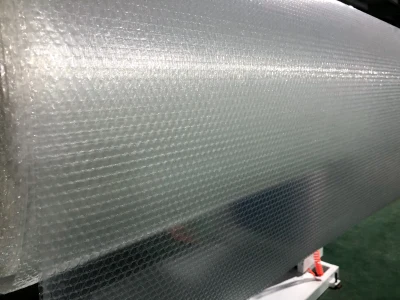
The demand for high-performance protective packaging is growing rapidly as industries such as logistics, e-commerce, manufacturing, and export transportation require more secure and efficient product protection solutions. To meet these market needs, manufacturers are increasingly adopting wide-format bubble film production lines capable of producing wider web widths with stable output and consistent quality.
A modern bubble film line must be designed for reliable operation under continuous industrial conditions. By optimizing key systems such as screw geometry, drive control, thermal regulation, and machine structure, manufacturers achieve consistent stable film quality, minimize scrap rates, and maxmize long-term production efficiency.
Engineering Challenges in Wide-Format Bubble Film Manufacturing
Wide-format bubble film production places greater demands on extrusion equipment. Compared to narrow film lines, wider production systems require more precise control of melt pressure, cooling conditions, and web tension. Minor process deviations are magnified across a wider web width.
Common production defects include uneven bubble formation, gauge variation, unstable web tension, and excessive edge trim scrap. These defects are often related to insufficient extrusion capacity, fluctuating torque transmission, inadequate thermal management, or mechanical vibration.
For high-volume protective packaging manufacturers, addressing these engineering challenges requires a thorough understanding of the principles governing modern high-output extrusion equipment.
Optimized Screw Design for Stable Material Extrusion
The extrusion screw is critical to a bubble film line, responsible for conveying, melting, mixing, and pressurizing polymer resins before entering the die.
When producing wide-format bubble film, the screw design must match the required output capacity and resin characteristics. A properly designed screw with an optimal compression ratio, channel depth, and mixing sections improves plasticating efficiency and maintains stable melt pressure.
Larger screw diameters are essential in high-output extrusion lines to achieve greater material conveying capacity at controlled rotational speeds. Compared to operating a smaller screw at excessive speed, an appropriately sized screw reduces unnecessary shear stress and prevents thermal degradation, maintaining melt temperature stability.
Stable extrusion conditions are vital when processing materials such as LDPE, LLDPE, recycled polymers, or blended resin formulations. Consistent melt quality enables the forming system to create uniform air bubbles, improving the overall appearance and mechanical strength of the final bubble film.
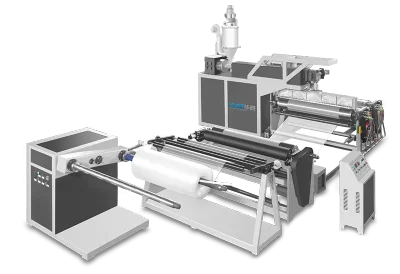
Torque Stability and Extrusion Process Control
The drive system directly impacts the consistency of the extrusion process. During continuous production, fluctuations in raw material properties, thermal profiles, or throughput demands alter resistance inside the barrel.
A reliable bubble film line requires a motor and control system capable of maintaining stable screw rotation under varying operating conditions. Variable frequency drive (VFD) technology and closed-loop control systems precisely regulate motor output, enabling the extrusion system to respond dynamically to process load shifts.
Stable torque transmission ensures screw speed remains consistent, synchronizing extrusion output with downstream forming speed. This balance is essential for maintaining tight gauge tolerances, bubble cell structure, and winding quality.
For industrial manufacturers, precise drive control minimizes operator intervention and delivers repeatable, high-yield production.
Thermal Management for Consistent Film Quality
Temperature control is critical to polymer processing. During extrusion, excessive heat generation or uneven temperature distribution compromises melt viscosity and induces instabilities during web forming.
Modern bubble film lines employ multiple heating zones and cooling systems to precisely regulate thermal profiles along the barrel. Each zone is independently controlled based on material characteristics, throughput rates, and layer structure.
Effective thermal management delivers key operational benefits. It ensures stable polymer flow, prevents thermal material degradation, and enhances bubble-forming stability. For multi-layer bubble film production, precise temperature control also promotes interlayer bonding between different material layers.
With the growing utilization of recycled materials and cost-effective resin blends, precise thermal control is essential to achieving repeatable product quality.
Mechanical Structure and Vibration Control
As web widths expand, mechanical stability becomes increasingly critical. The extrusion system, forming rollers, cooling components, and winding units must maintain precise mechanical alignment during long-term operation.
A heavy-duty machine frame suppresses vibration generated by motors, gearboxes, and rotating assemblies. Structural rigidity ensures consistent roll positioning and maintains uniform web tension across the entire width.
In wide-format bubble film production, even minor alignment deflections compromise cooling balance and winding quality. A rigid structural design enhances operational reliability and minimizes downtime caused by frequent realignment.
Therefore, the machine frame functions not merely as a structural support, but as a critical foundation for maintaining long-term production accuracy.
Integrated Engineering for Efficient Bubble Film Production
The performance of a bubble film line depends on the synergy of interconnected subsystems rather than isolated components. A high-output extrusion line must harmonize material processing, mechanical stability, and advanced process control.
A well-designed system combines:
Optimized screw geometry for stable polymer melting and conveying
Robust drive technology for consistent extrusion speed
Precise thermal management for controlled melt conditions
Rigid mechanical structure for stable long-term operation
When these elements operate in synergy, manufacturers realize uniform bubble formation, superior film quality, and maximized throughput efficiency. This integrated approach is essential for wide-format lines where production requirements are more demanding and process variations are magnified.
A Reliable Bubble Film Making Machine for Industrial Applications
Our bubble film lines are engineered for a wide range of protective packaging applications, from standard packaging films to large-format industrial bubble film production. With carefully engineered extrusion systems, optimized screw configurations, advanced temperature control, and rigid mechanical designs, our machines deliver consistent film quality, reduced scrap rates, and dependable production performance.
By selecting the appropriate machine configuration based on specific production needs, manufacturers can establish an optimized, highly stable bubble film production process while enhancing their competitiveness in the global packaging market.