How Bubble Film Extrusion Machine Optimize Factory Resource Utilization
2026-08-19
Modern packaging manufacturers are under increasing pressure to produce more while controlling material consumption, energy costs, labor requirements, and production downtime. Improving overall equipment effectiveness (OEE) is therefore becoming an important part of factory management. A modern bubble film extrusion machine can help address these challenges by combining multilayer extrusion, efficient drive systems, automatic process control, and high-speed winding technology. By making better use of resin, electricity, equipment capacity, and labor, advanced bubble film production lines can turn production resources into greater and more consistent manufacturing output.
The Hidden Cost of Traditional Bubble Film Manufacturing
Traditional bubble film production can involve significant resource losses when equipment lacks precise process control. Material waste is one of the most visible problems. In a basic production system, edge trim, startup scrap, off-specification film, and unstable bubble formation can increase resin consumption. When production parameters are adjusted manually, it can also take longer to achieve stable film thickness and consistent bubble dimensions after startup or a material change.
Energy consumption is another important consideration. Extrusion requires continuous heating, melting, air cooling, and mechanical drive power. Conventional heating systems and motors may continue operating at a fixed level even when the actual production demand changes. Poor temperature stability can further increase energy consumption because excessive heating may be required to compensate for process fluctuations. At the same time, unstable melt temperatures can affect film quality and increase the amount of rejected material.
Labor and downtime also influence the real production cost of a bubble film factory. Manual roll changes, frequent parameter adjustments, cleaning, material changes, and quality inspections can require considerable operator attention. If each changeover takes a long time, available production hours are reduced. For factories operating several extrusion lines, inefficient manual control can make it difficult for a limited number of operators to monitor production consistently.
The Crucial Role of Bubble Film in Modern Industry
Bubble film remains an important protective packaging material for e-commerce logistics, warehousing, furniture, electronics, glass products, household goods, industrial components, and other applications where cushioning and surface protection are required. Its lightweight structure provides impact absorption while using relatively little raw material compared with many solid protective packaging materials.
As packaging requirements become more demanding, manufacturers are also looking beyond basic single-layer bubble film. Multilayer structures can provide greater flexibility in material selection and allow different layers to perform different functions. For example, selected inner layers may incorporate recycled material or cost-efficient resin blends, while outer layers can be designed for better appearance, sealing performance, puncture resistance, or surface protection.
Sustainability is also influencing bubble film production. Lightweight film structures, controlled thickness, efficient resin utilization, and the appropriate use of recycled materials can help manufacturers reduce material consumption without unnecessarily compromising packaging performance. These requirements make extrusion technology increasingly important to overall factory resource efficiency.
How a Bubble Film Extrusion Machine Optimizes Factory Resources
Multilayer Coextrusion Improves Material Efficiency
One of the main advantages of an advanced bubble film extrusion machine is the ability to produce multilayer structures. Three-layer, five-layer, and seven-layer extrusion systems allow manufacturers to distribute materials according to the functional requirements of each layer instead of using the same material throughout the entire film structure.
For suitable applications, a multilayer structure can reduce the amount of premium resin required in specific layers while maintaining the required cushioning and mechanical performance. Depending on the film specification, resin formulation, and production process, material savings can be substantial compared with a less optimized single-layer structure. In some applications, optimized multilayer structures may reduce virgin resin consumption by up to around 30%, although actual savings depend on the target film properties and formulation.
Seven-layer extrusion provides even greater flexibility for material distribution. Recycled resin or selected cost-efficient materials can be introduced into designated inner layers, while the outer layers can be produced with materials selected for appearance and functional performance. This approach allows manufacturers to improve material economics without simply reducing the total film thickness.
Material recovery is another important part of resource utilization. Edge trim and suitable production scrap can be collected and returned to the process where the material specification allows it. A well-designed recycling system can reduce avoidable material losses and improve overall resin utilization. With stable production conditions and effective edge-trim recovery, some production lines can target material losses below a few percent, although actual results depend on product specifications, startup procedures, and the recycling ratio.
Intelligent Power Management Reduces Energy Consumption
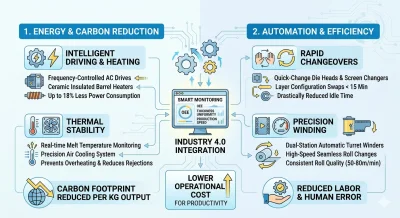
Energy efficiency is closely connected with extrusion stability. A modern bubble film extrusion machine can use efficient AC drives, optimized motors, temperature controllers, and zoned heating systems to match energy input more closely with actual production requirements.
Advanced heating systems can improve heat transfer to the barrel while reducing unnecessary heat loss. Precise temperature control helps maintain stable melting conditions across different extrusion zones, reducing the need for excessive heating. Efficient drive systems can also regulate motor output according to production requirements rather than continuously operating at a fixed load.
With optimized drive, heating, cooling, and process-control systems, energy consumption can be reduced compared with conventional equipment. Depending on the machine configuration and operating conditions, energy savings of up to approximately 10–18% may be achievable in suitable applications. However, actual energy consumption should always be evaluated according to output, resin type, film thickness, number of layers, operating speed, and factory conditions.
Stable melt temperature also contributes to resource efficiency. When temperature fluctuations are minimized, the extrusion process becomes easier to control, which can reduce startup waste and off-specification production. Precision cooling and stable bubble formation further help maintain consistent film quality across continuous production.
Automation Reduces Labor Requirements and Downtime
Automation can improve factory productivity without simply increasing the number of machines. A modern bubble film extrusion machine can integrate PLC-based control, touchscreen operation, automatic temperature regulation, production parameter storage, thickness monitoring, and other functions that reduce the amount of routine manual adjustment.
Fast changeovers are particularly valuable for factories producing multiple film specifications. Quick-change die components and automatic screen changers can shorten the transition between production conditions. The exact changeover time depends on machine configuration, resin type, product specification, and operator preparation, but optimized systems can significantly reduce downtime compared with fully manual procedures.
The winding system also has a direct effect on labor efficiency. An automatic dual-station winding system can perform roll changes with limited operator intervention while maintaining controlled winding tension. Depending on film width, thickness, bubble size, and machine configuration, production speeds can reach approximately 50–80 m/min or higher on suitable lines.
Centralized monitoring provides another productivity advantage. Operators can monitor extrusion temperatures, winding conditions, production speed, and other key parameters from a centralized HMI. When several production lines are installed in the same facility, automation makes it easier for operators to supervise multiple machines while focusing manual attention on tasks that require direct intervention.
Strategic Capacity Matching for Different Factory Requirements
Resource optimization does not always mean choosing the highest-speed machine available. The best production line should match the factory's product mix, expected demand, available capital, floor space, labor structure, and future expansion plans.
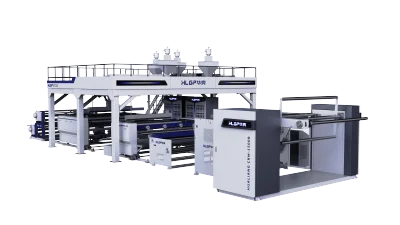
High-speed two-layer, three-layer, five-layer, and seven-layer systems are suitable for manufacturers handling large and continuous orders. These lines can provide higher production capacity and make better use of factory space when demand is sufficiently strong to keep the equipment operating at a high utilization rate.
Medium-speed bubble film extrusion machines can provide a practical balance between investment and production capacity. Depending on the machine design, film specification, and resin formulation, production capacities in the range of approximately 60–100 kg/h can be suitable for many general-purpose applications. These systems can be attractive for manufacturers that require stable output without the capital investment associated with a larger high-speed line.
Lower-speed systems can be appropriate for smaller factories, specialized products, limited-volume orders, or companies entering the bubble film market. Selecting equipment according to actual demand can prevent unnecessary capital expenditure and help maintain a healthier equipment utilization rate.
Build a More Efficient Bubble Film Production Line
Factory resource utilization depends on more than production speed. Material efficiency, energy consumption, automation, winding stability, process consistency, and equipment utilization all contribute to the actual operating performance of a bubble film production line. An advanced bubble film extrusion machine provides the technical foundation for improving these factors together.
Our bubble film extrusion machine solutions are designed to support efficient and stable bubble film production across different capacity requirements. With multilayer coextrusion configurations, optimized extrusion systems, automatic control, efficient winding technology, and flexible production options, the equipment can be configured around specific film structures and factory requirements.
Whether the goal is to increase output with a high-speed multilayer line, improve material utilization through optimized coextrusion, or achieve a practical balance between investment and production capacity, our bubble film extrusion machine provides a reliable foundation for efficient and stable packaging production. With flexible machine configurations, advanced extrusion technology, automated winding systems, and precise process control, our equipment can be adapted to different film structures, production capacities, and material requirements, helping manufacturers achieve consistent quality while making better use of materials, energy, and factory resources.