Customizing Bubble Sizes: The Flexibility of Modern Bubble Film Extrusion Machine
2026-09-01
Packaging demands have splintered far beyond a single "one size fits all" cushioning solution. A precision electronics component, a food-safe container, and a heavy industrial part each need a different level and type of protection, and increasingly, manufacturers are expected to deliver all three without running three separate production lines. That expectation is exactly what has pushed bubble size customization from a nice-to-have feature into a defining requirement for a modern bubble film extrusion machine.
Where Conventional Bubble Film Machines Fall Short on Flexibility
Many bubble film lines still operate around a fixed forming roller configuration, which means switching between bubble sizes requires swapping out entire tooling assemblies or working through lengthy manual recalibration. That downtime adds up quickly, and it pushes many manufacturers toward running multiple dedicated production lines just to cover a normal spread of order sizes — an approach that ties up capital and floor space that could otherwise go toward more productive capacity.
Process parameters compound the problem when a size change is attempted. Melt temperature, extrusion speed, cooling efficiency, and line tension all need to be re-matched to the new bubble geometry, and on a conventional line without integrated sensor feedback, operators are left manually guessing their way back to stable output. That trial-and-error period is where scrap accumulates fastest, and it's also where material efficiency — and by extension, sustainability performance — takes the biggest hit. For manufacturers trying to serve a genuinely diverse customer base, this rigidity turns what should be routine order variation into a recurring operational cost.
Why Bubble Size Flexibility Matters Across Different Applications
The right bubble size isn't a cosmetic choice — it's the variable that determines whether a shipment arrives intact, and it looks different depending on what's being protected.
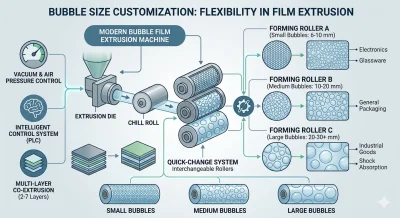
For electronics and glassware packaging, small bubbles in the 6 to 10 millimeter range provide the smooth, precise surface contact that lightweight, fragile items need. A production line that struggles to consistently hit this smaller geometry, or that takes too long switching into it, risks delivering film with uneven cushioning exactly where delicate components need the most protection.
For food and pharmaceutical packaging, consistency and cleanliness carry as much weight as cushioning performance, and these sectors typically rely on medium bubble sizes in the 10 to 20 millimeter range for balanced, general-purpose protection. A line that produces uneven batches during size transitions — or that can't hold tight tolerances run after run — creates exactly the kind of variability that food and pharmaceutical quality standards are least willing to tolerate.
For heavy industrial goods, large bubbles of 20 millimeters or more are what deliver the shock absorption these products actually require, and some applications layer in additional needs like anti-static protection or laminated structures for specialty handling. A machine limited to a narrow bubble-size range, or one that can't support multi-layer functional structures, simply can't follow these products into the applications where they're needed most.
Flexible Production with Our Bubble Film Extrusion Machine
| Machine Configuration | Film Structure | Typical Applications | Key Advantages |
|---|---|---|---|
| 2-Layer | Basic two-layer structure | Electronics, glassware, general packaging | Simple structure and efficient cushioning |
| 3-Layer | Three-layer co-extruded structure | E-commerce, food, consumer goods | Balanced protection and material efficiency |
| 5-Layer | Five-layer multi-material structure | Heavy-duty logistics and industrial packaging | Enhanced strength and functional layering |
| 7-Layer | Seven-layer multi-material structure | Heavy-duty and customized industrial packaging | Advanced control of film properties and layer functions |
Our bubble film extrusion machine lineup is engineered around this range from the ground up, spanning 2-layer through 7-layer configurations so that bubble size and film structure can be matched to the application rather than compromised to fit a single generalized specification. A 2-layer line suited to smaller, tightly controlled bubble geometries serves a very different purpose than a 7-layer system built for heavy-duty, multi-material protection, and having both available means manufacturers can select the configuration that actually fits their product — from electronics-grade small bubble film through to large-bubble, multi-layer industrial film.
Multi-layer co-extrusion extends that flexibility beyond size alone. Our machines support structures ranging from 2-layer to 7-layer configurations, allowing different materials to be combined for improved strength, barrier properties, or recyclability depending on what the application calls for. For heavy industrial and specialty packaging — including anti-static or laminated bubble film — this layered approach means the functional requirements of the product, not just its size, can be engineered directly into the film.
Underpinning all of this is a PLC-based intelligent control system that maintains stable extrusion conditions throughout production and through every size transition. Real-time monitoring keeps bubble geometry uniform and significantly reduces the material waste that typically accumulates during a manual changeover, which matters just as much for food and pharmaceutical packaging — where batch-to-batch consistency is non-negotiable — as it does for high-volume electronics or industrial runs.
That control is reinforced by integrated sensors and feedback systems that continuously track melt temperature, extrusion speed, cooling efficiency, and line tension, adjusting automatically to keep bubble dimensions uniform across the entire film width. Rather than relying on an operator to manually re-tune the process after every size change, the system holds these variables in balance on its own, which is what allows food and pharmaceutical manufacturers in particular to trust that every roll leaving the line meets the same specification as the last.
The combined effect of these technologies is a production line that doesn't force a trade-off between flexibility and consistency. Manufacturers can move from small bubble film for electronics and glassware, to medium bubble film for food and pharmaceutical packaging, to large bubble or multi-layer specialty film for industrial goods — all without sacrificing the dimensional accuracy or material efficiency that each application depends on. That flexibility also supports sustainability goals directly: matching bubble size precisely to the protection level actually required reduces unnecessary material use, and when it's combined with recyclable-compatible materials and energy-efficient extrusion, the result is lower environmental impact alongside tighter cost control.
A well-configured bubble film extrusion machine should provide enough process flexibility to accommodate different bubble sizes and film specifications without requiring major changes to the production setup. Stable control of extrusion, air pressure, cooling, and film forming allows the same line to respond to different packaging requirements while maintaining consistent film quality. This flexibility makes the equipment more practical for producers handling a varied mix of electronics, food, pharmaceutical, and industrial packaging applications.