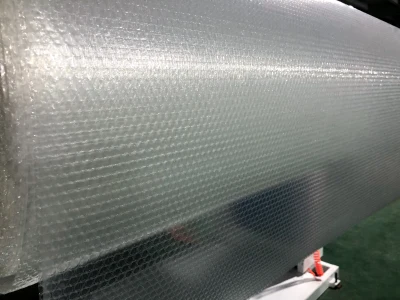
In the high-end packaging industry, thickness uniformity is considered the gold standard of quality. Whether for protective cushioning or specialized lamination, bubble film requires extremely precise gauge control. The core component responsible for this level of precision is the high-precision extrusion T-die.
A key reason a T-die can achieve such consistent results lies in its advanced internal flow design. The die typically uses a coat-hanger manifold geometry, which is engineered through CAD to ensure that the molten polymer maintains balanced pressure and velocity as it spreads from the center inlet toward both edges. By equalizing the residence time of the melt across the flow channel, the system effectively eliminates common issues such as a thicker center or thinner edges, ensuring a more uniform initial distribution.
Another critical factor is the automatic die lip adjustment system, which relies on thermal expansion bolts for real-time control. During production, an online thickness scanner, often using beta or X-ray measurement, continuously monitors the film downstream. When deviations in thickness are detected, the system responds by adjusting the temperature of specific thermal bolts. These bolts expand or contract at a micron level, subtly deforming the die lip to increase or decrease the gap where needed. This closed-loop control allows continuous correction without manual intervention, significantly improving stability and consistency.
Temperature control also plays a vital role in maintaining uniform film quality. Since polymer viscosity is highly sensitive to temperature changes, high-precision T-dies are designed with multiple independently controlled heating zones regulated by PID systems. By maintaining a consistent thermal profile across the full width of the die, the system prevents flow irregularities caused by localized viscosity differences, thereby reducing surface defects and thickness variation.
In conclusion, investing in a high-precision T-die is not simply a matter of upgrading equipment, but a strategy for optimizing overall production efficiency. By combining optimized flow dynamics, precise thermal management, and automated feedback control, manufacturers can significantly reduce material waste, shorten startup times, and consistently produce bubble film that meets demanding international quality standards.