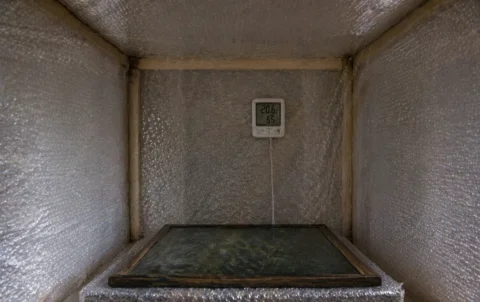
In the production of premium lacquerware, decorative panels, and high-end coated products, environmental stability plays an important role in achieving consistent surface quality. Lacquer curing is highly sensitive to temperature, humidity, dust, and airflow conditions. Even small variations during the drying process may affect gloss, color consistency, surface smoothness, and final appearance.
While professional climate control equipment remains essential for maintaining stable curing conditions, passive environmental protection materials can further improve the performance of lacquer painting shading rooms. Specialized bubble film provides an additional insulation and moisture-buffering layer that helps reduce external environmental impacts. By producing customized polyethylene structures through an advanced bubble film manufacturing machine, manufacturers can develop protective materials suitable for different lacquer curing environments, from small artisan workshops to industrial coating facilities.
Environmental Requirements for Lacquer Curing and Drying Spaces
Lacquer coating processes require carefully managed environmental conditions because the chemical curing reaction depends on stable temperature and humidity levels. During the drying stage, excessive moisture variation may slow evaporation, while overly dry conditions can accelerate surface drying and create uneven curing between the surface layer and internal coating layers.
Common surface defects associated with unstable curing environments include whitening, cloudiness, uneven gloss, pinholes, and surface texture variations. These issues are often caused by condensation, inconsistent solvent evaporation, airborne contamination, or rapid changes in the surrounding atmosphere.
Traditional climate control systems, including air conditioning, ventilation, and humidity management equipment, provide active environmental regulation. However, airflow generated by these systems may introduce additional challenges in sensitive coating areas. Strong air movement can disturb dust control, accelerate local drying differences, and create uneven conditions between different areas of a large curing space.
For this reason, many manufacturers combine active climate management with passive insulation materials. Bubble film barriers installed around shading rooms, temporary curing spaces, or protective partitions can help reduce heat exchange with the external environment and provide a more stable surrounding atmosphere.
How Bubble Film Supports Passive Environmental Control
Bubble film is composed of sealed air cells formed between polyethylene layers. These air pockets function as insulating spaces that reduce direct heat transfer and help slow temperature changes caused by external environmental fluctuations.
In lacquer painting shading rooms, this structure can help maintain a more stable internal environment by reducing the impact of rapid temperature changes from surrounding workshops, outdoor conditions, or production areas. Compared with ordinary plastic films, bubble film provides improved thermal resistance due to its three-dimensional air cell structure.
Moisture management is another important advantage of specialized bubble film structures. Although bubble film does not replace professional humidity control systems, its polyethylene layers provide a certain level of moisture resistance, helping reduce uncontrolled moisture exchange between the curing area and the outside environment. This is particularly useful in enclosed spaces where maintaining consistent drying conditions is important.
The performance of bubble film depends greatly on material selection, film thickness, bubble diameter, and layer structure. For example, thicker bubble structures may provide better insulation performance, while multi-layer designs can improve mechanical strength and durability for long-term installation.
Through precise extrusion technology, manufacturers can adjust these characteristics according to application requirements. A reliable bubble film manufacturing machine allows producers to control film uniformity, bubble formation stability, and layer distribution, ensuring consistent quality for specialized industrial applications.
Selecting the Right Bubble Film Structure for Different Applications
Different lacquer production environments have different requirements for insulation performance, durability, and production volume. The design of the bubble film structure should therefore match the specific working conditions.
For small-scale lacquer studios, restoration workshops, and customized production spaces, a 2-layer bubble film structure can provide a practical solution. This type of film generally consists of a flat polyethylene layer combined with a bubble layer, offering basic insulation and moisture protection while maintaining lightweight handling and easy installation.
For commercial coating facilities requiring stronger mechanical performance, 3-layer to 5-layer bubble film structures provide enhanced durability. A three-layer structure typically places the bubble layer between two flat polyethylene films, improving protection against puncture and extending service life. Additional layers can incorporate different polyethylene materials to optimize flexibility, strength, and barrier performance.
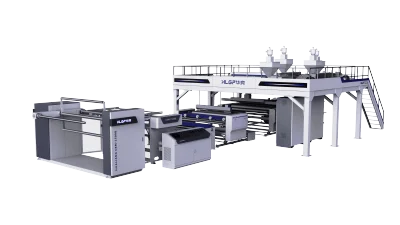
Medium-speed bubble film production equipment is suitable for manufacturers producing customized protective materials for regional markets and industrial customers. With multi-layer co-extrusion technology, producers can combine different polymer characteristics within a single film structure, creating materials that meet specific requirements for insulation, protection, and environmental resistance.
For large-scale packaging material manufacturers supplying industrial coating, furniture, automotive, and architectural surface industries, high-output multi-layer production lines provide greater efficiency and product consistency. Advanced bubble film manufacturing machines equipped with precise temperature control, stable extrusion systems, and automated monitoring technology enable continuous production with reliable thickness and bubble quality.
Advanced Extrusion Technology for Consistent Bubble Film Quality
The quality of bubble film used in environmental protection applications depends heavily on the precision of the manufacturing process. Uneven film thickness, unstable bubble formation, or inconsistent layer bonding can reduce insulation performance and affect long-term reliability.
Modern bubble film manufacturing machines utilize advanced extrusion components to improve production stability. Precise screw and barrel designs ensure uniform melting and mixing of polyethylene materials, while accurate temperature control systems help maintain stable processing conditions throughout the extrusion process.
Multi-layer co-extrusion technology also allows manufacturers to develop customized film structures using different polyethylene formulations. For example, outer layers can be designed for improved mechanical protection, while inner layers can focus on flexibility or moisture resistance.
Automatic control systems further improve production efficiency by monitoring key parameters such as extrusion temperature, film thickness, and production speed. These technologies help manufacturers reduce material waste, maintain consistent product quality, and produce bubble film suitable for demanding industrial environments.
Improving Lacquer Production Stability with Reliable Bubble Film Manufacturing Technology
Maintaining stable conditions in lacquer painting shading rooms requires a combination of professional climate management and suitable protective materials. Bubble film provides an effective passive solution by reducing heat exchange, improving environmental insulation, and helping maintain more consistent conditions around sensitive coating areas.
For manufacturers producing specialized bubble film materials, choosing the right extrusion equipment is essential for achieving reliable product performance. A high-quality bubble film manufacturing machine enables precise control over film structure, layer configuration, and production efficiency, allowing producers to develop materials for a wide range of industrial applications.
With flexible configurations from 2-layer systems to multi-layer high-speed production lines, our bubble film manufacturing machines are designed to support different production capacities and material requirements. Through stable extrusion performance, efficient operation, and customizable processing capabilities, our equipment helps manufacturers produce high-quality bubble film solutions for lacquer workshops, protective partitions, packaging industries, and other specialized applications. Contact our technical team to discuss your production requirements and explore the right extrusion solution for your business.