Sizing Your Production: Should You Get a 2-Layer or 7-Layer Bubble Film Extrusion Machine?
2026-04-29
In the competitive packaging industry, manufacturers face the challenge of balancing cost-efficiency with the need for high-performance, high-barrier protective films. Standard monolayer or basic co-extrusion lines often struggle to provide the ideal combination of puncture resistance, tear strength, cushioning, and clarity without compromising material costs or production speed.
This is where the choice between 2-layer and 7-layer bubble film extrusion machines becomes critical.
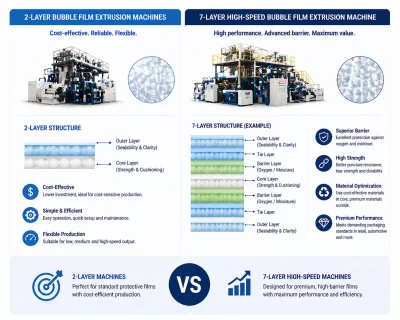
For cost-effective, flexible production, the 2-Layer Low-Speed Bubble Film Machine offers a reliable solution for standard protective films. It’s ideal for smaller, cost-sensitive production runs. The 2-Layer Medium-Speed Machine enhances output stability, making it suitable for medium-volume production. The 2-Layer High-Speed Bubble Film Machine maximizes throughput, ensuring high-volume, streamlined production with consistent quality.
For more demanding applications requiring superior mechanical properties and enhanced barrier performance, the 7-Layer High-Speed Bubble Film Machine stands out. It uses multi-layer co-extrusion to precisely place different polymer grades in each layer—stronger core layers, virgin polymers for sealability and clarity in outer layers, and dedicated barrier materials. This technology solves the performance-cost trade-off, enabling premium, high-performance films with optimized material costs.
Choosing between a 2-layer and 7-layer machine depends on production needs. A 2-layer machine is perfect for targeted, cost-efficient production, while the 7-layer machine delivers high-margin, premium films that meet demanding packaging standards, such as those in retail and automotive industries. It offers greater versatility, superior film control, and consistent high-quality output, reducing material costs and boosting production efficiency.