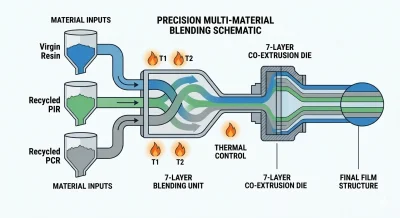
The global shift toward high-performance yet sustainable protective packaging has long presented a challenge: how to integrate recycled content without sacrificing barrier integrity or production speed. The advanced 7-layer high-speed bubble film machine addresses this through a precision-engineered multi-material blending system, bridging the gap between circular economy goals and industrial efficiency.
1. Precision Thermal Control: The Core of Multi-Material Blending
At the heart of this system are seven independent temperature zones, each dedicated to a specific extruder. This granular control is critical for processing diverse polymers—such as virgin resins, Post-Industrial Recycled (PIR), or Post-Consumer Recycled (PCR) flakes—which possess distinct melting points and flow characteristics.
By eliminating inconsistent melt viscosity—a traditional bottleneck—this modular control prevents flow lines and layer instability, ensuring consistent film quality even at high throughput.
2. Advanced Co-extrusion Die Technology
The technical principle relies on synchronized modular control. Each extruder’s temperature, screw speed, and pressure are optimized for its unique material recipe. These seven homogenous melt streams converge in a sophisticated multi-layer co-extrusion die, where laminar flow is meticulously managed to prevent intermixing.
This architecture allows for strategic material placement:
- Inner Layers (2-6): Can incorporate up to 50% recycled content, providing structural bulk and cushioning.
- Outer Layers (1 & 7): Utilize high-performance virgin materials to ensure superior printability, puncture resistance, and aesthetic clarity.
- 3. High-Speed Efficiency and Rapid ROI
- For procurement officers and plant managers, this technology translates into three measurable business advantages:
- Material Cost Savings: Maximize the use of cost-effective recycled resins without compromising the final product's protective quality.
- Enhanced Throughput: Precise thermal management enables high-speed operations—often exceeding 120 meters/minute—lowering per-unit energy consumption.
- ESG Compliance: Future-proof production lines against tightening environmental regulations and meet demanding customer sustainability criteria in tender processes.
- 4. A Future-Ready Platform for Smart Packaging
- Beyond current needs, the 7-layer modular system serves as a platform for next-generation material science. Its flexibility allows for the seamless adoption of bio-based polymers and the development of "smart" films with embedded functionalities, such as UV protection, anti-static properties, or specialized gas barriers.
- Investing in multi-material blending capability is a strategic move to decouple production efficiency from virgin material dependency, securing long-term profitability in a circular economy.