Why Precision Matters in Your Bubble Film Extrusion Machine
2026-09-03
In high-performance packaging production, precision is the primary driver of both quality and cost-efficiency. Small deviations in film thickness or bubble formation might seem minor on paper, but at production scale they translate directly into material waste, inconsistent cushioning performance, and compromised protection for the goods that film is meant to safeguard. A high-precision bubble film extrusion machine addresses these issues at the source, ensuring consistent output and structural integrity across every roll produced.
Where Precision Gaps Create Real Production Problems
Inconsistent film thickness and irregular bubble structure are among the most persistent challenges in bubble film manufacturing, and they typically trace back to uneven thermal control. When a production line lacks properly integrated temperature zoning, melt temperature gradients form across the die width, producing film with variable thickness and inconsistent cell formation. The downstream effect is a product that looks acceptable on the surface but performs unpredictably once it reaches the customer, undermining both cushioning reliability and visual consistency.
Pressure instability compounds the problem. Extrusion systems without servo-level pressure control are prone to melt pressure fluctuation, which shows up on the line as web breaks, unplanned stoppages, and noticeable batch-to-batch variation. Every unscheduled stop adds downtime and rework, and every inconsistent batch adds uncertainty for customers who expect the same film performance shipment after shipment.
These precision gaps ultimately show up on the balance sheet as material waste. When thickness and pressure control fall short of what a production run requires, off-spec output increases and raw material consumption climbs along with it. This creates a difficult tension for manufacturers trying to reduce film gauge and material usage in response to sustainability and cost pressures—thinner films demand tighter tolerances, and equipment that can't hold those tolerances simply can't support that shift.
The Growing Role of Precision in Bubble Film Applications
Bubble film has long served as a dependable, lightweight cushioning material, but its role has expanded well beyond basic protective wrap. Electronics manufacturers, optical component suppliers, and producers of other high-value technical goods now depend on film that meets far tighter specifications than general-purpose packaging ever required—consistent gauge, predictable optical clarity, and reliable multi-layer barrier performance. For these applications, precision is no longer a quality nicety; it's a functional requirement that determines whether the film actually performs its protective role.
At the same time, market demand continues shifting toward thinner, stronger, and more functionally complex films. Brands and packaging converters alike are under pressure to reduce material usage without sacrificing protection, which only works when the underlying extrusion process can hold tight tolerances consistently. As these expectations rise across industries, the precision built into the extrusion equipment itself becomes the deciding factor in whether a manufacturer can keep pace with where the market is heading.
Matching Machine Configuration to Production Needs
Selecting the right equipment configuration starts with matching layer architecture to the performance the application actually requires. Two-layer systems provide a stable, dependable foundation for standardized production, offering consistent quality across both smaller specialized runs and larger-volume orders where cost-efficiency and reliability matter more than complex functional layering.
Three to five layer co-extrusion systems introduce a different level of capability through multi-manifold die technology, which allows manufacturers to construct film with strategic layer functionality—a robust structural core paired with functional skin layers engineered for specific performance traits. This layered approach is particularly well suited to high-value electronics protection, where the film needs to deliver both mechanical strength and controlled barrier properties in a single structure rather than relying on a single homogeneous layer to do everything at once.
Seven-layer systems represent the highest tier of design flexibility, capable of maintaining nanometer-level uniformity across every layer of the film. This level of construction control supports highly customized technical packaging solutions where each layer can be engineered for a distinct function—whether that's optical clarity, moisture resistance, or targeted mechanical performance—giving manufacturers the flexibility to meet increasingly specific customer and application requirements.
The Core Technology Behind Precision Extrusion
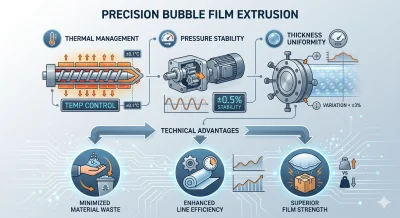
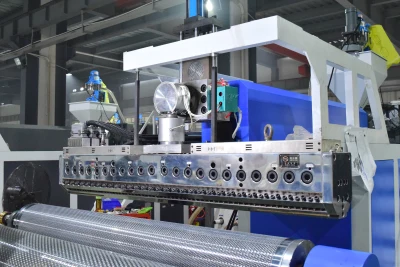
Achieving this level of consistency depends on several engineering systems working together rather than any single component acting alone. Digitally integrated temperature control zones eliminate the thermal gradients that would otherwise cause uneven melt distribution, ensuring the material entering the die is consistent from edge to edge. This thermal stability is foundational—without it, no amount of downstream precision engineering can fully compensate for an inconsistent melt.
Servo-driven extrusion systems build on that thermal foundation by maintaining melt pressure stability within a tolerance of approximately ±0.5%, a level of control that significantly reduces the pressure fluctuations responsible for web breaks and batch inconsistency. Paired with advanced die design, this pressure stability supports uniform cell structure formation and keeps film thickness variation under roughly ±3%, a tolerance tight enough to meet the demands of technical packaging applications where dimensional consistency directly affects performance.
What Precision Delivers in Practice
The technical advantages of high-precision extrusion translate into measurable operational benefits. Reducing off-spec production directly lowers raw material consumption, which matters both for cost control and for manufacturers responding to sustainability expectations from their own customers. Stable extrusion also means fewer web breaks and less unscheduled downtime, allowing production lines to run closer to their full rated capacity rather than losing hours to avoidable interruptions.
Precision control further enables the production of stronger, more reliable film using less material overall, improving the weight-to-protection ratio that increasingly matters to both packaging converters and the brands they supply. As market demand continues pushing toward thinner, stronger, and more functionally complex films, this level of precision isn't just a current advantage—it's what allows equipment to remain capable as those requirements continue to tighten.
Building a Precision-First Production Line
Precision in bubble film production isn't the result of a single feature, but the outcome of thermal management, pressure stability, and die design working in concert across the full production line. Our bubble film extrusion machines are engineered around this exact principle, integrating digitally controlled thermal zoning, servo-driven pressure regulation, and precision die construction across every configuration—from foundational 2-layer systems to advanced 3-5 layer and 7-layer co-extrusion platforms. This gives manufacturers the consistency needed to meet the exacting standards of electronics protection, technical packaging, and other high-value applications without sacrificing material efficiency. For manufacturers evaluating equipment upgrades, our precision-engineered extrusion lines offer a direct path to reducing waste, improving line uptime, and staying ahead of a market that continues to demand thinner, stronger, and more technically sophisticated film.