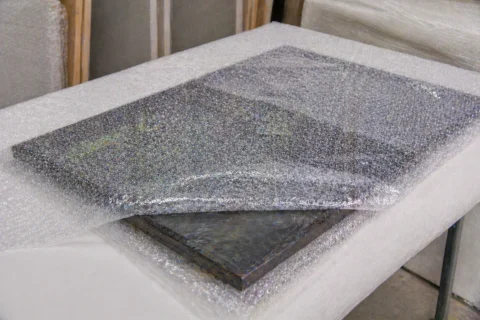
In high-end furniture manufacturing, decorative panel production, and automotive interior applications, surface finishing quality directly influences the final product value. Lacquer boards usually pass through multiple production stages, including coating, drying, inspection, storage, and assembly. During the interval between these processes, maintaining a clean and stable protection environment is essential to prevent surface defects.
Semi-finished lacquer boards are particularly sensitive to airborne dust, wood fibers, and other industrial particles before the coating process is fully stabilized. Even small contaminants on the surface may lead to additional polishing, cleaning, or rework, increasing production time and material consumption.
Bubble film has become an effective protective solution for these applications because it combines cushioning performance with dust isolation. With advanced bubble film manufacturing machines, manufacturers can produce customized protective films with different structures and functional properties to meet the requirements of sensitive surface protection.
Dust Contamination Challenges in Lacquer Board Storage
Airborne Particles Can Affect Surface Finishing Quality
Lacquer finishing requires strict control of environmental conditions because the appearance of the final product depends heavily on surface cleanliness. During intermediate storage, lacquer boards may be exposed to dust generated from cutting, sanding, packaging, and other manufacturing activities.
Fine wood particles, workshop dust, and airborne fibers can attach to partially cured coating surfaces. When these contaminants remain on the board before the next processing stage, they may create visible surface imperfections, uneven gloss, or additional preparation work.
For manufacturers producing large quantities of decorative panels or furniture components, repeated sanding and cleaning not only increase labor requirements but may also reduce production efficiency. Therefore, controlling contamination during storage has become an important part of modern surface finishing processes.
Limitations of Traditional Protection Methods
Many factories still use conventional plastic sheets or basic covering materials to protect semi-finished boards. However, these solutions often provide limited protection performance.
Ordinary plastic film can reduce direct dust exposure but does not provide sufficient cushioning during handling and stacking. Friction between boards and packaging materials may also generate static electricity, which increases the possibility of attracting fine particles.
Fabric covers and reusable protection materials have additional limitations because they are more difficult to maintain in a consistently clean condition. For high-value lacquer boards, manufacturers require protective materials that can provide both physical separation and improved environmental protection.
Bubble Film Protection for Semi-Finished Lacquer Boards
Cushioning Structure Provides Surface Protection During Handling
Bubble film offers an effective combination of cushioning and surface separation through its air-filled bubble structure. The bubble layer creates a flexible buffer between lacquer boards, helping reduce direct contact during storage, internal transportation, and packaging operations.
Compared with conventional flat films, bubble film provides additional protection against minor impacts and surface friction. This makes it suitable for sensitive products such as high-gloss lacquer panels, decorative boards, and finished furniture components.
During factory operations, where boards frequently move between coating areas, drying zones, and assembly lines, bubble film helps maintain surface condition while improving handling safety.
Anti-Static Properties Help Reduce Dust Attraction
Static electricity is one of the major factors affecting dust accumulation on plastic protective materials. During film handling, friction can generate electrostatic charges, causing small particles to attach more easily to the film surface and surrounding areas.
By incorporating anti-static additives into the polymer formulation, manufacturers can produce bubble film with improved surface performance. Anti-static bubble film helps reduce static charge buildup during wrapping and storage, creating a cleaner protective environment for lacquer-coated surfaces.
The anti-static performance can be customized according to different application requirements, making it suitable for industries where surface cleanliness is critical, including furniture manufacturing, decorative panels, and automotive interior components.
Multi-Layer Bubble Film Structures for Different Protection Requirements
Different lacquer board applications require different levels of protection, and the film structure plays an important role in determining strength, flexibility, and protective performance. Modern bubble film manufacturing machines support flexible co-extrusion configurations, allowing manufacturers to produce films according to specific application requirements.
For general workshop storage and short-distance movement, two-layer bubble film provides a practical solution with stable cushioning performance and efficient production capability. Its simple structure is suitable for protecting boards during short production intervals when basic dust protection and surface separation are required.
For applications involving higher-value products or longer storage periods, three-layer and five-layer bubble film provides improved mechanical strength and durability through multi-layer co-extrusion technology. By combining different polymer layers, manufacturers can optimize film performance, including flexibility, puncture resistance, and moisture protection. These structures are widely used for premium furniture panels, decorative materials, and products requiring more reliable protection during transportation.
For demanding industrial applications, seven-layer bubble film offers greater flexibility in material design. The multi-layer structure allows manufacturers to integrate functional layers, such as anti-static layers or reinforced layers, into the film. This makes it suitable for high-value lacquer boards and other surface-sensitive products requiring customized protection performance.
The ability to produce different bubble film structures allows manufacturers to balance protection requirements, material efficiency, and production costs while maintaining consistent product quality.
How Bubble Film Manufacturing Machines Produce High-Performance Protective Film
Precision Extrusion Ensures Stable Film Quality
The performance of protective bubble film depends greatly on production accuracy and process stability. Advanced bubble film manufacturing machines are designed to provide precise extrusion control, ensuring uniform material distribution and consistent bubble formation.
During production, accurate temperature management helps maintain stable polymer melting conditions, while controlled extrusion pressure supports consistent film thickness. The forming system creates evenly structured bubbles, ensuring reliable cushioning performance across the entire roll.
Flexible Co-Extrusion Technology for Customized Film Production
Different industries have different requirements for protective film performance. Advanced bubble film manufacturing machines allow producers to adjust layer structures, material combinations, and film specifications according to application needs.
Through multi-layer co-extrusion technology, manufacturers can produce protective films with different levels of strength, flexibility, and functional performance. This flexibility enables customers to develop suitable solutions for various lacquer board applications instead of relying on standard protective materials.
The ability to customize film thickness, layer ratio, and material selection also helps manufacturers improve production efficiency and reduce unnecessary material waste.
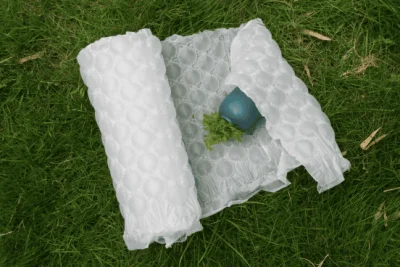
In-House Film Production Improves Supply Flexibility
Producing protective film internally provides manufacturers with greater control over material supply and product consistency. Instead of depending entirely on external suppliers, companies can adjust production according to their own packaging requirements.
With reliable bubble film manufacturing machines, manufacturers can produce protective materials on demand, shorten supply cycles, and quickly respond to changes in product specifications. This is especially valuable for large-scale furniture and decorative panel producers that require stable protection materials throughout continuous production.
Bubble Film Manufacturing Machines for Customized Protective Film Production
Producing high-quality protective film requires reliable equipment with stable extrusion performance and flexible production capability. Hualiang bubble film manufacturing machines are designed to help manufacturers produce dust-proof, anti-static, and high-performance bubble film through advanced extrusion technology and multi-layer co-extrusion solutions.
From efficient two-layer production systems to advanced multi-layer configurations, our bubble film manufacturing machines provide flexible solutions for furniture panels, decorative materials, automotive interiors, and industrial surface protection applications. With precise control, stable output, and customizable film structures, Hualiang helps customers improve protective film production efficiency and meet the growing requirements of global surface protection markets.