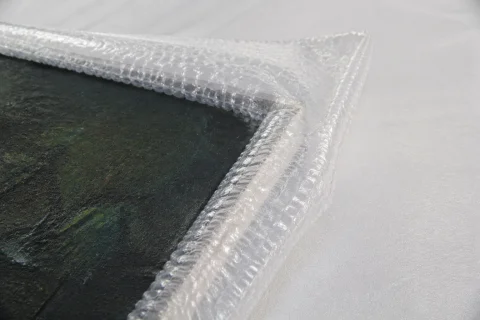
Lacquer paintings represent some of the most delicate and valuable forms of cultural heritage. Whether preserved in museums, private collections, or international exhibitions, these artworks require professional protection against physical impact, vibration, pressure, and environmental risks. Unlike ordinary decorative products, lacquer paintings often contain aged lacquer layers and fragile substrates that can be damaged by even minor external forces, especially around edges and corners.
During storage, restoration, and global transportation, the edges of lacquer paintings are among the most vulnerable areas. Sudden impact, repeated vibration, or uneven pressure distribution can cause surface cracking, coating separation, and irreversible structural damage. As cultural institutions and professional art logistics companies demand higher protection standards, traditional packaging materials are no longer sufficient for high-value artwork protection.
Modern bubble film manufacturing machines provide an advanced production solution for manufacturers who need to produce high-performance cushioning materials specifically designed for sensitive applications. Through multi-layer extrusion technology, precise bubble forming systems, and stable production control, these machines enable the manufacturing of durable protective bubble films with excellent shock absorption, pressure distribution, and long-term cushioning performance.
Challenges of Traditional Protection Methods for Lacquer Paintings
Traditional packaging methods, including paper-based materials, foam sheets, and standard single-layer bubble wrap, can provide basic protection for general products but often fail to meet the strict requirements of fine art conservation.
One major challenge is insufficient edge protection. The corners and edges of lacquer paintings are highly sensitive because impact forces are usually concentrated in these areas during handling and transportation. Conventional packaging materials mainly rely on material thickness to absorb impact, but they cannot effectively distribute external pressure across a wider surface area. As a result, even small collisions may create stress points that damage fragile lacquer surfaces.
Another limitation is the lack of long-term cushioning stability. Standard bubble film is commonly produced with a simple single-layer structure, which may lose protective performance after continuous compression. For artwork stored in archives or transported over long distances, the cushioning material must maintain its shape, elasticity, and impact resistance for extended periods.
Global transportation also creates additional challenges. Museum loans, international exhibitions, auction transportation, and collector relocation often involve multiple handling processes and complex logistics conditions. During transportation, artworks may experience road vibration, loading impact, stacking pressure, and unexpected movement. Therefore, professional protective materials must provide not only softness but also reliable structural support and high damping performance.
How Multi-Layer Bubble Film Improves Lacquer Painting Edge Protection
Multi-layer bubble film provides a more advanced protection solution by combining air-cell cushioning technology with reinforced film structures. Compared with conventional packaging materials, high-quality bubble film creates a flexible protective barrier that absorbs external forces and reduces direct impact on fragile artwork surfaces.
The air bubbles inside the film act as independent cushioning units. When external pressure is applied, the air-cell structure helps distribute the force across multiple areas instead of allowing concentrated pressure on a single point. This characteristic is particularly important for lacquer paintings because edge areas require gentle but stable support.
The consistency of bubble geometry is another important factor. Professional bubble film manufacturing machines produce films with controlled bubble size, uniform wall thickness, and stable air retention. These characteristics ensure that each cushioning cell performs consistently during storage and transportation.
For archival applications, stable bubble structures help maintain long-term protection performance. The material can provide continuous support around artwork edges, reducing the risk of deformation caused by uneven pressure over time. This makes multi-layer bubble film suitable for climate-controlled storage environments where valuable collections require reliable protection for extended periods.
For transportation applications, multi-layer structures provide enhanced impact absorption. Different layers can be engineered to perform specific functions, including surface protection, shock absorption, and structural reinforcement. This layered design helps isolate artworks from external vibration and sudden impact during handling and logistics operations.
Bubble Film Manufacturing Machines for Producing High-Performance Protective Materials
The production of professional-grade artwork protection materials requires advanced manufacturing technology. Modern bubble film manufacturing machines are designed to produce customized multi-layer bubble films with stable quality, precise thickness control, and consistent cushioning performance.
Multi-layer co-extrusion technology is one of the key features of advanced bubble film production systems. Depending on application requirements, manufacturers can produce different configurations, including 2-layer, 3-layer, 5-layer, and 7-layer bubble films. By combining different polymer layers, producers can optimize the balance between flexibility, strength, durability, and impact resistance.
For premium protection applications such as lacquer paintings and cultural heritage products, multi-layer structures provide significant advantages. The outer layers can improve abrasion resistance and mechanical strength, while the inner layers enhance cushioning performance and provide gentle contact protection.
Precision bubble forming technology also plays an important role in final product quality. The forming roller system controls bubble size, shape, and distribution to ensure consistent air-cell performance throughout the entire roll. Stable bubble formation reduces the risk of weak points and improves the reliability of the protective material.
Advanced temperature control and extrusion systems further improve manufacturing stability. Precise heating control ensures consistent polymer melting and forming conditions, while automated extrusion control maintains uniform film thickness and production accuracy. These technologies allow manufacturers to produce bubble films with repeatable performance for demanding applications.
In addition, modern bubble film manufacturing machines are equipped with intelligent control systems that improve operational efficiency. PLC-based control, automatic parameter adjustment, and real-time monitoring help maintain stable production conditions while reducing material waste and improving overall productivity.
| Machine Function | Production Advantage |
|---|---|
| Multi-Layer Co-Extrusion | Produces stronger and more durable bubble film structures |
| Precision Bubble Forming | Ensures uniform bubbles and stable cushioning performance |
| Temperature Control System | Maintains consistent film quality and thickness |
| PLC Control System | Improves production stability and efficiency |
| Customized Production | Supports different bubble film specifications |
Applications of Bubble Film in Fine Art Protection and Cultural Heritage Preservation
High-performance bubble film produced by advanced manufacturing equipment has a wide range of applications in artwork protection, museum logistics, and conservation industries.
For museum storage, multi-layer bubble film provides a reliable cushioning layer for archived collections. It helps protect lacquer paintings from accidental contact, surface friction, and pressure changes during long-term storage. The stable cushioning structure makes it suitable for professional collection management environments.
For international exhibitions and artwork transportation, bubble film serves as an essential protective component in logistics packaging systems. Museums, galleries, and art transportation companies require materials that can withstand complex transportation conditions while maintaining consistent protection performance.
During restoration projects, protective bubble film can also be used as a temporary safety layer. When fragile lacquer paintings are moved, repaired, or installed, high-quality cushioning materials help reduce the risk of accidental damage during handling operations.
Beyond cultural heritage applications, the same technology can also support the protection of other valuable products, including framed artworks, antiques, precision instruments, and high-end decorative items.
Reliable Bubble Film Manufacturing Machines for Advanced Protective Material Production
Producing professional protection materials requires more than basic film extrusion technology. Manufacturers need equipment that can deliver consistent quality, flexible production capability, and long-term operational reliability.
Advanced bubble film manufacturing machines provide the foundation for producing customized cushioning solutions through precise extrusion control, multi-layer co-extrusion capability, and optimized bubble forming technology. These machines enable producers to manufacture protective films that meet the requirements of demanding industries such as fine art conservation, museum logistics, and premium packaging.
With growing demand for safer transportation and long-term preservation of valuable items, high-performance bubble film continues to become an important protective solution. By investing in advanced bubble film production technology, manufacturers can supply reliable materials that help preserve fragile lacquer paintings and protect cultural heritage around the world.