Energy Efficiency in Modern Bubble Film Extrusion Machine
2026-08-14
The increasing demand for cost-effective and sustainable packaging solutions has pushed bubble film manufacturers to focus on production efficiency and energy management. As electricity prices rise and environmental requirements become stricter, reducing energy consumption has become a key factor when selecting production equipment. Traditional bubble film production lines often face problems such as excessive heat loss, unstable temperature control, and inefficient power utilization, which directly increase operating costs.
A modern bubble film extrusion machine is designed to solve these challenges through advanced extrusion structures, intelligent temperature control, efficient drive systems, and optimized multi-layer production technology. By improving energy utilization throughout the extrusion process, modern machines help manufacturers achieve stable output, lower production costs, and higher-quality bubble film products.
Energy Challenges Faced by Traditional Bubble Film Extrusion Lines
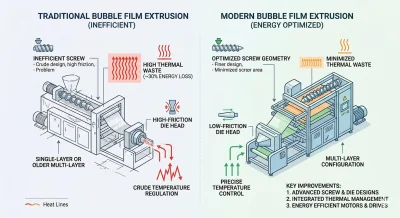
Traditional bubble film extrusion lines often rely on outdated mechanical designs and basic control systems, resulting in unnecessary energy consumption during continuous production. A large amount of electrical energy is converted into unwanted heat due to inefficient screw designs, excessive friction inside the extrusion system, and inaccurate temperature regulation.
Older single-layer and conventional multi-layer machines may require more power to maintain stable melting and forming conditions. When temperature control is not precise, heating zones frequently switch between overheating and compensation modes, causing additional energy waste. At the same time, fixed-speed motors continue operating at high power levels even when production requirements change, reducing overall energy efficiency.
Another common issue is unstable production performance. Temperature fluctuations, inconsistent melt pressure, and poor layer distribution can lead to film thickness variation and increased material waste. For manufacturers producing large volumes of bubble film, these small inefficiencies accumulate into significant energy and material losses over time.
The Importance of Bubble Film in Modern Packaging Applications
Bubble film plays an essential role in modern protective packaging due to its lightweight structure, cushioning performance, and versatility. It is widely used for protecting electronic products, furniture, glass items, industrial components, and export goods during transportation and storage.
With the rapid growth of e-commerce logistics and global supply chains, customers increasingly require packaging materials that provide better protection while using less raw material. Lightweight bubble film with improved strength and durability has become an important trend in the packaging industry.
To meet these requirements, manufacturers need production equipment capable of producing high-performance films with stable quality and efficient resource utilization. Advanced multi-layer extrusion technology allows manufacturers to combine different polymer materials and functional layers, improving film performance while reducing unnecessary material consumption.
How Modern Bubble Film Extrusion Machine Improves Energy Efficiency
Advanced Multi-Layer Co-Extrusion Technology
Multi-layer co-extrusion is one of the most important developments in energy-efficient bubble film production. Compared with traditional single-layer structures, multi-layer technology allows manufacturers to create films with different functional layers, improving strength, flexibility, and protective performance without increasing overall material usage.
A 7-layer high-speed bubble film machine uses precise layer distribution control and advanced extrusion management to produce lightweight films with excellent mechanical properties. By optimizing the thickness of each layer, manufacturers can reduce raw material consumption while maintaining the required cushioning effect.
For medium and high-volume production, a 3–5-layer high-speed bubble film machine provides an effective balance between production capacity and energy efficiency. The optimized extrusion structure reduces unnecessary energy loss while maintaining stable output during long-term operation.
Intelligent Temperature Control System Reduces Thermal Waste
Temperature management directly affects energy consumption in plastic extrusion. Modern machines are equipped with intelligent temperature control systems that monitor and adjust heating zones in real time.
Advanced closed-loop temperature control technology maintains stable processing conditions and helps reduce temperature overshoot. Some high-performance systems can maintain heating accuracy within approximately ±0.5°C, ensuring consistent melt quality while minimizing unnecessary heating cycles.
Stable temperature control also improves film quality by reducing thickness fluctuations and bubble instability. This means manufacturers can reduce production waste while achieving more efficient use of electrical energy.
High-Efficiency Motors and Variable Frequency Drives
The drive system is another important factor affecting energy consumption. Traditional fixed-speed motors often operate inefficiently when production speed changes. Modern bubble film extrusion equipment uses variable frequency drives (VFDs) and high-efficiency motors to automatically adjust operating speed according to production requirements.
For example, a 3–5-layer high-speed bubble film machine equipped with variable frequency control can optimize motor performance during different production stages. During start-up, speed adjustment, or lower-output conditions, the system reduces unnecessary power consumption while maintaining stable operation.
Efficient motors also improve torque utilization, reducing mechanical losses and helping manufacturers achieve better energy performance during continuous production.
Optimized Screw and Die Head Design
The extrusion system plays a critical role in determining overall energy efficiency. Modern screw designs improve plasticizing efficiency by optimizing material flow, reducing excessive shear heat, and ensuring more uniform melting.
A low-friction die head design reduces pressure loss during extrusion, allowing the motor to operate with lower torque requirements. This not only decreases energy consumption but also improves melt stability and film consistency.
In addition, improved barrel insulation structures help maintain heat inside the extrusion system, reducing thermal loss and improving heating efficiency. These mechanical improvements allow the machine to achieve better performance with less energy input.
Energy Efficiency Advantages of Different Bubble Film Machine Configurations
Different production requirements require different machine configurations. Modern bubble film extrusion machines provide flexible solutions for manufacturers of various scales.
A 7-layer high-speed bubble film machine is suitable for large-scale production requiring high output, advanced material combinations, and strict quality control. Its multi-layer structure and intelligent control systems help reduce energy consumption while increasing production efficiency.
A 3–5-layer medium-speed bubble film machine provides a practical solution for manufacturers seeking reliable performance with balanced investment and operating costs. The optimized extrusion system and efficient heating control help reduce specific energy consumption during daily production.
A 2-layer bubble film machine remains an effective choice for standard protective packaging applications. With improved heating modules, insulation systems, and process monitoring technology, modern two-layer machines achieve better energy efficiency compared with traditional models.
| Machine Configuration | Energy-Saving Features | Production Benefits |
|---|---|---|
| 7-layer High-Speed Bubble Film Machine | Multi-layer optimization, intelligent temperature control | High output and reduced material consumption |
| 3–5-layer High-Speed Bubble Film Machine | Variable frequency drive system, optimized extrusion | Efficient operation for large production volumes |
| 3–5-layer Medium-Speed Bubble Film Machine | Low-friction die head, stable temperature control | Balanced energy efficiency and production flexibility |
| 2-layer Bubble Film Machine | Efficient heating system, improved insulation | Reliable production with lower operating costs |
Benefits of Choosing an Energy-Efficient Bubble Film Extrusion Machine
Investing in an energy-efficient production line provides long-term advantages for bubble film manufacturers. Lower electricity consumption directly reduces operating expenses, especially for companies running machines continuously throughout the year.
Improved energy efficiency also contributes to more stable product quality. Precise temperature control, optimized extrusion performance, and intelligent monitoring systems reduce production fluctuations and minimize defective film caused by unstable processing conditions.
Furthermore, energy-saving equipment supports sustainable manufacturing goals. By reducing power consumption and improving material utilization, manufacturers can lower their environmental impact while maintaining competitive production costs.
Improve Production Efficiency with Our Bubble Film Extrusion Technology
Energy efficiency has become a key consideration in modern bubble film manufacturing. Compared with traditional production lines, advanced extrusion technology provides better control over energy consumption, material usage, and production stability. Through multi-layer co-extrusion, intelligent temperature management, efficient motors, and optimized mechanical structures, modern equipment helps manufacturers achieve reliable and cost-effective production.
Our bubble film extrusion machine adopts advanced energy-saving design concepts and high-precision manufacturing technology to provide stable performance for different production requirements. With flexible configurations including 2-layer, 3–5-layer, and 7-layer solutions, our machines help customers reduce energy consumption, improve production efficiency, and manufacture high-quality bubble film products with consistent performance. By choosing our advanced bubble film production solutions, manufacturers can build a more efficient, sustainable, and competitive packaging production system.