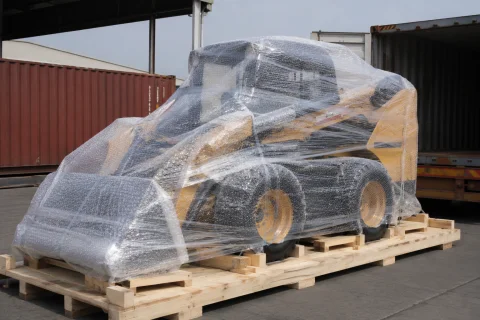
How Loader Exporters Use Bubble Film Manufacturing Machine for Packaging

2026-08-05

The global construction machinery market requires loader exporters to deliver heavy equipment safely across long distances and challenging transportation environments. Wheel loaders, hydraulic components, axle housings, and other mechanical assemblies often experience sea freight vibration, humidity, salt spray, and repeated handling during international shipping. To reduce surface damage, corrosion risks, and packaging failures, many equipment manufacturers are adopting multi-layer bubble film produced by an advanced bubble film manufacturing machine as a reliable industrial packaging solution.

Unlike traditional protective materials that mainly provide simple surface coverage, high-performance bubble film combines cushioning, impact absorption, and moisture isolation. For loader exporters, producing customized bubble film in different thicknesses and layer structures helps improve transportation safety while reducing packaging waste and labor requirements.

Why Loader Exporters Need Better Industrial Packaging Solutions

Heavy equipment transportation involves multiple logistics stages, including factory handling, inland transportation, container loading, ocean shipping, and final unloading. During these processes, loaders and their components are exposed to mechanical stress that can affect appearance, functionality, and delivery quality.

One of the major challenges is mechanical impact caused by vibration and collision. Large loader components such as booms, buckets, hydraulic cylinders, and chassis parts are often transported separately due to their size and weight. During container transportation, continuous vibration and sudden movement can cause metal parts to rub against each other or contact the container structure, resulting in scratches, paint damage, and surface deformation.

Corrosion protection is another important concern for exported construction machinery. Ocean transportation usually involves high humidity levels and salt-containing air, which can accelerate oxidation on exposed metal surfaces. Precision areas such as hydraulic connectors, threaded parts, and machined surfaces require effective protection to prevent rust before the equipment reaches overseas customers.

Packaging irregular components also creates difficulties for loader manufacturers and exporters. Many loader parts feature complex shapes, sharp edges, and uneven surfaces. Components such as hydraulic oil tanks, ripper attachments, control systems, and mechanical joints can easily damage low-quality packaging materials. When conventional materials fail to provide sufficient protection, companies often need additional filling materials and manual reinforcement, increasing both material consumption and labor costs.

Traditional manual packaging methods may also reduce export efficiency. Large equipment requires considerable time for wrapping, cutting, fixing, and inspection. Inconsistent manual operations can result in different packaging quality between batches, making it difficult for exporters to establish standardized industrial packaging processes.

How Multi-Layer Bubble Film Protects Loaders and Heavy Equipment Components

Bubble film has become an effective protective material for heavy machinery packaging because of its lightweight structure and excellent cushioning performance. By adjusting the number of layers and material composition, manufacturers can produce bubble film suitable for different loader components and transportation requirements.

Two-layer bubble film is commonly used for lighter components and surface protection applications. It provides a flexible protective layer for control panels, cables, hydraulic hoses, small accessories, and painted surfaces. The air-filled bubbles help reduce direct contact between components and external packaging materials, minimizing scratches and abrasion during transportation.

Three-layer to five-layer bubble film provides stronger impact resistance and puncture protection for medium and heavy components. This structure is suitable for hydraulic tanks, engine accessories, axle components, and irregular mechanical parts. The additional layers improve compression resistance, allowing the packaging material to maintain cushioning performance under pressure and vibration.

Seven-layer high-strength bubble film is designed for demanding heavy-duty applications. Large loader structures such as frames, booms, and heavy attachments require stronger protection during long-distance transportation. Multi-layer bubble film produced by a professional bubble film manufacturing machine can provide enhanced shock absorption and maintain structural stability even under continuous loading pressure inside shipping containers.

Besides impact protection, bubble film also works as a physical barrier against moisture and environmental exposure. When combined with other protective packaging methods, high-quality bubble film helps reduce direct contact between metal surfaces and humid air, supporting better corrosion prevention during international transportation.

Bubble Forming Roller for Bubble Film Making Machine.jpg

The Role of Bubble Film Manufacturing Machine in Industrial Packaging Production

For loader exporters, stable access to high-quality protective materials is essential for maintaining efficient packaging operations. A modern bubble film manufacturing machine allows packaging material producers to manufacture customized bubble film with consistent quality, precise dimensions, and reliable performance.

One important advantage is high-efficiency continuous production. Advanced bubble film production lines integrate extrusion, bubble forming, cooling, and winding processes into a continuous operation. Depending on machine configuration and product requirements, production speeds can reach around 40 meters per minute while maintaining stable bubble formation and film quality.

Automatic winding technology also improves production efficiency. Traditional bubble film production and packaging processes often require frequent manual adjustment, cutting, and handling. Modern winding systems can control roll length, maintain stable tension, and reduce unnecessary downtime. This allows packaging manufacturers to supply large quantities of bubble film rolls for industrial customers with improved production consistency.

Precise thickness control is another key feature of professional equipment. Uniform film thickness directly affects bubble strength, flexibility, and cushioning performance. Advanced extrusion control systems and temperature management technology help maintain stable material flow, ensuring consistent bubble height and reducing problems such as uneven thickness, bubble collapse, or air leakage.

Material efficiency is also becoming increasingly important for industrial packaging manufacturers. A well-designed bubble film manufacturing machine can optimize layer distribution and extrusion parameters, helping reduce unnecessary raw material consumption. Multi-layer production technology allows manufacturers to select suitable material combinations for different applications, balancing protection performance and production costs.

Customized Bubble Film Production for Heavy Machinery Export Applications

Different loader components require different levels of protection, which means standardized packaging materials are not always the most efficient choice. A flexible bubble film production system allows manufacturers to produce various film specifications according to customer requirements.

For example, exporters shipping compact loaders or replacement parts may prefer lightweight bubble film with good flexibility and easy handling characteristics. For large-scale construction equipment, thicker multi-layer bubble film with enhanced puncture resistance may be more suitable.

Material selection can also be adjusted according to application requirements. Common raw materials include LDPE and LLDPE, which provide good flexibility, impact resistance, and processing stability. For companies focusing on sustainable packaging development, recycled materials or environmentally friendly materials can also be considered in suitable layers without affecting overall protective performance.

By matching bubble film structure with transportation conditions, loader exporters can improve packaging reliability while avoiding excessive material usage. This approach helps create a more efficient packaging process for global equipment supply chains.

Improving Export Packaging Efficiency with Advanced Bubble Film Production Technology

As international construction equipment trade continues to expand, loader exporters need packaging solutions that combine protection, efficiency, and cost control. Bubble film provides an effective balance between lightweight handling and impact protection, while automated production equipment ensures stable supply for large-scale industrial applications.

A professional bubble film manufacturing machine helps packaging manufacturers achieve consistent film quality through automated extrusion control, multi-layer production capability, and efficient winding systems. These technologies allow exporters to receive protective packaging materials that meet the practical requirements of heavy machinery transportation.

Our bubble film manufacturing machine is designed for industrial packaging applications, providing reliable production performance, accurate process control, and flexible configuration options for different bubble film requirements. With stable operation, efficient material utilization, and customized production solutions, our equipment helps loader exporters and packaging manufacturers improve transportation protection, reduce packaging challenges, and deliver heavy machinery safely to customers worldwide.

How Loader Exporters Use Bubble Film Manufacturing Machine for Packaging

GET IN TOUCH NOW

*We respect your privacy. When you submit your contact information, we agree to only contact you in accordance with our Privacy Policy.