The Science Behind Once-Through Shaping Technique for Bubble Film Extrusion Machine
2026-09-17
Consistent bubble formation is fundamental to producing high-quality bubble film. Film thickness, cell structure, and mechanical performance are influenced not only by the resin formulation and extrusion conditions, but also by how effectively the molten polymer is cooled and stabilized after leaving the die.
For a modern bubble film extrusion machine, cooling therefore plays a critical role in the shaping process. If the cooling airflow is unstable or the bubble is difficult to control, manufacturers may encounter gauge variation, inconsistent cell formation, and higher levels of startup or changeover waste. Once-through shaping addresses these challenges by creating a more controlled path for cooling and bubble stabilization.
Where Conventional Cooling Can Create Process Variation
Traditional bubble film lines commonly use recirculated air to cool the bubble after the molten polymer exits the die. While this approach can support basic production, changes in airflow temperature, velocity, and distribution can make bubble stabilization more difficult.
When cooling conditions fluctuate, the bubble may respond unevenly around its circumference. This can affect the solidification of the film and make it more difficult to maintain consistent thickness and cell dimensions across the web.
The effect becomes more noticeable in multi-layer extrusion. A co-extruded bubble may contain several resin layers with different processing characteristics, so stable melt distribution and controlled cooling are important for maintaining the intended layer structure.
For production teams, the consequences can include additional process adjustments, unstable startup conditions, edge trim, and off-specification material. These losses may appear individually small, but they can accumulate over continuous production runs.
Why Stable Bubble Formation Matters
Bubble film is used across a wide range of protective packaging applications, and the required film characteristics vary according to the product being protected.
For electronics, optical components, and other precision products, consistent cell structure and film thickness help provide predictable cushioning and surface coverage. Localized thin areas or irregular cells can create differences in how the material responds to compression and handling.
For furniture and industrial equipment, the film may need to withstand larger loads and repeated handling during transportation. In these applications, stable film structure supports more consistent tensile and tear performance when combined with an appropriate resin formulation and film design.
Technical multi-layer films can place additional demands on the extrusion process. Structures incorporating functional or barrier materials require accurate layer distribution and suitable processing conditions for each resin. Cooling is therefore not an isolated step; it is part of the overall process used to stabilize the final film structure.
How Once-Through Shaping Works
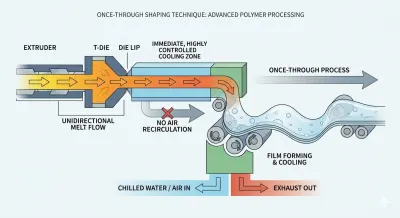
Once-through shaping changes the way cooling air is delivered around the forming bubble. Instead of relying primarily on recirculated air, the system uses a controlled, directional airflow through the cooling zone.
After the molten polymer exits the die, the bubble enters this controlled cooling area. The objective is to establish a more consistent airflow environment around the film so that cooling and solidification occur more evenly.
This approach combines two important elements: controlled melt distribution at the die and stable airflow at the cooling ring.
The co-extrusion die is designed with optimized flow channels to distribute the melt more evenly across the different layers. Consistent flow at the die provides a more stable starting point for bubble formation and helps reduce variations caused by uneven melt distribution.
The cooling ring then delivers a controlled airflow around the bubble. By managing airflow direction and distribution, the system helps stabilize the forming bubble and maintain a more predictable frost line.
The two systems work together. A well-designed die cannot compensate for unstable cooling, while effective cooling cannot fully correct uneven melt distribution. Consistent bubble film production depends on both.
From Cooling Control to Gauge Consistency
Film gauge is one of the clearest areas where stable shaping conditions can provide practical value.
If bubble formation changes during production, the resulting film can develop variations in thickness across the web. These variations may affect material utilization and make downstream converting or packaging operations less predictable.
Once-through shaping is designed to reduce unnecessary variation by providing more consistent cooling conditions around the bubble. When combined with accurate extrusion control and an appropriately configured die, this can help manufacturers maintain tighter and more repeatable film thickness.
It is important to note that gauge consistency is influenced by several factors, including resin properties, extrusion output, die design, cooling conditions, haul-off speed, and process settings. Once-through cooling is therefore one part of a broader process-control system rather than a standalone guarantee of a specific gauge tolerance.
Supporting Multi-Layer Bubble Film Production
The value of controlled shaping becomes more significant as the number of extrusion layers increases.
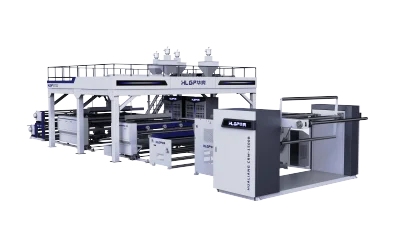
A two-layer bubble film machine may primarily focus on reliable cushioning film production, while three-to-five-layer configurations can combine different materials to balance cushioning, strength, sealing, or other functional requirements.
Seven-layer systems provide additional flexibility for more complex structures. Different resin combinations can be assigned to specific layers according to the required film properties and material cost targets.
In each configuration, stable melt distribution and cooling conditions help maintain the intended structure as the film transitions from the molten state to the finished bubble film. The exact processing window still depends on the selected resins, layer configuration, output rate, and product specification, but controlled shaping gives the production process a more consistent operating foundation.
Reducing Waste During Production
Material efficiency is another practical consideration for bubble film manufacturers.
Unstable bubble formation can lead to additional adjustments during startup, width changes, roll changes, or other process transitions. Material produced while the line is being stabilized may need to be trimmed, downgraded, or rejected if it falls outside the required specification.
A more controlled cooling and shaping process can help shorten the period in which the bubble is unstable, reducing avoidable process waste when the rest of the extrusion system is correctly configured.
The benefit is particularly relevant for manufacturers processing large volumes of polyethylene resin. Even a small improvement in usable yield can become meaningful over continuous production because less resin is lost to off-specification material.
Integrated Into Our Bubble Film Extrusion Machines
Once-through shaping is incorporated into our bubble film extrusion machine designs as part of the overall approach to bubble stabilization and film quality control.
The system combines optimized die flow, controlled cooling airflow, and extrusion process management to create more consistent conditions from melt formation through bubble stabilization. This approach is available across different machine configurations, from two-layer systems for standard protective packaging to three-to-five-layer and seven-layer machines for more demanding multi-layer structures.
The objective is not simply to cool the film faster. It is to control the conditions under which the bubble forms and solidifies, giving manufacturers a more stable process for managing film thickness, cell structure, and production consistency.
For manufacturers evaluating a new bubble film extrusion machine, cooling design should therefore be considered alongside screw configuration, die structure, layer count, automation, and output requirements. A well-matched system can provide a more controlled production environment and a stronger foundation for consistent bubble film quality over long production runs.