Stretch Film vs. Bubble Film: Choosing the Right Machine for Your Business
2026-05-26
Industrial packaging optimization relies on selecting the appropriate extrusion technology to meet specific load protection requirements. While both a stretch film machine and a bubble film machine utilize polyolefin resins—primarily low-density polyethylene (LDPE) and linear low-density polyethylene (LLDPE)—their technical structures, manufacturing methods, and downstream forming processes create distinct protective materials engineered for different logistics challenges.
Structural and Engineering Principles of Cast Stretch Film Machinery
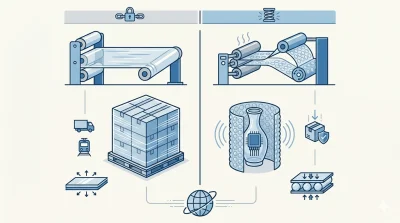
A stretch film machine utilizes advanced cast extrusion technology to process LLDPE and LDPE blends into high-clarity, puncture-resistant, and highly elastic polymer webs. Through a precision T-die extrusion block and water-cooled continuous chilling rollers, the molten resin is rapidly quenched to maximize the film's clarity and tensile performance.
Standard configurations, ranging from multi-layer coextrusion layouts like the 2-layer stretch film machine, 3-layer stretch film machine, to the heavy-duty 5-layer stretch film machine, employ precise gauge control to layer the polymers. This structure integrates tackifier resins into specific functional layers to produce controlled cling properties.
The distinction between a semi-automatic stretch film machine and a fully automatic stretch film machine lies strictly within the downstream winding mechanism and paper core changing system. The semi-automatic variant requires manual intervention for roll unloading and core placement. In contrast, the fully automatic line integrates an advanced programmable logic controller (PLC) to execute high-speed, non-stop automatic film cutting and automatic paper core swapping, ensuring continuous extrusion without operational downtime.
Structural and Engineering Principles of Bubble Film Machinery
Conversely, a bubble film machine transforms LDPE and LLDPE melts through continuous thermal lamination and vacuum-forming encapsulation. Instead of producing an elastic flat web, this machinery is engineered to lock ambient air into structured geometric patterns to create high-efficiency protective matrices.
The production line utilizes a specialized internal-vacuum forming roller to draw the molten resin sheet into precise cavities, creating uniform air pockets. Downstream laminating stations apply a secondary flat backing film over these cavities to seal the air inside. Depending on the required configuration, systems vary from the 2-layer low-speed bubble film machine and 2-layer medium-speed bubble film machine up to high-output variations like the 2-layer high-speed bubble film machine. For enhanced performance, multi-layer coextrusion lines—including the 3–5-layer low-speed bubble film machine, 3–5-layer medium-speed bubble film machine, 3–5-layer high-speed bubble film machine, and 7-layer high-speed bubble film machine—introduce additional resin sheets to sandwich the air pockets, optimizing the bubble retention rate and preventing pneumatic deflation under long-term compression.
Distinct Logistics and Application Scenarios
The operational divergence between these two technologies is defined by whether the logistics application requires rigid structural containment or impact-absorbing surface protection.
Industrial Unitization and Pallet Stabilization (Stretch Film Applications)
Films produced by a cast stretch film machine are applied at the outermost layer of logistics packaging. They are specifically engineered for heavy-duty, uniform, or palletized freight that requires dimensional stability during transit.
- Palletized Cargo Securement: Creating a tight, unitized wrap around multi-box pallet loads to withstand the dynamic forces of heavy braking and turning during intermodal transport.
- Logistics Environmental Protection: Wrapping building materials, chemical drums, and industrial machinery to shield the cargo from dust, moisture, and outdoor weathering.
- Containment Force Optimization: Utilizing the high tensile strength and elastic recovery of cast film to lock heavy, shifting loads to the pallet base, eliminating the risk of cargo tipping.
Shock Absorption and Interstitial Cushioning (Bubble Film Applications)
Materials generated by a bubble film machine serve primarily as inner packaging or direct product wrappers. They are engineered to dissipate mechanical energy and insulate sensitive components from external shocks.
- E-commerce and Courier Parcel Void Fill: Filling the empty spaces inside shipping cartons to prevent product movement and absorb localized impacts during high-speed automated conveying.
- Fragile and Precision Product Shielding: Wrapping electronics, glassware, automotive components, and instruments in multi-layer bubble matrices to neutralize high-frequency vibrations and impacts.
- Surface Scratch Prevention: Providing a non-abrasive, cushioned barrier for high-end painted parts, furniture, and polished metals to eliminate friction-induced scuffing during handling.
System Integration in Modern Packaging Lines
For standard industrial operations requiring dimensional integrity, investing in a high-efficiency cast stretch film machine ensures optimal pallet stabilization and minimized film consumption. For operations focused on delicate, variable-shaped components, a high-speed bubble film machine delivers the necessary thickness-to-weight protection to lower damage claims. In high-volume packaging facilities, these technologies are frequently paired—utilizing bubble film for primary internal product cushioning and cast stretch film for final external load containment.