Bubble Film Impact Resistance: Physics and Mechanism Explained
2026-08-18
In modern logistics and industrial packaging, protective materials must do more than simply separate products from external impacts. With the rapid growth of e-commerce, export transportation, and high-value product distribution, packaging materials are required to provide stable, predictable, and long-lasting impact protection. Traditional bubble film often fails to meet these increasingly demanding requirements due to bubble breakage, air pressure loss, and inconsistent cushioning performance.
The impact resistance of bubble film is not determined only by the size of the air bubbles. It is a combination of material properties, bubble structure, internal pressure stability, and manufacturing precision. Advanced bubble film extrusion machine technology has transformed bubble film production from a simple plastic forming process into a highly controlled engineering system capable of producing reliable protective packaging solutions.
Why Traditional Bubble Film Fails During Transportation
Traditional bubble film has been widely used for decades because of its lightweight structure and simple cushioning principle. However, conventional production methods often struggle to maintain consistent protective performance, especially in demanding transportation environments.
One of the most common problems is premature bubble rupture. When a bubble receives external impact, the compressed air inside should absorb and distribute energy. However, if the film thickness is uneven or the bubble structure is unstable, stress becomes concentrated in specific areas. These weak points can cause individual bubbles to burst before they complete the energy absorption process.
Another critical issue is pressure loss. The air trapped inside each bubble acts as a miniature cushioning chamber. If sealing quality is insufficient, air gradually escapes during storage or long-distance transportation. Once internal pressure decreases, the bubble loses its ability to function as an effective shock absorber.
Heat sealing performance also directly affects impact resistance. Weak bonding between film layers can create separation points under repeated vibration or sudden impact. For industrial logistics applications involving electronics, glass products, precision components, or fragile goods, inconsistent cushioning performance can significantly increase the risk of transportation damage.
From a physical perspective, poor-quality bubble film cannot provide predictable impact absorption because each bubble behaves differently under pressure. Some bubbles may absorb energy effectively, while others collapse immediately, resulting in uneven protection across the packaging surface.
The Physics Behind Modern High-Performance Bubble Film
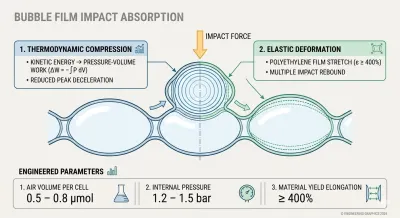
High-performance bubble film works through a combination of air compression and polymer deformation. Together, these mechanisms create an efficient energy absorption system similar to a large number of small engineered springs distributed across the packaging surface.
When an external force impacts the bubble structure, the air inside the bubble is compressed rapidly. This compression converts kinetic energy from the impact into compression work. Because the air chamber slows down the transfer of force, the peak acceleration transmitted to the packaged product is reduced.
At the same time, the polyethylene film surrounding the bubble undergoes elastic deformation. High-performance polyethylene materials with excellent elongation properties can stretch under impact and then recover their original shape. This elastic response allows the bubble to absorb additional energy while maintaining repeated cushioning capability.
The combination of air compression and polymer elasticity creates a dual energy dissipation mechanism. Air pressure manages the initial impact force, while the flexible polymer structure controls deformation and recovery. This balance is essential for producing bubble film with stable shock absorption performance.
Precision Parameters That Define Bubble Film Performance
The protective ability of bubble film depends heavily on manufacturing accuracy. Even small variations in bubble geometry, film thickness, or sealing quality can affect impact performance.
Air volume control is one of the key factors. Each bubble must maintain a consistent internal air chamber to achieve uniform cushioning behavior. In industrial production, bubble dimensions are carefully controlled through extrusion temperature, cooling conditions, and forming processes to ensure stable air retention.
Internal pressure is another important parameter. Proper pressure balance allows bubbles to compress during impact while maintaining sufficient structural strength. If pressure is too low, cushioning performance decreases. If pressure is too high, the bubble structure may become more fragile under sudden impact.
Material strength also plays an essential role. Modern protective bubble films often use advanced polyethylene formulations, including LLDPE and mLLDPE materials, which provide high toughness, flexibility, and puncture resistance. These materials help maintain the “engineering spring” effect of each bubble during storage, handling, and transportation.
How Advanced Bubble Film Extrusion Machine Technology Improves Protection
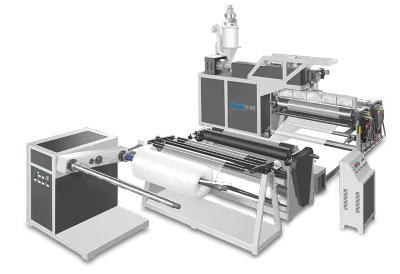
The performance of modern bubble film begins with precision manufacturing equipment. An advanced bubble film extrusion machine integrates accurate temperature control, stable extrusion systems, automatic tension adjustment, and intelligent production management to create consistent bubble structures.
High-speed two-layer bubble film machines focus on production efficiency while maintaining precise thickness control. Servo-driven systems and closed-loop control technology help stabilize extrusion conditions, reducing film thickness variation and minimizing weak points that could cause bubble failure.
For premium protective applications, multi-layer extrusion technology provides additional performance advantages. Three-layer and five-layer bubble film machines allow manufacturers to combine different material properties within one structure. The outer layers can provide higher strength and puncture resistance, while inner layers improve flexibility and cushioning performance.
Seven-layer bubble film production technology further enhances structural control. Through advanced co-extrusion technology, different polymer layers can be optimized for specific functions, creating a balanced structure with improved durability, sealing performance, and impact resistance.
Multi-layer bubble film can also create a progressive cushioning effect. Instead of absorbing all impact energy at one point, the layered structure allows gradual deformation, extending the impact absorption time and reducing the force transferred to the packaged product.
Medium and Low-Speed Bubble Film Production Solutions
Not every packaging manufacturer requires maximum production speed. Medium-speed and low-speed bubble film extrusion systems provide flexible solutions for companies focusing on customized products, specialized applications, and cost-effective production.
Medium-speed two-layer and three-to-five-layer systems are suitable for applications such as heavy-duty shipping bags, protective laminates, industrial packaging, and warehouse distribution materials. These machines provide a balance between production capacity, material efficiency, and product quality.
Low-speed bubble film extrusion machines are commonly selected for manufacturers entering the protective packaging market or producing standard bubble film products. With optimized machine configurations, they can deliver reliable bubble quality while maintaining competitive investment costs.
Regardless of production speed, accurate extrusion control remains the foundation of consistent bubble film performance. Stable temperature management, precise die design, and reliable winding systems ensure that every roll maintains uniform quality.
Key Advantages of Modern Bubble Film Technology
Advanced bubble film manufacturing provides several important benefits for packaging companies and end users.
Improved structural efficiency allows manufacturers to reduce material consumption while maintaining or increasing protection performance. By optimizing bubble geometry and layer structures, modern bubble film can achieve better cushioning with less raw material usage.
Uniform bubble distribution eliminates stress concentration areas. When every bubble shares impact loads evenly, the entire packaging surface provides more reliable protection during transportation.
High-quality bubble film also supports strict packaging performance requirements. Consistent sealing strength and stable air retention help products meet demanding transportation standards, including industrial impact and vibration testing requirements.
Another major advantage is repeatable cushioning performance. Unlike traditional bubble film that may lose pressure over time, precision-manufactured bubble structures maintain their protective properties throughout storage and long-distance shipping.
Building Better Protective Packaging with Advanced Bubble Film Production
The future of protective packaging depends on combining material science with intelligent manufacturing technology. Impact resistance is no longer determined by bubble size alone but by the complete interaction between polymer performance, air pressure control, structural design, and extrusion precision.
For manufacturers seeking higher-quality protective packaging solutions, investing in reliable production equipment is essential. Our advanced bubble film extrusion machine is designed with precise extrusion control, automatic adjustment systems, and multi-layer production capabilities to solve common problems such as bubble breakage, pressure loss, and inconsistent cushioning performance.
Whether you need high-speed mass production or customized multi-layer bubble film solutions, our bubble film extrusion machine can help you produce industrial-grade protective materials with stable quality and excellent impact resistance. Contact our technical team today to receive a professional equipment selection plan and customized quotation for your bubble film production requirements.