How Does an Bubble Film Extrusion Machinee Perfect Seal Every Bubble?
2026-08-31
In industrial packaging, the structural integrity of an air cushion is what ultimately determines whether transported goods arrive intact. Micro-porosity, inconsistent thickness, and unstable bubble geometry are the most common causes of compression failure in lower-end production systems, and the damage they cause rarely shows up until a shipment is already in transit. A properly engineered bubble film extrusion machine eliminates these defects at the source, combining precision mechanical design with careful material science at every stage of the process.
The Structural Weak Points Behind Compression Failure
Most compression failures trace back to problems that started long before the bubble film ever left the production line. Loose temperature control at the die is one of the most common culprits, since even a modest variance across the web width creates thickness streaks that leave thin spots and weak seal points scattered through an otherwise usable roll. Once that instability enters the melt, it tends to compound rather than correct itself, and the resin flow that should be forming a consistent structural base ends up carrying weak points into the very first layer.
The problems multiply from there. Machines without genuine multi-layer co-extrusion, or with skin layers that lack strong heat-sealing affinity, struggle to produce a bubble film with real long-term airtightness, which becomes obvious only after weeks or months of storage when the cushioning has quietly leaked away. Imprecise vacuum control during bubble formation introduces a different kind of defect, causing necking and uneven wall thickness across each bubble's surface rather than the uniform hemisphere a well-formed cell should have. On top of all this, loose tension management during forming lets semi-molten bubbles sag, over-stretch, or collapse before the polymer has fully crystallized, undoing whatever precision existed earlier in the process.
Where a Weak Seal Turns Into a Real Loss
These structural weaknesses are not just production defects, they translate directly into damaged goods and costly claims in specific industries where the packaging has to hold up under real stress. Glass and ceramic sanitary ware exported by sea freight is one of the clearest examples, since these shipments spend weeks or even months in transit before reaching their destination. Long-term air retention is not optional in this context, it is the entire point of the packaging, and a bubble film with even a minor micro-leak has effectively failed its job well before the container reaches port, leaving fragile goods with no meaningful cushioning left when they need it most.
Outdoor machinery parts and hardware tools present a different kind of stress on the same underlying weakness. These loads are heavy, irregularly shaped, and often stacked for extended storage periods, which puts sustained compression on the bubble structure rather than a single moment of impact. Wall thickness inconsistency in this scenario is not a cosmetic issue, it is the exact spot where a bubble will compress and fail under sustained weight, and once one section collapses, the load above it loses support and the whole stack becomes vulnerable.
Where Perfect Sealing Actually Begins
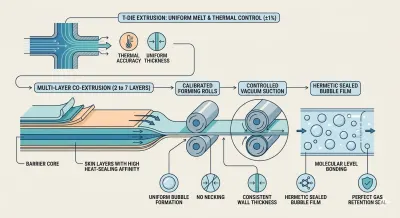
Perfecting the seal on every bubble starts well before the bubble itself takes shape, at the T-die where melt distribution is established across the full width of the web. Advanced T-dies hold temperature variance below plus or minus one percent, and that level of thermal accuracy is what eliminates the thickness streaks responsible for thin spots and weak seal points further down the line. A stable, well-controlled resin flow at this stage prevents structural weak points from ever forming in the first layer, which means every later stage of the process is building on a consistent foundation rather than compensating for one.
Building Airtightness Into the Layer Structure Itself
From there, multi-layer co-extrusion is what turns a structurally sound film into a genuinely airtight one. Production lines ranging from 2-layer configurations up to high-capacity 7-layer high-speed bubble film machines use functional layering to serve two purposes at once, with a structural core layer providing rigidity while external skin layers are engineered specifically for high heat-sealing affinity. When these layers pass together through calibrated forming rolls, they bond at a molecular level rather than simply fusing at the surface, and that specific combination of heat and contact pressure is what creates a hermetic seal capable of preventing gas permeation across long storage cycles, exactly the kind of long-haul reliability that sea-freight glass and ceramic packaging depends on.
Precision Vacuum Control for Every Cell
Getting the bubble's shape right is a separate engineering challenge, and one that 2-layer low-speed and 2-layer medium-speed bubble film machines are specifically tuned to solve for applications where material efficiency and seal strength both matter. Controlled vacuum suction inside the forming roll draws molten film evenly into each cavity, and that even draw is what prevents necking while keeping bubble height and diameter consistent from one cell to the next. The result is uniform wall thickness across the entire hemisphere of every bubble, which is precisely the property that keeps a stacked load of hardware tools or machinery parts from developing the kind of weak point that collapses under sustained pressure.
Holding the Shape Until It Sets
None of this precision matters if the bubble cannot hold its shape while the polymer finishes crystallizing, which is why multi-layer bubble film machines rely on closed-loop, automated tension control throughout the forming stage. Sensors continuously monitor web tension and adjust feed rates dynamically, preventing the sagging or over-stretching that would otherwise distort bubble geometry before it has a chance to set. That same system carries the film's structural integrity all the way from the forming roll to the final winding station, so the bubble shape that gets measured at the die is still intact by the time the roll is finished.
Closing the Loop for Near-Zero Leakage
At the top of this system, 7-layer high-speed bubble film machines connect resin flow consistency directly to overall line speed through continuous closed-loop calibration. Extrusion pressure is calibrated against cooling rates in real time, and that continuous synchronization reduces micro-leaks by roughly 99.8 percent compared to older, purely mechanical systems that rely on static settings rather than live feedback. The airtight sealing this produces is reliable enough to support a 15 percent reduction in film gauge without giving up cushioning performance or compression resistance, which translates directly into lower material cost for high-volume export and heavy industrial packaging alike.
Engineering Every Layer of the Seal
A truly reliable air cushion is never the result of one single feature, it comes from precision compounding at every stage, from the T-die's thermal accuracy through molecular-level layer bonding, controlled vacuum forming, dynamic tension management, and closed-loop process calibration. That is the standard we build into every bubble film extrusion machine we manufacture, because customers shipping glass and ceramic goods across oceans or stacking heavy hardware for months in a warehouse cannot afford a bubble that fails quietly. When every stage of the process is engineered to the same tolerance, the result is a film where every bubble holds its seal, whether it is opened the same week it was produced or after a long journey across the world.