Packaging Trends 2026: The Future of Bubble Film Extrusion Machines
2026-08-14
The global packaging industry is entering a new stage in 2026, driven by the combined demand for sustainable materials, higher protection performance, and more efficient production methods. As brands and manufacturers focus on reducing material consumption while maintaining packaging reliability, advanced film technologies are becoming increasingly important. Traditional single-layer production methods are gradually facing limitations, while multi-layer co-extrusion technology is becoming a key solution for producing high-performance bubble packaging materials.
New Challenges Facing Traditional Bubble Film Production in 2026
For many years, conventional single-layer bubble film production has been widely used for e-commerce packaging, logistics protection, and industrial transportation. However, as packaging requirements continue to increase, traditional structures are facing greater challenges in terms of material efficiency, sustainability, and functional performance.
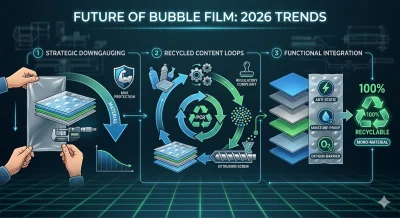
One of the major challenges is material reduction. Customers increasingly require lighter packaging solutions that can reduce resin consumption without sacrificing cushioning performance. Although single-layer bubble film can provide basic protection, achieving further downgauging while maintaining strength, flexibility, and impact resistance becomes more difficult when the film structure has limited design options.
Another challenge comes from the growing demand for recycled materials. Global packaging manufacturers are paying more attention to the application of post-consumer recycled materials (PCR) and circular packaging systems. However, processing recycled materials requires precise control of extrusion temperature, melt stability, and layer distribution. Without suitable extrusion technology, recycled materials may affect film appearance, mechanical performance, and production consistency.
At the same time, the packaging market is moving toward more functional materials. Modern protective packaging is no longer only focused on cushioning. Industries such as electronics, precision equipment, food logistics, and high-value products require packaging materials with improved moisture resistance, static protection, and customized barrier properties. This trend is encouraging manufacturers to adopt advanced multi-layer structures instead of relying only on traditional single-material designs.
How Advanced Bubble Film Technology Supports Modern Packaging Needs
Bubble film remains one of the most important protective packaging materials because of its lightweight structure, excellent cushioning ability, and flexible application range. With the development of modern extrusion technology, bubble film is becoming more efficient, sustainable, and performance-oriented.
One important trend is strategic lightweighting. By optimizing the layer structure, manufacturers can achieve better protection performance with reduced material consumption. Multi-layer bubble film allows different polymer materials to perform different functions. For example, the outer layers can provide strength and durability, while the middle layer can be designed for cushioning efficiency or recycled material integration.
This structure optimization helps manufacturers achieve better cost control while maintaining packaging quality. Instead of increasing film thickness to improve protection, advanced bubble film production focuses on improving material distribution and structural performance.
Sustainability is another important direction for future bubble film production. Modern bubble film extrusion machine technology is designed to support a wider range of materials, including virgin polymers, PCR materials, and other environmentally friendly resin options. Through optimized layer design, manufacturers can incorporate recycled content into suitable layers while maintaining stable production performance.
For companies seeking sustainable packaging solutions, the ability to process different material combinations provides greater flexibility. It allows packaging producers to respond to changing environmental regulations while developing products that meet different market requirements.
Beyond traditional e-commerce applications, high-performance bubble film is also expanding into more demanding industries. Electronics manufacturers require packaging with reliable cushioning and anti-static properties. Food and cold-chain logistics require improved moisture protection. Industrial products need durable protection during long-distance transportation. These applications create new opportunities for advanced bubble film structures and high-precision extrusion systems.
Multi-Layer Co-Extrusion Technology Becomes the Future of Bubble Film Production
The development of multi-layer co-extrusion technology is one of the most important trends shaping the future of bubble film manufacturing. Compared with conventional single-layer systems, multi-layer extrusion provides greater control over material distribution, product performance, and production efficiency.
A modern bubble film extrusion machine with multi-layer capability enables manufacturers to produce different film structures according to application requirements. Two-layer systems provide an economical solution for standard protective packaging, while three-layer and five-layer systems offer improved strength, cushioning performance, and material optimization.
For manufacturers producing general packaging products, two-layer bubble film machines provide a practical balance between investment cost and production efficiency. These systems are suitable for applications such as online retail packaging, warehouse protection, and daily transportation needs. With stable extrusion control and precise temperature management, they can deliver consistent bubble formation and reliable film quality.
Three-layer and five-layer bubble film production systems provide greater flexibility for customers who need higher performance packaging materials. By combining different functional layers, manufacturers can create structures that improve impact resistance, reduce material usage, and support recycled material applications. These machines are especially suitable for industrial packaging, export protection, and customers looking to upgrade from basic bubble film products.
For premium applications requiring advanced protection performance, seven-layer bubble film extrusion systems provide the highest level of structural flexibility. Through precise layer distribution and advanced process control, these systems can support customized material combinations for industries that require higher barrier performance, improved durability, and specialized packaging functions.
Advanced Bubble Film Extrusion Machine Solutions for Future Packaging
The future of bubble film production depends not only on material development but also on extrusion equipment performance. A high-quality bubble film extrusion machine needs to provide stable operation, accurate temperature control, efficient energy management, and flexible material compatibility.
Modern extrusion systems are equipped with advanced heating and cooling control technologies to maintain stable processing conditions during continuous production. Precise temperature management helps improve melt uniformity, bubble stability, and final film quality. This is especially important when processing recycled materials or multi-layer structures, where production stability directly affects product consistency.
Energy efficiency is also becoming a key consideration for packaging manufacturers. Intelligent heating control, optimized screw design, and efficient drive systems help reduce unnecessary energy consumption during production. Lower energy usage not only improves operating efficiency but also supports manufacturers in achieving more sustainable production goals.
Automation technology further improves production reliability. Advanced control systems can monitor production parameters, manage operating settings, and support quick adjustments for different material recipes. This reduces dependence on manual operation and helps manufacturers maintain consistent quality during long production cycles.
A flexible equipment platform also allows customers to expand their product range. From standard protective bubble film to high-performance packaging materials, manufacturers can respond more quickly to changing market demands by using extrusion equipment designed for multiple applications.
Building a Competitive Packaging Future with Advanced Bubble Film Production Technology
As packaging trends continue to evolve in 2026 and beyond, manufacturers need equipment that can balance sustainability, performance, and production efficiency. The next generation of bubble film production will focus on smarter extrusion technology, optimized material structures, and flexible solutions that support both traditional packaging markets and emerging high-value applications.
Our bubble film extrusion machine solutions are developed to meet these changing industry requirements through advanced co-extrusion technology, stable extrusion systems, precise temperature control, and energy-efficient production design. With options covering two-layer, three-layer, five-layer, and seven-layer configurations, our machines help customers produce reliable bubble film products with improved material efficiency and wider application possibilities. By supporting different resin combinations, recycled material integration, and customized production requirements, our bubble film extrusion machine provides packaging manufacturers with the technology needed to upgrade their production capabilities and achieve long-term growth in the evolving global packaging market.