Stretch Film Extrusion Machines Guide: Optimizing Elongation, Puncture & Tear Strength
2026-06-30
The global logistics and warehousing industries rely heavily on high-performance pallet wrapping to secure goods during transit. For stretch film manufacturers, maximizing film performance while reducing material costs is the ultimate goal. Achieving the perfect balance between high elongation, exceptional puncture resistance, and optimum tear strength requires a deep understanding of modern cast film technology.
Technical Challenges in Legacy Stretch Film Manufacturing
Traditional cast film lines often struggle to meet the strict mechanical requirements demanded by modern high-speed automated wrapping machines. Legacy stretch film machinery frequently exhibits hardware limitations that directly compromise the quality of the final pallet wrap, leading to significant material failures.
Poor Elongation and Frequent Film Snap
Low-tier extrusion systems often suffer from poor melt homogenization. When the resin blend, including metallocene linear low-density polyethylene (mLLDPE), is not thoroughly mixed, the polymer chains remain fragmented or clumped. This lack of uniform molecular orientation means the film cannot withstand high pre-stretch ratios. During automated pallet wrapping, the film easily snaps, which halts packaging lines and increases product damage during transport.
Inadequate Puncture Resistance Against Sharp Cargo
Pallets containing sharp cardboard corners, wooden crates, or irregular industrial goods put severe stress on stretch wrap. Legacy machines often produce film with inconsistent gauge thickness across its width. These microscopic variations create weak points. When the film encounters a sharp edge, it punctures immediately rather than flexing around the obstacle, sacrificing load stability.
Low Tear Strength and Edge Fraying
The edges of a stretch film roll are highly vulnerable. If the die does not distribute the melt perfectly, or if the edge trim system operates unevenly, the film develops micro-tears along its margins. During the longitudinal stretch phase on a wrapper, these small imperfections quickly propagate into catastrophic transverse tears, causing the entire web to break.
Next-Generation Components for Superior Film Properties
Overcoming these manufacturing bottlenecks requires precision engineering at the component level. Upgrading key parts of the extrusion train ensures the polymer matrix is optimized for maximum physical strength.
High-Efficiency Multi-Screw Co-Extrusion System
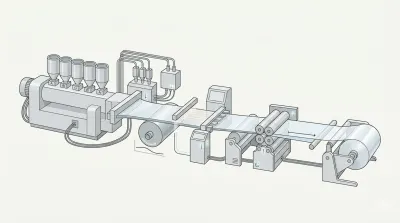
Instead of relying on standard screws that can degrade material or mix inconsistently, advanced lines utilize multiple independent extrusion screws dedicated to feeding different layers. Each screw is precisely calibrated to handle specific material layers, such as the high-slip outer layer, the core stretch layer, and the high-tack cling layer. This specialized configuration guarantees superior melting efficiency, eliminates un-melted gels, and maintains low running noise. The highly homogenized melt forms a resilient molecular lattice that acts as the foundation for excellent stretchability.
Auto-Gauge Adjusting Cast Die with T-Slot Geometry
To eliminate the gauge variations that cause punctures, modern stretch film making machines utilize an automatic micro-adjustment T-die. This die incorporates a streamlined internal coat-hanger flow channel that minimizes polymer residence time. High-sensitivity thermal expansion bolts constantly adjust the die lip gap based on real-time thickness feedback. By keeping the transverse thickness tolerance within negligible limits, the film achieves uniform tensile strength across its entire surface, removing the thin zones where punctures usually occur.
Rapid-Response Positive and Negative Pressure Air Box with Chilled Rollers
The crystal structure of LLDPE determines its transparency and mechanical elasticity. Advanced chill roll modules utilize a dual-circuit spiral flow internal design to maintain uniform surface temperatures across the roller, keeping variations below half a degree Celsius. Working in tandem with a dual-chamber vacuum box and a negative pressure air knife, the system instantly pins the molten web to the cooling roll. This rapid quenching locks the polymer molecules into an optimal crystalline state, providing both high clarity and a balanced ratio of machine-direction to cross-direction tear strength.
Integrated Cast Stretch Film Machine Solutions
Integrating these advanced components into a single, automated production unit creates a highly stable multi-layer co-extrusion cast film line. This configuration allows packaging suppliers to manufacture high-yield premium films at a reduced cost per roll.
Multi-Layer Co-Extrusion and High-Speed Cast Technology
Modern cast lines combine the outputs of three independent screws into multi-layer structures, typically configured as two, three or five layers. This structural flexibility allows engineers to sandwich an ultra-tough, high-metallocene core layer between highly functional outer skins. The high-speed casting process operates continuously with minimal mechanical vibration, allowing factories to scale up throughput without experiencing the gauge fluctuations typical of older, slower machinery.
Intelligent PLC Automation and Human-Machine Interface
Control accuracy is vital for maintaining film quality over long production runs. Modern machines are governed by an advanced programmable logic controller (PLC) tied to an intuitive touch-screen Human-Machine Interface (HMI). Operators can monitor zone temperatures, screw speeds, line tension, and winding parameters from a centralized dashboard. The closed-loop automation automatically compensates for minor material variations, reducing the need for constant operator intervention and preventing human error from affecting the film's mechanical properties.
Cost Reduction and Sustainability
Investing in an optimized co-extrusion line delivers clear financial and competitive advantages for film manufacturers and their end-user clients.
Down-Gauging and Material Optimization
The combination of uniform thickness control and advanced resin blending allows for significant film down-gauging. Manufacturers can produce a fifteen-micron film that outperforms a traditional twenty-micron film in both puncture resistance and containment force. This reduction in thickness translates directly into a twenty-five percent savings in raw material consumption, allowing factories to produce more linear meters of film from the same volume of resin.
High-Efficiency Green Manufacturing
Sustainability is a critical metric for global supply chains. The integrated online trim recycling system ensures that close to one hundred percent of edge scrap is reused immediately without thermal degradation.
Optimizing stretch film for elongation, puncture resistance, and tear strength is no longer a matter of adjusting resin recipes alone. It requires a highly coordinated engineering solution where multi-screw extrusion, automated die gauge control, and intelligent PLC winding systems work in perfect harmony. By upgrading to a high-speed multi-layer co-extrusion cast line, film producers can eliminate frequent film breaks, reduce material thickness, and deliver high-performance pallet wrap that meets the demands of modern logistics. Adopting these advanced machinery solutions is the most reliable path to achieving sustainable, high-margin growth in the competitive industrial packaging market.