How to Handle Emergency T-Die Leakage on a Stretch Film Extrusion Machine?
2026-07-01
Maximizing uptime and maintaining tight gauge tolerances are the ultimate goals in heavy-duty cast stretch film production. At the heart of this process sits the T-Die, a high-precision component engineered to distribute molten polymer into a perfectly uniform, ultra-thin film. However, unexpected molten resin leakage at the T-Die junctions remains one of the most disruptive emergencies on a stretch film extrusion machine. When a leak occurs under high pressure and temperature, it threatens operator safety, ruins film optics, and halts your entire line. Understanding how to mitigate this crisis through precision engineering and advanced automation is critical for modern plastics packaging manufacturers.
Chronic Vulnerabilities and the Pitfalls of Traditional Leak Response
In traditional manufacturing environments, detecting a polymer leak along the die body bolts or deckling system relies almost entirely on visual monitoring by operators. By the time a mechanical technician notices smoking or pooling polymer, a massive volume of degraded material has already accumulated. This delay leads to immediate material contamination, rendering large batches of cast film unmarketable.
Faced with a sudden leak, a common yet highly dangerous instinct is to manually torque the die body bolts while the extrusion line is running at full operating temperature. Attempting to tighten bolts under high backpressure often results in thread stripping, bolt shearing, or permanent mechanical warping of the T-Die lips.
Furthermore, the collateral damage of a severe melt leak extends far beyond the ruined material. Cleaning carbonized, degraded LLDPE from delicate die surfaces requires hours of downtime as the line cools down, resulting in expensive labor costs and missed delivery schedules. Reheating the massive steel die back to 250°C consumes electrical energy, deeply cutting into a factory's profit margins.
Mechanical Advancements in High-Precision Hard-Sealing Components
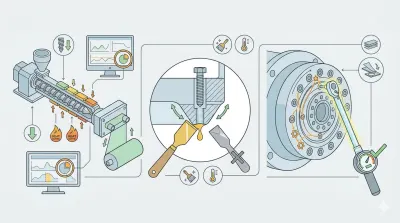
To prevent these catastrophic failures, our cutting-edge components introduce a major upgrade over traditional die-clamping mechanisms. The foundation of this engineering breakthrough lies in specialized thermal expansion matching technology. By fabricating our sealing components from premium alloy mold steel that mirrors the exact thermal expansion coefficient of the main T-Die body, the seal self-adjusts. As the extrusion line heats up to its standard operating range between 200°C and 300°C, the sealing elements expand in perfect synergy with the die, eliminating microscopic pathways before the polymer can escape.
Complementing this material synergy is our micro-precision contact surface grinding. Every mating surface undergoes an ultra-precise polishing and grinding sequence, achieving a flatness tolerance measured in microns. This ultra-flat finish allows for a true metal-to-metal hard seal capable of withholding intense hydraulic pressures without relying on soft, degradable gaskets.
To ensure long-term durability, these components undergo an advanced surface hardening treatment, such as hard-chrome plating or tungsten carbide thermal spraying. This treatment provides exceptional wear resistance against abrasive resins and additives, while preventing degraded polymer from sticking to the flow channels. Additionally, optimized internal melt flow channels reduce local shear stress and eliminate high-pressure spikes at the die edges, mitigating the primary physical catalyst for joint leakage.
Integrating PLC Automation and System Synergy for Passive Leak Prevention
While mechanical precision reduces the physical risk of a breach, true operational security requires intelligent machinery control. Our advanced stretch film extrusion machine solves this by embedding an industrialized PLC system into the core processing architecture. This centralized controller transforms your leak management from a reactive, chaotic scramble into an automated, passive defense system.
Real-Time Data Monitoring and Early Overpressure Detection
The integrated PLC system continuously polls high-precision melt pressure transducers and thermocouple sensors positioned throughout the extruder barrel, melt pump, and T-Die adapters. By establishing a baseline of normal operating parameters, the PLC detects subtle, abnormal pressure surges long before they are visible to the human eye. If a screen changer becomes blinded or a formulation shift causes an unexpected viscosity drop, the PLC flags the anomaly instantly, triggering multi-tier visual and audible alarms so operators can intervene proactively.
Automated Machine Synergy and Emergency Pressure Relief
In the event of a sudden, severe pressure spike or an identified leak, the PLC system executes a pre-programmed, one-touch emergency pressure relief sequence. Rather than leaving operators to manually scramble with control knobs, the PLC instantly decelerates the main extruder screw and coordinates a synchronized speed reduction of the melt pump. By dropping the internal cavity pressure within seconds, the system chokes off the force driving the polymer leak, instantly containing the spill and protecting both the machinery and nearby floor staff.
Closed-Loop PID Temperature Control to Prevent Material Degradation
Polymer leakage is frequently caused by localized overheating, which degrades the LLDPE matrix, drastically drops its viscosity, and allows it to slip through mechanical seals. Our PLC architecture features integrated, multi-zone PID temperature control modules that communicate directly with high-performance heating bands and cooling blowers. By regulating the thermal profile across the entire width of the T-Die to within a strict variance of plus-or-minus one degree Celsius, the system eliminates hot spots, stabilizes melt viscosity, and removes a core root cause of unexpected leakage.
High-Rigidity Die Support and Bi-Directional Precision Alignment Architecture
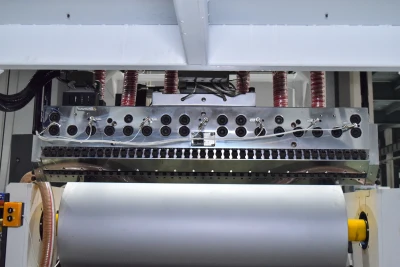
Even with advanced automation, mechanical stability under extreme thermal conditions is crucial for preventing leaks. To address this, our stretch film extrusion machine utilizes a heavy-duty, high-rigidity die support base engineered to withstand continuous structural stress without micro-deflections. This robust framework features a bi-directional precision alignment mechanism, allowing technicians to make micron-level adjustments to the die position relative to the chill roll without loosening critical melt-sealing joints. By maintaining perfect parallel alignment and absorbing structural vibrations during high-speed winding, this specialized architecture eliminates the mechanical shifting that frequently causes gasket wear and subsequent polymer leakage.
Investing in Long-Term Operational Stability
Relying on outdated, manual intervention methods to manage T-Die leakage is a costly operational bottleneck that modern packaging manufacturers can no longer afford. Protecting your margins requires a unified engineering approach that addresses both the physical and digital aspects of extrusion. By upgrading to high-precision alloy components with matched thermal expansion rates, and pairing them with a responsive, PLC-driven automation network, you effectively insulate your production line from catastrophic downtime. Investing in a smarter, automated stretch film extrusion machine is not just an emergency protocol; it is a strategic business decision that optimizes material yield, reduces energy waste, and secures predictable profitability for your factory floor.