Advantages of Selecting PLC Touch Screen Control for 2-Layer Bubble Film Extrusion Machine
2026-09-23
A 2-layer bubble film extrusion machine must coordinate several processes simultaneously, from stable resin melting and extrusion to bubble forming, cooling, and lamination. The base film and bubble layer need to maintain consistent thickness and bonding throughout production, while temperature, air pressure, and line speed must remain properly synchronized. When these variables are managed effectively, the machine can produce bubble film with more consistent cushioning performance and dimensional stability. This is why PLC touch screen control plays an important role in modern bubble film production, providing operators with clearer process monitoring and more precise control over key operating parameters.
Where Conventional Control Systems Fall Short
Many 2-layer bubble film machines still rely on manual coordination to keep the flat layer and bubble layer in sync. Without precise, linked control over the line speeds of both extruders, operators are left trial-and-error adjusting settings by feel, and even small mismatches between the two layers can lead to delamination — a bond that looks fine off the line but separates under stress. Thickness monitoring often suffers from the same gap: melt pump output and screw speed are checked through periodic manual inspection rather than continuous digital feedback, which allows thickness and tensile strength to drift unevenly across a single roll without anyone noticing until the film is already in a customer's hands.
Vacuum forming control tends to be similarly imprecise on conventional equipment. Vacuum pressure within the forming roller is frequently set to fixed positions rather than fine-tuned in real time, which means bubbles across a run can end up underformed, leaving them weak under pressure, or overformed in ways that waste material without adding real cushioning benefit. This lack of precision becomes a real cost problem the moment a production line needs to switch between specifications — moving from small bubble to large bubble film, for example, forces a full manual reset of parameters with no saved reference point, which stretches out changeover time and generates scrap during every restart.
The absence of real-time diagnostics compounds all of this. On a conventional line, problems in the heating or forming sections are often only caught after they've already produced defective film, since there's no system flagging early deviations before they become scrap. That reactive troubleshooting model, combined with heating and motor loads that aren't optimized for actual production conditions, tends to push both energy consumption and labor dependency higher than they need to be — operators need more experience to catch problems manually, and the process stays harder to repeat consistently from one shift to the next.
Why Bubble Film Consistency Matters Across Applications
The gap between a well-controlled 2-layer bubble film machine and a loosely controlled one shows up differently depending on what the film is protecting, which is exactly why control precision matters as much as raw output.
In household relocation and freight forwarding packaging, order specifications shift constantly between small bubble and large bubble film depending on what's being wrapped, and batch consistency has to hold up across widely varying shipment types. A line that struggles with slow changeovers or uneven thickness makes it harder to keep pace with the specification diversity this segment demands.
In hardware and fastener wholesale packaging, sharp-edged, irregularly shaped items need dependable bubble strength to prevent surface damage during handling and transit, and production costs need to stay controlled at scale. Underformed bubbles from imprecise vacuum pressure translate directly into localized cushioning gaps exactly where sharp components are most likely to cause damage.
In e-commerce warehouse fulfillment, high shipment frequency depends on a production line that can hold a steady output rhythm with minimal disruption. Frequent unplanned downtime from undiagnosed faults directly threatens the reliable, continuous supply this kind of operation depends on.
How PLC Touch Screen Control Delivers These Advantages
Our 2-layer bubble film extrusion machine addresses these gaps through a PLC touch screen control system that manages the entire process as a coordinated whole rather than a series of manually adjusted steps.
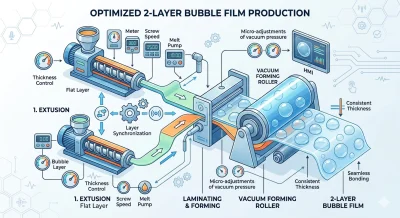
Layer synchronization is handled directly by the PLC, which precisely coordinates the line speeds of both extruders so the flat layer and bubble layer bond seamlessly without the mismatch that leads to delamination. Digital sensors provide real-time monitoring of melt pump output and screw speed, keeping thickness and tensile strength consistent across both layers throughout a run. For hardware and fastener wholesale packaging, that bonding reliability means the finished bubble film holds together through repeated handling and pressure rather than separating at the exact moments it's needed most.
Vacuum forming precision is managed through the HMI, which allows micro-adjustment of vacuum pressure within the forming roller so every bubble across the sheet forms fully and holds its pressure resistance. That level of control is what keeps cushioning performance dependable for hardware and fastener packaging, where sharp, uneven product shapes leave no margin for underformed bubbles.
Changeover efficiency is built into the system through automated recipe storage, letting operators save specific parameter sets for different bubble film specifications and recall them with a single touch. For household relocation and freight forwarding customers whose orders shift constantly between small bubble and large bubble film, this turns what used to be a lengthy manual reset into a fast, low-waste transition between production runs.
Real-time process visualization displays temperature zones, winding tension, and every other stage of the extrusion process graphically on the touch screen, giving operators immediate visibility into how the line is actually running rather than relying on periodic manual checks. Paired with smart fault diagnosis that flags issues in the heating or forming sections as they emerge, the system catches deviations before they turn into scrap or unplanned downtime — a difference that matters most in e-commerce warehouse fulfillment, where a steady, uninterrupted output rhythm is the whole point.
The same intelligent control also delivers efficiency gains that apply across every application: optimized motor loads and heating cycles reduce the energy consumption ratio per kilogram of film produced, precise parameter control minimizes resin waste during startup, and the intuitive interface lowers the dependence on highly specialized operators, making output more stable and repeatable across shifts.
For manufacturers producing high-performance protective packaging, a 2-layer bubble film extrusion machine built around PLC touch screen control isn't an added convenience — it's what turns a mechanically capable line into a consistently reliable one. By replacing manual guesswork with synchronized, data-driven control across every stage of the extrusion process, this approach delivers the layer integrity, dimensional consistency, and production efficiency that today's protective packaging buyers expect as standard.