1. The Engineering Challenge of Perforation Pitch Control
In air bubble film production, the perforation pitch—the exact distance between two tear lines—is a critical metric of machine performance. Traditional bubble film extrusion lines rely on mechanical chain drives, gears, or open-loop control systems. These older methods suffer from inherent limitations:
- Mechanical Backlash: Wear and tear in gears and chains create microscopic delays, translating into cumulative pitch errors.
- Tension Fluctuations: As the bubble film passes through the forming, cooling, and winding stages, elastic deformation occurs. Materials stretch and contract dynamically.
- Velocity Mismatch: During acceleration or deceleration phases of the extruder, mechanical slaving cannot react fast enough to match the perforation blade with the changing line speed.
These issues result in inconsistent perforation lines, drift errors, and web tracking problems. Modern smart bubble film making machines eliminate these mechanical bottlenecks entirely by replacing physical gearing with digital synchronization driven by Programmable Logic Controllers (PLCs).
2. The Closed-Loop Architecture: How the PLC System Works
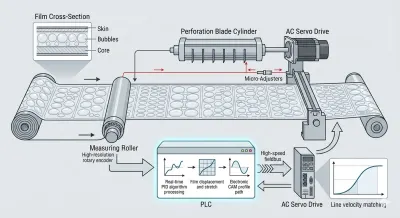
The modern PLC control system operates on a high-speed, closed-loop feedback mechanism. It ensures that the cutting tool and the moving substrate maintain a strict electronic relationship. The process unfolds in four continuous steps:
Step 1: High-Speed Signal Acquisition
High-resolution rotary encoders are strategically mounted on the measuring rollers along the film path. As the bubble film moves, the encoder tracks the exact linear displacement at a micrometer scale. It converts this physical movement into high-frequency electronic pulses, streaming them directly into the PLC’s high-speed counter (HSC) modules.
Step 2: Real-Time Algorithm Processing
The central PLC processor executes advanced motion control algorithms (such as PID and electronic cam profiling) in millisecond cycles. It continuously calculates:
- The exact instantaneous line velocity.
- The raw material displacement.
- The rate of material stretch caused by tension variations across the multi-layer film structure.
Step 3: Predictive Servo Command Execution
Based on these computations, the PLC determines the precise angular position and rotational frequency required for the perforation knife. It sends digital commands via high-speed industrial fieldbus protocols (such as EtherCAT or Profinet) to the AC servo drive.
Step 4: Dynamic Motor Correction
The servo motor, which is directly coupled to the perforation blade cylinder, executes the velocity profile. If the line speed increases by 0.1 m/min, or if the film stretches due to a temperature shift, the PLC detects the phase deviation via encoder feedback and forces the servo motor to accelerate or decelerate instantly. This eliminates inertia lag and maintains a perfect spatial lock between the blade and the film.
3. Application Stability Across Multi-Layer Machine Configurations
The demands on a PLC control system vary significantly depending on the layer structure and speed profile of the smart bubble film machine. The smart PLC architecture scales its control parameters to match these specific requirements:
- 2-Layer & 3-Layer Systems: These configurations focus on maintaining constant pitch during standard roll-change sequences and winding transitions. The PLC stabilizes the perforation blade against the tension spikes caused by automatic flying splicers.
- 5-Layer & 7-Layer High-Speed Lines: High-barrier films (incorporating Nylon or EVOH layers) possess different tensile strengths and elastic behaviors compared to standard LDPE. The PLC system utilizes specialized tension-feedforward algorithms to compensate for the higher stiffness of co-extruded structures, preventing perforation pitch distortion even at production speeds exceeding 40 meters per minute.
4. Technical Performance and Automation Features
Integrating a dedicated PLC motion controller upgrades the mechanical layout into a fully automated, software-driven module. The technical advantages include:
- Sub-Millimeter Precision: The system maintains a uniform perforation pitch within a strict ±0.5 mm tolerance limit, ensuring absolute consistency across the entire roll.
- Digital HMI Recipe Management: Operators can modify the perforation pitch (e.g., changing from 200 mm to 500 mm) instantly by entering numerical values on the HMI touchscreen. The PLC recalculates the electronic gear ratio automatically in the background.
- Zero-Gear Changeover: This digital adjustment completely eliminates the need to shut down the machine, drain lubricants, or manually swap out physical mechanical gears, reducing product changeover downtime by up to 40%.
- Synchronization with Die and Winder: The perforation PLC is interconnected with the main extruder PLC. If the extrusion output changes or the winding tension fluctuates, the perforation speed scales proportionally to safeguard the structural integrity of the air bubbles.
5. Future-Proofing and Industry 4.0 Integration
Beyond real-time motion control, modern PLC processors act as data gateways on the factory floor. The digital nature of the perforation control system enables several advanced technical capabilities:
- Data Logging: The system continuously monitors and records performance metrics, including pulse counts, motor torque curves, and deviation logs.
- Predictive Maintenance: By analyzing the torque feedback from the servo motor, the PLC can detect increased friction or blade dullness, triggering maintenance alerts before a mechanical failure occurs.
- Remote Diagnostics: The PLC supports secure cloud connectivity, allowing engineers to perform remote troubleshooting, firmware updates, and control loop tuning without on-site intervention.