How to Keep Bubble Film Extrusion Machine Running Stably in High Humidity
2026-05-27
The bubble film extrusion machine is the core production equipment for manufacturing protective packaging, but its performance is highly sensitive to environmental factors. High ambient moisture exceeding 70% RH creates critical operational challenges for these advanced extrusion lines. In tropical and coastal climates, high humidity causes hydrolytic degradation in resins like LDPE and LLDPE. This results in bubble instability, pinholes, and reduced tensile strength in the final packaging product. Concurrently, moisture condensation inside electrical enclosures triggers PLC logic faults and servo drive failures, causing unscheduled downtime. Without engineered protection, a high-performance bubble film extrusion machine can experience yield losses of up to 15%.
Implementing a sealed electrical architecture, dry-air material handling, and corrosion-resistant mechanical components ensures 97%+ operational uptime regardless of ambient moisture.
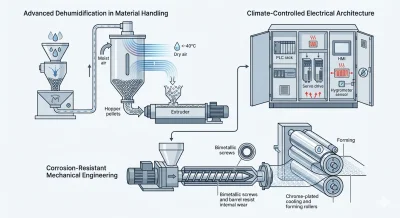
Advanced Dehumidification in Material Handling
Moisture control at the feeding stage is critical to prevent film defects. Ambient humidity alters the properties of raw polymers, causing melt fracture and bubble rupture.
- Deep Dehumidification: Integrating a dehumidifying hopper dryer with a dew point of -40°C or lower is essential.
- Resin Protection: Pre-treatment reduces resin moisture content below 0.01%.
- Application Scope: This ensures defect-free extrusion across all configurations, including the high-output 7-layer high-speed bubble film machine, the 3–5-layer medium-speed bubble film machine, and the 2-layer low-speed bubble film machine.
Climate-Controlled Electrical Architecture
High-speed lines demand precise servo synchronization for accurate layflat control. Electrical systems must be completely isolated from ambient moisture.
- Anti-Condensation Heaters: Integrated heaters work with automated hygrostats to eliminate internal condensation.
- Component Safeguarding: This thermal regulation prevents logic errors in PLCs, servo drives, and HMI systems on high-performance lines, including 2-layer high-speed and 3–5-layer high-speed models.
Corrosion-Resistant Mechanical Engineering
Acidic moisture byproducts accelerate wear on extruders and forming systems, causing gauge variations and surface imperfections.
- Bimetallic Screws: Standardized on 7-layer high-speed and 3–5-layer high-speed units, bimetallic barrels resist corrosion and maintain uniform melt temperatures.
- Chrome-Plated Cooling Rollers: Equipped on models ranging from the 2-layer medium-speed to the 3–5-layer low-speed lines, premium chrome plating prevents surface pitting.
- Quality Assurance: For 2-layer medium-speed and 3–5-layer medium-speed machines, these specialized roller coatings reduce film rejection rates due to surface defects by up to 30% in high-humidity environments.