How Bubble Film Extrusion Machine Stability Directly Impacts Film Quality
2026-05-18
In protective packaging manufacturing, mechanical stability is the foundation of high-performance film production. The operational stability of a bubble film extrusion machine directly regulates polymer melt pressure and cooling rates during the extrusion process. When the bubble film extrusion machine lacks stability, it triggers severe production defects like wrinkling, thin spots, and premature bubble popping.
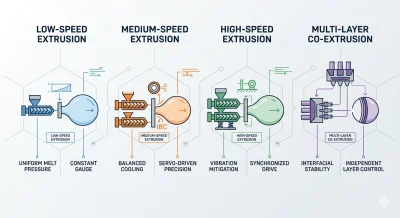
1. Low-Speed Extrusion: Melt Pressure Uniformity
Low-speed operations require precise drive and heating control to prevent melt pressure oscillations.
- Applicable Equipment: 2-layer low-speed bubble film machine, 3–5-layer low-speed bubble film machine.
- The Impact of Instability: Fluctuations in heating zones or drive systems distort bubble geometry. This causes erratic gauge variations and reduces film tensile strength.
- The Role of Stability: Stable machine operation ensures uniform polymer melt delivery. This uniformity allows air bubbles to form with consistent wall thickness and optimal air retention.
2. Medium-Speed Extrusion: Balanced Precision and Cooling
Medium-speed production must balance high throughput with precise cooling rates to maintain film integrity.
- Applicable Equipment: 2-layer medium-speed bubble film machine, 3–5-layer medium-speed bubble film machine.
- The Impact of Instability: Unstable motor speeds or temperature shifts create uneven cooling in the external air ring and internal bubble cooling (IBC) systems. This unevenness forms critical weak spots in the film.
- The Role of Stability: Advanced machine architecture integrates servo-driven extruders with closed-loop PID temperature controllers. Maintaining stability keeps polymer melt pressure within a tight ±0.5% tolerance. This results in uniform film thickness and minimal elongation variation.
3. High-Speed Extrusion: Vibration Mitigation and Synchronized Drive
High-speed lines amplify micro-vibrations, making mechanical rigidity essential for continuous production.
- Applicable Equipment: 2-layer high-speed bubble film machine, 3–5-layer high-speed bubble film machine.
- The Impact of Instability: Micro-vibrations or drive fluctuations trigger rapid cooling inconsistencies and sudden bubble collapse.
- The Role of Stability: High-speed stability relies on heavy-duty gearboxes, precision-ground screws, and advanced web tension control. A synchronized multi-motor drive system matches the haul-off speed exactly to the extruder output. This synchronicity eliminates thin spots, stabilizes the bubble structure, and removes wrinkling defects.
4. Multi-Layer Co-Extrusion: Interfacial Stability
Multi-layer co-extrusion represents the highest demand for operational stability due to complex material interactions.
- Applicable Equipment: multi-layer high-speed bubble film machine.
- The Impact of Instability: Each of the different layers has distinct melt flow indices and temperature profiles. Any deviation in layer-to-layer melt pressure causes interfacial instability, delamination, or gauge bands.
- The Role of Stability: Stability is maintained through independent extruder controls, advanced die designs, and intelligent real-time process monitoring. This precise control enables the extrusion of ultra-thin, high-barrier bubble films with uniform tensile strength and exceptional gas retention.
Conclusion
Whether operating a 2-layer low-speed bubble film machine or a complex 7-layer high-speed bubble film machine, machine stability determines final film quality. Maintaining consistent melt pressure and precise cooling rates eliminates extrusion defects and ensures standardized, reliable bubble film production.