Twin vs Triple Screw: Which Stretch Film Extrusion Machine to Choose?
2026-07-03
In modern packaging manufacturing, stretch film extrusion machines play a critical role in determining the final performance of industrial wrapping films. As demand increases for higher cling force, improved puncture resistance, and more precise gauge control, manufacturers are forced to rethink one of the most important components in the entire production line: the screw configuration inside the extrusion system.
The choice between twin-screw and triple-screw architecture is no longer a minor technical detail. It directly influences melt stability, layer distribution accuracy, production efficiency, and overall energy consumption.
Industry Challenges In Modern Stretch Film Production
One of the most persistent challenges in stretch film extrusion machines is maintaining stable melt quality during continuous high-speed operation. Polyethylene-based materials such as LLDPE, mLLDPE, and VLDPE are highly sensitive to temperature fluctuations and shear conditions. Even minor instability in the melting process can lead to uneven film thickness and inconsistent mechanical performance.
Another major issue is gauge variation. In multi-layer film production, inconsistent thickness distribution often leads to weak points in the final roll, reducing stretchability and increasing the risk of film breakage during pallet wrapping. This not only affects packaging efficiency but also increases material waste.
Layer adhesion is also a common problem in conventional extrusion systems. Without sufficient mixing efficiency, different polymer layers may not bond properly, leading to delamination under stress. This is especially critical in high-performance industrial applications where film integrity is essential.
Finally, energy efficiency and production throughput are often in conflict. Many traditional stretch film extrusion machines consume excessive energy when pushed to higher output levels, without delivering proportional improvements in production capacity. This imbalance limits scalability for manufacturers aiming to expand operations.
Twin-Screw Extrusion Systems And Their Operational Advantages
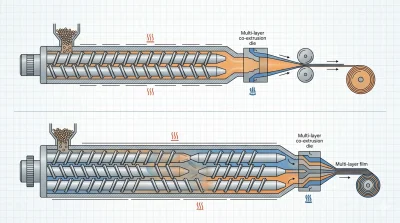
Twin-screw configurations are widely used in standard stretch film extrusion machines, especially in 2-layer and basic 3-layer production lines. Their design focuses on stable material conveying and predictable melt behavior, making them suitable for conventional film applications.
One of the key advantages of twin-screw systems is their stable melt control. The screws work in a coordinated manner to ensure consistent feeding and melting of standard LLDPE formulations. This results in a uniform temperature profile and reliable extrusion output, particularly in mid-volume production environments.
Energy consumption is another strong point. Twin-screw stretch film extrusion machines typically operate with lower specific energy requirements compared to more complex multi-screw systems. This makes them highly cost-effective for manufacturers focused on operational efficiency and controlled production costs.
In terms of application, twin-screw systems are ideal for standard packaging films used in manual or semi-automatic wrapping operations. These systems are commonly integrated into semi-automatic stretch film extrusion machines, where simplicity, durability, and ease of maintenance are prioritized over ultra-high performance.
Maintenance requirements are also relatively straightforward. The mechanical structure of twin-screw systems is less complex, reducing downtime and simplifying long-term service procedures. This contributes to stable production continuity in standard industrial environments.
Triple-Screw Extrusion Systems And Advanced Performance Capability
Triple-screw configurations represent a more advanced technology used in high-performance stretch film extrusion machines designed for demanding industrial applications. These systems are typically integrated into 3-layer advanced lines and 5-layer premium production systems.
The most significant advantage of triple-screw systems is their superior mixing capability. The additional screw element increases shear interaction and enhances melt homogenization. This results in more uniform polymer distribution, which is critical for achieving high-performance film properties such as strong cling, high elongation, and excellent puncture resistance.
Material flexibility is another key strength. Triple-screw stretch film extrusion machines are capable of processing complex polymer blends, including metallocene-based LLDPE, VLDPE, and various tackifier-modified formulations. This enables manufacturers to develop specialized film structures tailored to specific industrial applications.
Layer precision is significantly improved in triple-screw systems. In multi-layer co-extrusion, accurate distribution of each polymer layer is essential for achieving balanced mechanical performance. Triple-screw configurations ensure that each layer is delivered with high consistency, reducing the risk of weak interfaces and structural imbalance.
These systems also support higher production throughput. By optimizing melt flow and reducing resistance in the extrusion process, triple-screw machines can maintain stable output at higher operating speeds. This makes them suitable for fully automated stretch film extrusion machines where continuous high-volume production is required.
Comparison Of 2-Layer, 3-Layer, And 5-Layer Extrusion Configurations
The relationship between screw design and layer structure is a key factor in selecting stretch film extrusion machines.
For 2-layer production systems, twin-screw configurations are typically sufficient. These setups are designed for standard hand-wrap films where moderate mechanical strength and cost efficiency are the primary requirements. The focus is on stable output rather than advanced material engineering.
In 3-layer production systems, both twin-screw and triple-screw configurations can be used depending on performance expectations. Twin-screw systems provide a balanced solution for general industrial packaging, while triple-screw systems offer enhanced film strength and improved material distribution for more demanding applications.
For 5-layer high-performance systems, triple-screw configurations are strongly preferred. These advanced stretch film extrusion machines are designed for ultra-thin downgauging, high stretch ratios, and premium mechanical performance. The additional layers allow for optimized functional separation, such as combining strength, cling, and puncture resistance within a single film structure.
Selecting The Right Stretch Film Extrusion Machine For Your Production Needs
Choosing between twin-screw and triple-screw systems depends primarily on production scale, product requirements, and material complexity.
For manufacturers focused on standard packaging films with controlled investment costs, twin-screw stretch film extrusion machines offer a practical and reliable solution. They deliver stable performance, lower energy consumption, and straightforward maintenance.
For manufacturers targeting high-performance industrial films, especially in multi-layer 5-layer structures, triple-screw systems provide the necessary processing power and material flexibility. These machines support advanced formulations and ensure superior mechanical properties in the final product.
In 3-layer production scenarios, the decision should be based on whether cost efficiency or performance optimization is the priority. Both systems can perform effectively, but their outcomes differ significantly in terms of film quality and production capability.
Conclusion
The screw configuration is one of the most critical design elements in stretch film extrusion machines. Twin-screw systems provide stable, cost-efficient solutions for standard film production, while triple-screw systems deliver advanced mixing capability, higher throughput, and superior multi-layer precision.
As the packaging industry continues to demand stronger, thinner, and more efficient films, selecting the right extrusion architecture becomes a strategic decision rather than a purely technical one. Manufacturers that align their equipment choice with production goals can significantly improve film performance, reduce operational costs, and enhance long-term competitiveness in the global packaging market.