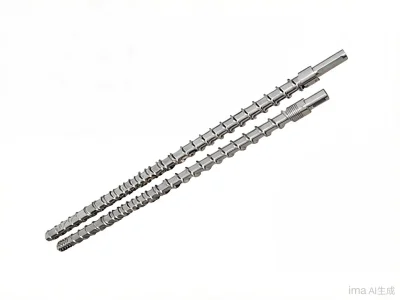
For producers operating a stretch film extrusion machine, screw configuration has a direct influence on how efficiently polymer is plasticized, mixed, and conveyed toward the die. While twin-screw systems remain widely used for conventional film production, triple-screw configurations provide additional mixing and conveying capabilities that can be valuable when manufacturers need tighter melt uniformity, broader formulation flexibility, or higher production stability.
The difference is not simply the number of screws inside the extruder. Screw arrangement, intermeshing geometry, screw design, temperature control, and operating conditions all affect the final result. Understanding these factors helps manufacturers select a stretch film extrusion machine according to the film structure, resin formulation, output target, and quality requirements of each application. Film structure, resin formulation, output targets, and quality requirements each shape which configuration best fits a given application.
Where Twin-Screw Extrusion Can Become a Limitation
A conventional co-rotating twin-screw extruder uses two intermeshing screws to transport polymer through successive conveying, melting, mixing, and pressure-building sections. This configuration offers proven processing performance and can be well suited to standard stretch film production where the formulation and product specifications remain relatively consistent.
However, increasingly demanding film applications can place greater pressure on the mixing section. Stretch film commonly contains different grades of polyethylene together with additives such as tackifiers, antiblock agents, or other performance modifiers. If these materials are not distributed evenly throughout the melt, localized differences in composition can contribute to gels, optical defects, or variations in mechanical performance.
The challenge becomes more noticeable when manufacturers change resin grades, introduce recycled material, adjust additive concentrations, or increase production speed. Under these conditions, the extruder needs to maintain effective plasticization and mixing while delivering a stable melt to the die. A configuration with greater mixing capability can provide additional processing flexibility when these requirements become more demanding.
Why Melt Homogeneity Matters on the Production Floor
The importance of melt quality becomes clearer when looking at real packaging applications.
In tire and rubber goods packaging, stretch film must withstand significant stretching around heavy products with irregular edges and surfaces. Consistent resin distribution helps the finished film maintain more uniform mechanical properties across the web, reducing the likelihood that localized material defects will become weak points during wrapping.
For stone and slab packaging, optical appearance and gauge uniformity can also matter. Customers may need to inspect packaged surfaces through the film, making excessive haze, uneven thickness, or visible defects undesirable. Stable melting and mixing provide a stronger foundation for producing film with consistent optical and physical characteristics.
In beverage can and metal container palletizing, production speed becomes particularly important. High-frequency wrapping operations place continuous demand on film supply, so the extrusion line needs to maintain stable output rather than repeatedly stopping for adjustments or quality issues. The extruder is therefore one part of a larger production system in which melt stability, winding performance, and downstream packaging speed must work together.
How a Triple-Screw Configuration Changes the Process
A triple-screw extrusion system introduces an additional screw into the plasticating section, creating more interaction between the screws and the polymer melt. Depending on the specific screw geometry, the additional processing surfaces can increase the opportunities for material redistribution, melting, and mixing as the polymer moves through the barrel.
This additional mixing capability can be useful when processing formulations that contain multiple resin grades or additives. Instead of relying primarily on downstream process adjustments to compensate for variations in the melt, the extrusion system itself provides more controlled opportunities for homogenization before the material reaches the die.
The actual performance of a triple-screw system still depends on screw design and processing conditions. Screw diameter, L/D ratio, screw element arrangement, barrel temperature, feed rate, and screw speed all contribute to the final melt condition. For this reason, the number of screws should not be considered independently when evaluating a stretch film extrusion machine.
Supporting Consistent Stretch Film Performance
Better melt homogenization can translate into more consistent film characteristics across the production width.
For heavy-duty packaging, more uniform material distribution helps maintain stable tensile and puncture performance. For transparent or semi-transparent stretch film, stable processing can support consistent optical quality. For machine-grade film running through automated wrapping equipment, maintaining predictable thickness and mechanical behavior is important because the film is repeatedly stretched under controlled tension.
This does not mean that every stretch film application requires a triple-screw extruder. A well-designed twin-screw system can still provide effective processing for many formulations. The practical advantage of a triple-screw configuration becomes more relevant when the manufacturer places greater emphasis on formulation flexibility, intensive mixing, or maintaining stable production as processing conditions change.
More Flexibility for Resin and Additive Formulations
Material flexibility is another factor worth considering when comparing screw configurations.
Stretch film manufacturers may work with LLDPE, LDPE, mLLDPE, recycled polyolefin materials, or different combinations of these resins depending on the required film properties and production economics. Additive packages can also vary according to the required cling, puncture resistance, tensile performance, transparency, and other characteristics.
A stronger mixing capability gives the extrusion system more room to accommodate formulation changes while maintaining a homogeneous melt. This can be particularly useful for manufacturers that regularly adjust resin ratios or incorporate recycled content into selected film structures.
Stretch Film Extrusion Machines Built Around Stable Processing
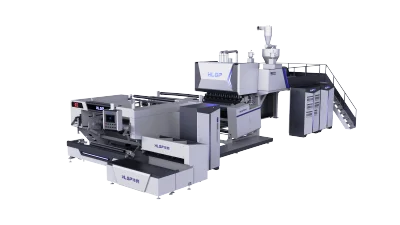
Our stretch film extrusion machines are engineered with these production requirements in mind. The screw and barrel assemblies use nitrided 38CrMoAlA alloy steel to provide wear resistance for continuous extrusion, while the cooling system supports stable temperature management during extended operation.
Depending on the required film structure and production target, our equipment is available in 2-layer, 3-layer, and 5-layer configurations. Screw dimensions are matched to the corresponding extrusion system, with L/D ratios in the 30:1 to 33:1 range to provide sufficient space for melting, mixing, and conveying before the melt reaches the T-die.
For manufacturers producing different grades of stretch film, the multi-layer configuration also provides greater control over how individual resin formulations are assigned within the film structure. This makes it possible to balance properties such as stretchability, puncture resistance, cling, transparency, and material cost according to the intended application.
Our systems are designed for controlled film production with thickness tolerance of approximately ±3%, subject to the specific machine configuration and operating conditions. CE-compliant machine construction is also available for manufacturers serving markets with applicable European equipment requirements.
Whether the target application involves heavy tire and rubber goods, visually inspected stone and slab materials, or high-frequency beverage can and metal container palletizing, the extrusion system needs to provide stable plasticization, controlled melt delivery, and repeatable film quality. By combining suitable screw configuration, temperature control, multi-layer extrusion technology, and application-specific engineering, our stretch film extrusion machines provide a practical foundation for manufacturers seeking consistent output and greater flexibility in modern film production.