Why It Is Safe to Source Stretch Film Extrusion Machines Directly from Chinese Manufacturers
2026-09-16
For years, buying heavy industrial equipment from overseas was often associated with uncertainty. Buyers worried about inconsistent build quality, incompatible components, unclear specifications, and machines that underperformed after installation. These concerns were particularly relevant when sourcing a stretch film extrusion machine, where variations in processing stability, thickness control, or layer distribution can affect film quality and production efficiency.
In many cases, the underlying issue was not geography but manufacturing consistency. Suppliers without standardized production processes or dependable technical support could make international equipment purchases difficult to manage after installation. As China's industrial manufacturing sector has matured, established extrusion equipment manufacturers have increasingly adopted controlled production processes, standardized components, and structured after-sales support. For buyers evaluating overseas equipment today, these developments provide a more practical basis for assessing machine reliability and long-term operating value.
How Machine Reliability Affects Film Production
The reliability of an extrusion line becomes most visible in demanding packaging applications. In e-commerce and warehouse logistics, stretch film must maintain consistent thickness and tension to help stabilize palletized loads during handling and transit. In building material and profile packaging, film needs sufficient puncture resistance and tensile strength to withstand repeated handling and longer transportation cycles.
For industrial and chemical drum packaging, consistent film strength and cling can also contribute to package stability during handling and shipment. Across these applications, the quality of the finished film depends not only on the selected resin formulation but also on how consistently the extrusion line controls temperature, melt flow, thickness, and winding conditions.
This is why equipment reliability should be evaluated beyond the machine's appearance or nominal output. Stable processing, repeatable components, and maintainable systems all influence the consistency of the final film.
Precision Manufacturing and Film Quality
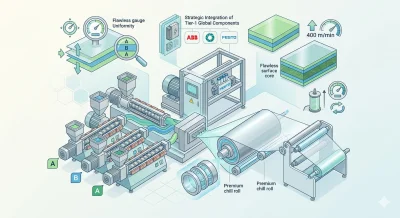
A reliable stretch film extrusion machine starts with controlled manufacturing of its critical components. Established manufacturers use CNC machining and defined inspection procedures to maintain dimensional accuracy in components such as extruder barrels, die heads, chill rolls, and other parts that directly influence film processing.
Consistent component manufacturing helps the extrusion system maintain stable processing conditions across extended production runs. When temperature control, melt distribution, and die performance remain consistent, the line can produce more uniform film thickness and reduce quality variation between production batches.
This is particularly important for multi-layer co-extrusion. Different layers can be designed to contribute specific properties such as stretchability, puncture resistance, cling, or material efficiency. Precise processing and stable layer distribution allow manufacturers to make better use of these different resin functions instead of relying only on increased film thickness to achieve performance targets.
For buyers supplying demanding packaging applications, this manufacturing consistency can be more valuable than a high nominal specification that cannot be maintained during actual production.
Automation Components and Maintenance
Another consideration is how easily the machine can be integrated into an existing production environment. A well-designed extrusion line can use widely adopted industrial components across its control, drive, and pneumatic systems, making routine maintenance more familiar for technicians.
PLC-based control systems, servo drives, inverters, sensors, and pneumatic components are common across modern industrial equipment. When appropriately selected and configured, these components can make troubleshooting and replacement more straightforward than systems that depend heavily on uncommon proprietary parts.
This does not mean every component will necessarily be available locally. However, using established industrial component standards can reduce dependence on highly specialized parts and give maintenance teams more practical options when servicing the equipment.
For continuous packaging operations, this consideration matters because maintenance requirements are inevitable over the working life of an extrusion line. A machine that is easier to inspect, service, and maintain can help reduce the operational impact of routine component replacement.
Configurations for Different Production Requirements
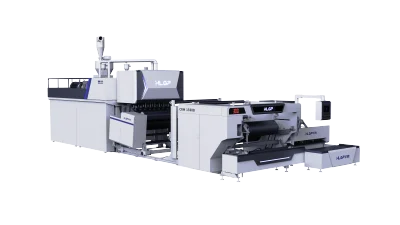
Production requirements vary significantly between manufacturers, so equipment configuration is another important part of the purchasing decision. Modern stretch film extrusion lines are available in two-layer, three-layer, and more advanced multi-layer configurations, allowing the equipment to be matched to the required film structure and production scale.
Two-layer systems can provide a relatively straightforward configuration for applications where production flexibility and cost control are priorities. Three-layer and other multi-layer co-extrusion systems provide greater control over layer functions and resin combinations, which can be useful when manufacturers need to balance stretch performance, puncture resistance, cling, clarity, and material consumption.
Automation levels can also vary. Semi-automatic equipment may suit operations with changing production volumes or more manual handling requirements, while fully automatic systems can integrate automated thickness control, synchronized winding, and other production functions where appropriate.
The key consideration is not simply choosing the most advanced configuration. Matching the machine structure, automation level, film width, layer configuration, and production requirements can help avoid investing in equipment that is either unnecessarily complex or unable to meet the intended application.
Technical Support After Installation
The quality of after-sales support is another important part of international equipment purchasing. Installation is only the beginning of a machine's operating life, and technical assistance may be required for commissioning, parameter adjustment, troubleshooting, maintenance, or process optimization.
Modern PLC-based systems can also support remote diagnostics and technical assistance in appropriate configurations. When machine data and operating conditions can be reviewed remotely, technical teams may be able to identify common control or processing issues without requiring an immediate on-site visit.
A structured spare parts system is equally important. Providing recommended spare parts, maintenance guidance, and technical documentation gives operators a clearer way to prepare for routine wear and unexpected