ROI of Upgrading to High-Speed Multi-Layer Stretch Film Extrusion Machines
2026-07-02
In today’s global packaging industry, manufacturers are under increasing pressure to reduce production costs while improving output capacity and maintaining consistent film quality. Stretch film has become a critical material in logistics, warehousing, and industrial packaging, and its performance directly impacts load stability and transportation safety. As demand continues to grow, many producers are re-evaluating their production systems and upgrading to stretch film extrusion machines that offer higher efficiency and multi-layer co-extrusion technology.
Upgrading from conventional single-layer or low-speed equipment to advanced high-speed multi-layer systems is no longer just a technical improvement. It has become a strategic investment decision that directly affects long-term return on investment (ROI), operational stability, and market competitiveness.
Challenges Faced by Traditional Stretch Film Production Systems
Conventional stretch film production lines often struggle to meet modern industrial requirements. One of the most common issues is limited production capacity. Older extrusion systems typically operate at lower line speeds, which restricts daily output and makes it difficult for manufacturers to handle large-scale or urgent orders. In highly competitive markets, this bottleneck often results in missed business opportunities.
Another critical problem is inconsistent film quality. Traditional machines frequently experience gauge variation across the film width, leading to uneven thickness distribution. This directly affects tensile strength, puncture resistance, and stretch performance. As a result, end users may face film breakage during pallet wrapping or transportation instability, increasing operational risks.
Material inefficiency is also a major concern. Single-layer structures do not allow for optimized material distribution, forcing manufacturers to use higher resin consumption to achieve acceptable strength. This leads to increased production costs and reduced profit margins. In addition, older systems tend to generate higher scrap rates due to unstable extrusion conditions and manual adjustments.
Energy consumption and maintenance costs further reduce profitability. Many legacy stretch film extrusion machines lack modern energy-saving designs and rely on outdated mechanical systems that require frequent maintenance. Downtime not only increases operational costs but also disrupts production schedules and delivery commitments.
Limitations of Conventional Production Technology
The fundamental limitation of traditional systems lies in their inability to balance speed, quality, and cost efficiency simultaneously. Increasing production speed alone often leads to instability in melt flow and film formation. Without advanced control systems, operators must constantly adjust machine parameters, increasing labor dependency and inconsistency.
Single-layer film structures also limit performance optimization. Since all functional requirements must be achieved within one layer, manufacturers cannot independently optimize properties such as cling strength, toughness, and rigidity. This results in over-engineering through excessive material usage, which further increases production costs.
These structural and technological constraints highlight why many manufacturers are shifting toward advanced multi-layer co-extrusion systems.
Advantages of High-Speed Multi-Layer Stretch Film Extrusion Technology
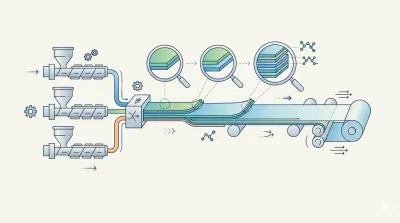
Modern Stretch Film Extrusion Machines with multi-layer co-extrusion capability introduce a completely different production approach. Instead of relying on a single homogeneous layer, these systems combine multiple functional layers within one film structure. Each layer serves a specific purpose, such as providing puncture resistance, improving elasticity, or enhancing surface cling properties.
This layered architecture enables material optimization at a molecular level. For example, high-performance resins can be strategically placed only where mechanical strength is required, while lower-cost materials can be used in supporting layers. This significantly reduces raw material costs while maintaining or even improving overall film performance.
High-speed extrusion capability is another major advantage. Advanced screw design, optimized die heads, and precise temperature control systems allow stable high-output production without compromising quality. Compared to conventional systems, modern multi-layer machines can significantly increase throughput while maintaining consistent film thickness and uniformity.
Integrated PLC control systems further enhance production stability. Automated control of temperature, pressure, and line speed ensures that the extrusion process remains within optimal parameters at all times. This reduces reliance on manual operation and minimizes human error, resulting in more stable production output and improved product consistency.
Energy efficiency is also significantly improved. Optimized heating systems and efficient motor drives reduce overall power consumption per kilogram of film produced. At the same time, improved process stability reduces material waste and startup losses.
Key Advantages of Our Advanced Stretch Film Extrusion Machines
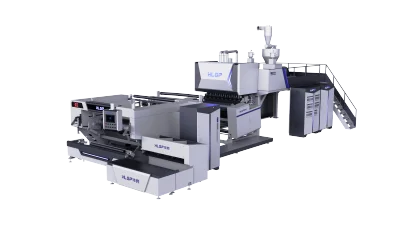
Our latest generation of Stretch Film Extrusion Machines is engineered specifically for high-performance industrial production environments. The system integrates high-precision co-extrusion die technology with advanced servo-driven components to ensure maximum stability and efficiency.
The extrusion system is designed to maintain stable melt flow even under continuous high-speed operation. This ensures consistent film quality over long production cycles without fluctuations in thickness or optical clarity. The cooling and traction systems are optimized to support rapid film formation while preventing deformation or instability.
Another key advantage is production scalability. The machine is capable of supporting multi-layer configurations, typically ranging from three to seven layers depending on application requirements. This flexibility allows manufacturers to produce a wide range of stretch film grades, from standard pallet wrapping films to high-performance industrial packaging films.
Operational efficiency is further enhanced through intelligent automation. The PLC control system continuously monitors production parameters and automatically adjusts operating conditions to maintain optimal performance. This reduces the need for manual intervention and significantly lowers the risk of production errors.
In addition, our system is designed for long-term reliability. Heavy-duty mechanical structures and wear-resistant components extend machine lifespan and reduce maintenance frequency. This contributes directly to lower total cost of ownership over the equipment lifecycle.
Return on Investment Analysis for Upgraded Systems
The ROI of upgrading to advanced Stretch Film Extrusion Machines is driven by three primary factors: cost reduction, productivity improvement, and profit margin expansion.
Raw material savings represent one of the most significant benefits. Multi-layer film structures allow precise material allocation, reducing unnecessary resin usage while maintaining mechanical performance. In many cases, manufacturers can achieve noticeable material savings per ton of output.
Production efficiency improvements also play a critical role. Higher line speeds combined with reduced downtime lead to significantly increased daily output. This allows manufacturers to fulfill more orders within the same operational timeframe, improving revenue potential without expanding factory footprint.
Waste reduction further enhances profitability. Stable extrusion conditions and precise control systems reduce startup scrap and production rejects. Over time, this contributes to substantial cost savings, especially in high-volume manufacturing environments.
When combining these benefits, many manufacturers experience a typical investment payback period ranging from several months to under two years, depending on production scale, raw material costs, and utilization rate. This makes high-speed multi-layer systems one of the most financially attractive upgrades in modern packaging production.
Industrial Applications and Market Demand
High-performance stretch film is widely used across logistics, warehousing, manufacturing, and export packaging industries. It is essential for pallet wrapping, cargo stabilization, and protecting goods during long-distance transportation.
As global supply chains become more complex, demand for stronger, thinner, and more cost-efficient packaging materials continues to increase. This has accelerated the adoption of advanced Stretch Film Extrusion Machines, particularly in regions with high export volumes and automated warehouse systems.
Upgrading to high-speed multi-layer Stretch Film Extrusion Machines represents a strategic shift from traditional manufacturing limitations to modern, data-driven, and efficiency-optimized production systems. By combining advanced co-extrusion technology, intelligent automation, and high-speed stability, manufacturers can significantly improve output quality while reducing overall production costs.
The ROI is not limited to direct cost savings. It also includes improved market competitiveness, stronger customer satisfaction, and greater flexibility in product offerings. As the packaging industry continues to evolve, investing in advanced extrusion technology is becoming a necessary step for sustainable growth and long-term profitability.