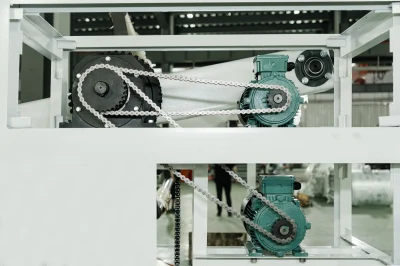
Advantages of Winding System Against Belt Drive
2026-08-24
The winding unit rarely gets as much attention as the extruder or the die, but it is often what determines whether a production run ends in tightly formed, sellable rolls or in film that has to be reworked. Tension control and positioning accuracy at this stage carry directly through to roll quality, and the drive mechanism behind that control matters more than most operators realize until it starts to fail.
Where Belt-Drive Winding Falls Short
Belt drive systems remain common because they are simple to build and inexpensive to install, and for lighter, lower-precision applications that simplicity is not necessarily a problem. The trouble shows up over time rather than on day one. Belts stretch, slip, and wear as they run continuously, and as that degradation progresses, transmission accuracy drops along with it. Positioning errors that start out negligible can grow to exceed plus or minus one millimeter, and once that happens, tension control becomes noticeably less predictable.
The downstream effects are hard to miss once they start. Uneven winding tension produces loose rolls, misaligned layers, and defects such as telescoping, where the roll shifts and the film edges no longer line up cleanly. None of this necessarily shows up as a sudden failure. It tends to creep in gradually as the belt ages, which makes it easy to attribute early symptoms to something else, right up until roll consistency has already dropped enough to affect customer-facing quality.
Maintenance schedules compound the issue. Belts in continuous industrial use typically need replacement every six to eight months, and each replacement means downtime plus the labor to source, install, and re-calibrate a new belt. On a line running near capacity, that recurring maintenance window is not a minor inconvenience, it is a real cost against total output.
Why Roll Quality Matters in Bubble Film Production
Bubble film earns its place in packaging because it protects effectively while staying lightweight and cost-efficient, which is exactly why it moves in high volume through e-commerce, appliance, and industrial protective packaging channels. At that kind of volume, roll quality is not a cosmetic detail. A loose or misaligned roll slows down slitting and rewinding, complicates downstream converting, and in the worst cases reaches a customer in a condition that undermines confidence in the product regardless of how well the film itself performed during extrusion. The winding stage is effectively where all of the upstream work in a bubble film extrusion machine either gets locked in or gets undone.
| Comparison Point | Belt Drive | Worm Gear Winding |
|---|---|---|
| Transmission Method | Indirect (belt tension) | Direct gear-to-wheel engagement |
| Backlash | Present, increases with wear | Eliminated |
| Positioning Accuracy | Can exceed ±1 mm as belt degrades | Up to ±0.1 mm |
| Tension Stability | Decreases over time | Consistently stable |
| Typical Service Life | Belt replacement every 6–8 months | Significantly longer, hardened-material construction |
| Lubrication | Not applicable / exposed | Enclosed lubrication structure |
| Common Roll Defects | Loose rolls, telescoping, misalignment | Tightly wound, uniform rolls |
Worm Gear Winding: Precision Without Backlash
This is where a worm gear winding system changes the equation. Instead of relying on a belt to transmit motion indirectly, the worm gear and wheel engage directly, and that direct engagement removes backlash from the equation entirely. Backlash is the small amount of play that exists in most indirect transmission systems, and while it may sound minor, it is exactly the kind of imprecision that accumulates into visible tension and positioning errors over a winding cycle.
With backlash eliminated, motion control becomes far more stable and far more accurate. Where a degraded belt drive can produce positioning errors beyond one millimeter, a worm gear system is capable of holding positioning accuracy to within roughly a tenth of a millimeter. That level of precision keeps tension consistent throughout the winding process, which is what actually produces tightly wound, uniform rolls rather than rolls that look acceptable on the outside but are inconsistent underneath.
The practical value of this precision compounds as line speed increases. A small tension deviation that might be tolerable at low speed becomes a larger and more visible defect at high speed, so the stability a worm gear system provides matters most exactly when production demands are highest, which is often when a belt-driven system is least able to keep up.
There is also a cumulative effect worth considering over the life of a roll. Winding tension does not just affect the outer layers of a roll, it influences how evenly pressure is distributed all the way through to the core. A belt drive that drifts slightly out of calibration tends to produce that drift consistently, layer after layer, so the inconsistency compounds rather than averaging out. A worm gear system holding steady positioning accuracy avoids that compounding effect entirely, which is part of why the difference in roll quality becomes more noticeable the larger the roll diameter gets.
Built to Last: Durability and Operational Performance
Precision is only half the advantage. Worm gear systems are typically built from hardened materials and operate with minimal friction, which is a large part of why they hold up so much longer than a belt under continuous industrial use. Rather than facing the six-to-eight-month replacement cycle common to belt drives, a worm gear winding system is designed for long-term performance with meaningfully less maintenance required over its working life. An enclosed lubrication structure adds another layer of reliability, keeping the mechanism running smoothly without the frequent manual attention that exposed, friction-based systems typically demand.
That mechanical stability shows up in day-to-day operation as well. Reduced vibration and fewer transmission errors translate into better roll alignment and more consistent roll formation, which in turn improves compatibility with whatever slitting, rewinding, or converting process comes next. A winding system that behaves predictably makes every downstream step easier to plan around, while one that drifts in accuracy forces operators to build in extra tolerance and extra inspection just to catch problems before they reach the customer.
What This Means for Long-Term Production
Taken together, the case for a worm gear winding system over a belt drive comes down to three connected advantages: tighter positioning accuracy, longer mechanical service life, and more stable operation at the speeds modern bubble film production demands. None of these advantages exist in isolation. Precision without durability would mean accurate winding early on that degrades within months, and durability without precision would mean a system that lasts a long time while still producing inconsistent rolls. It is the combination of both that actually changes production outcomes.
We build the winding units on our bubble film extrusion machines around worm gear transmission specifically because of this combination, since roll quality is not something we consider separately from film quality, it is the final step that determines whether everything upstream in the extrusion process actually reaches the customer intact. If your current line is dealing with loose rolls, telescoping, or a winding system that needs constant belt replacement, the underlying issue is very likely the transmission mechanism itself rather than anything in your material or process settings. Our machines are engineered with precision worm gear winding to keep tension and roll formation consistent over years of continuous operation, not just the first few months. If you would like to talk through how this fits into your production line, we are glad to walk through the details of our bubble film machine series with you.