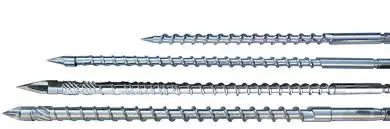
In cast stretch film production, extrusion performance directly impacts stretch film quality, production efficiency, and operational stability. Among key design parameters, screw diameter plays a critical role in determining extrusion capacity, polymer processing, and equipment configuration.
Screw diameter is the outside diameter of the extrusion screw inside the barrel. Together with screw design, speed, motor power, and the length-to-diameter (L/D) ratio, it determines how effectively polymer resins are conveyed, melted, mixed, and delivered to the casting die.
Selecting the right screw diameter is essential because production demands dictate extrusion capacities. A machine designed for high-volume industrial stretch film production requires a different screw configuration than equipment used for specialized multi-layer stretch films or low-output applications.
A properly matched screw diameter enables manufacturers to achieve stable melt pressure, consistent stretch film thickness, and efficient material utilization while avoiding excess energy consumption and over-capitalization.
How Screw Diameter Affects Extrusion Capacity and Output
Screw diameter directly impacts extrusion output. A larger screw delivers greater conveying volume due to its larger channel cross-sectional area. This allows more polymer to be processed with each screw revolution.
This larger processing volume enables manufacturers to achieve higher hourly output while maintaining stable extrusion conditions. Consequently, larger screws are ideal for applications such as heavy-duty stretch film, industrial wrapping stretch film, and large-scale packaging.
However, a larger screw diameter alone will not guarantee optimal performance. The extrusion system must be engineered as a complete unit, balancing motor power, gearbox capacity, heating and cooling capabilities, and screw geometry. An oversized screw without proper system integration can lead to inefficient operation and unstable processing.
Small Diameter Screws for Precision Multi-Layer Applications
While large screws excel in high-output production, smaller screw diameters offer distinct advantages in precision extrusion applications.
In multi-layer stretch film production, individual extrusion units supply distinct functional layers. Some layers require only minimal material throughput, such as adhesive, cling, color, or performance-enhancing additives. In these cases, smaller diameter screws ensure precise dosing and tighter process control.
For example, auxiliary extruders with screw diameters ranging from 50 to 80mm deliver precise output control for thin functional layers. Their smaller barrel volume shortens residence time, minimizing thermal degradation of heat-sensitive additives and expensive specialty resins.
This approach enables manufacturers to optimize stretch film structures while controlling material costs. Rather than relying on uniform screw sizes across all positions, a properly configured co-extrusion line pairs different screw sizes to achieve both production efficiency and precise layer ratios.
Relationship Between Screw Diameter and Melt Quality
Although output capacity is critical, stretch film quality depends heavily on melt stability prior to casting. Screw diameter influences not only throughput but also heat transfer, compression, and mixing inside the barrel.
A properly sized screw diameter provides sufficient processing capacity to completely melt and homogenize polymers such as LLDPE, mLLDPE, and other polyethylene-based resins. Stable melt conditions minimize common stretch film defects, including gels, uneven clarity, thickness fluctuations, and inconsistent mechanical properties.
If the screw diameter is too small for the required output, the extruder must operate at excessive speeds. Elevated rotational speeds increase shear heating and complicate thermal management, especially during continuous production.
Conversely, if the screw diameter is too large for the required output, the material faces excessive residence time inside the barrel. For certain resin formulations, extended thermal exposure compromises melt stability and heightens the risk of resin degradation.
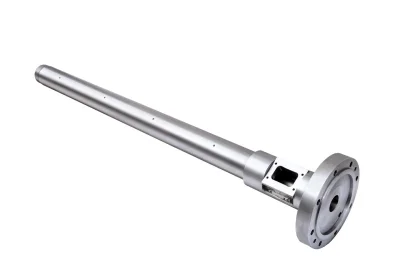
Balancing Screw Diameter with L/D Ratio Design
Screw diameter cannot be evaluated in isolation from the length-to-diameter (L/D) ratio. The L/D ratio determines the effective processing length, while the diameter determines material handling capacity.
In stretch film extrusion, typical L/D ratios range from 30:1 to 33:1. This configuration provides sufficient length for polymer melting, mixing, and pressure stabilization before the melt enters the T-die.
When screw diameter and L/D ratio are optimally balanced, the extrusion system delivers stable melt temperature and uniform viscosity. This is especially important for cast stretch film production because small variations in melt conditions can compromise gauge control and winding performance.
For example, a larger diameter screw in a high-output machine requires an appropriately scaled barrel length to maintain adequate residence time. Simply increasing screw diameter without considering the complete extrusion design can compromise mixing efficiency and stretch film consistency.
Impact on Energy Efficiency and Equipment Stability
Screw diameter also impacts the mechanical and electrical requirements of a stretch film line. Larger screws require higher torque to process higher material volumes, requiring appropriately sized motors, gearboxes, and drive trains.
When the screw diameter is properly matched to production requirements, the machine operates within an efficient operating window. This maintains stable motor loading, reduces energy waste, and improves long-term equipment reliability.
Stable extrusion conditions also reduce process interruptions caused by manual adjustments. A well-designed screw and barrel system ensures consistent stretch film quality during extended production runs, boosting overall manufacturing efficiency.
For high-volume stretch film producers, these gains can significantly lower production costs, as material utilization and machine uptime directly drive profitability.
Key Considerations for Screw Diameter Selection in Stretch Film Machines
Choosing the optimal screw diameter depends on several factors, including stretch film width, target output, layer structure, resin formulations, and production objectives.
A high-output industrial stretch film line requires a larger diameter screw to achieve the necessary throughput, while a multi-layer co-extrusion system combines different screw sizes to ensure precise layer control.
Manufacturers should also evaluate the interplay among screw diameter, L/D ratio, extrusion motor capacity, the temperature control system, and die design. These components must work in tandem to achieve stable polymer processing and consistent stretch film performance.
Advanced Screw Design Solutions for Stretch Film Manufacturing
Screw diameter is a fundamental parameter that directly impacts line performance. By selecting the optimal screw size and pairing it with optimized screw geometry, precise temperature control, and reliable extrusion components, manufacturers can achieve stable output and superior stretch film quality.
Our stretch film lines feature precisely matched extrusion systems to support diverse production requirements, from standard industrial stretch film to advanced multi-layer applications. Through tailored screw diameter selection, optimized L/D ratio design, and precise process control, our systems enable manufacturers to enhance stretch film consistency, reduce resin waste, and maintain consistent production performance.