In stretch film production, extrusion stability dictates final film quality, production efficiency, and material utilization. Among the key technical parameters of an extruder, the screw length-to-diameter ratio (L/D ratio) is the primary indicator of the system’s plasticizing and mixing capability.
Simply put,the L/D ratio is the effective working length of the extrusion screw divided by it’s diameter. For example, an L/D ratio of 33:1 means the screw is 33 times longer than its diameter. This specific design parameter directly affects how polymer melts, how long it stays in the barrel(residence time), how well it mixes, and how stable the melt pressure remains before entering the casting die.
In modern multi-layer co-extrusion applications, an optimized L/D ratio ensures consistent polymer processing and stable film output. This underlying stability is what ultimately allows manufacturers to produce films with uniform thickness,high transparency and reliable tensile strength.
The Role of L/D Ratio in Stretch Film Extrusion Performance
The production of high-quality stretch film requires precise control over polymer melting and homogenization. Common resin formulations such as LLDPE, mLLDPE, LDPE, recycled polymers, and functional additives have varing melting points and flow behaviors. If the extrusion system cannot provide sufficient residence time and shear energy, these materials will fail to form a completely homogeneous melt.
Insufficient plasticization manifests as various film defects, including gel particles, uneven optical clarity, gauge variation, and inconsistent mechanical properties. These defects cause film breakage, especially during automatic pallet wrapping operations where the film is subjected to continuous tension and rapid stretching forces.
The L/D ratio provides the necessary processing length inside the barrel for gradual melting, mixing, and pressure stabilization. A properly proportioned screw design allows the polymer to pass smoothly through different functional zones, including feeding, compression, melting, mixing, and metering. This controlled thermal-mechanical progression improves melt uniformity before the material reaches the T-die.
In a stretch film making machine, achieving stable melt conditions is especially important because even small variations in polymer viscosity can influence film thickness accuracy, winding quality, and final roll performance.
Advantages of a 33:1 L/D Ratio Extrusion Design
A 33:1 L/D ratio is widely considered an ideal configuration for high-performance cast film extrusion, offering an effective balance between plasticization efficiency, mixing capability, and energy consumption.
With this screw design, polymer materials have enough residence time inside the heated barrel to achieve complete melting and uniform dispersion. This allows for controlled shear generation, enabling different resin components blend evenly while maintaining stable melt material characteristics.
This advantage is especially critical in multi-layer stretch film production.Different layers often use distinct resin formulations to target specific functions- such as enhanced puncture resistance, higher stretch ratio, superior cling properties, or optimized cost. A thermally and mechanically stable extrusion system ensures each layer maintains a consistent composition before entering the co-extrusion feedblock and T-die.
Additionally, a 33:1 L/D ratio improves melt pressure stability. Steady pressure conditions minimize output fluctuations during casting, resulting in uniform film gauge across the entire web width. This yields superior roll appearance, reduced edge-trim waste, and optimizes overall material efficiency.
Improving Polymer Mixing and Film Quality Through Optimized Screw Design
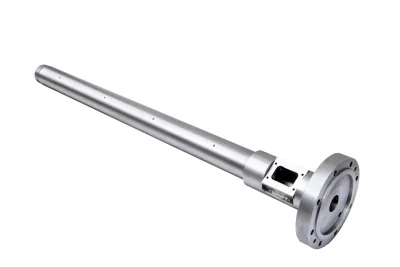
The screw is not simply a conveying component; it is the core processing element responsible for converting solid polymer pellets into a homogeneous melt. In a cast stretch film line, screw geometry and L/D ratio work together to determine how effectively raw materials are processed.
During extrusion, polymer pellets gradually absorb heat both from the barrel heating zones and mechanical shear generated by screw rotation. A properly designed screw provides sufficient compression and mixing action to eliminate unmelts and improve overall blend distribution.
For manufacturers using materials such as metallocene polyethylene (mLLDPE) or recycled polyolefin blends, effective mixing is particularly important. Recycled materials can exhibit variations in molecular weight and melt flow index. Without sufficient homogenization, these variations may contribute to weak points within the film matrix.
A 33:1 L/D ratio extruder provides the extended processing length needed to improve homogenization and promote more consistent melt properties. This can help manufacturers maintain consistent film performance while optimizing raw material costs through more flexible resin selection.
Relationship Between L/D Ratio and Multi-Layer Co-Extrusion Performance
However, successful multi-layer production depends heavily on stable extrusion conditions. Each extruder in the co-extrusion system must deliver a consistent melt flow so that individual resin layers can combine evenly inside the co-extrusion feed block and casting die.
An inadequate screw design with an insufficient L/D ratio can lead to unstable melting, resulting in uneven layer distribution and inconsistent mechanical properties across the stretch film. In contrast, an optimized 33:1 L/D ratio provides more uniform polymer processing, helping each extrusion unit maintain a steady output rate and melt quality.
This stability is essential for industrial stretch film applications, where finished rolls must perform consistently during high-speed wrapping operations, long-distance transportation, and demanding warehouse environments.
How L/D Ratio Influences Influence Energy Efficiency and Equipment Reliability
Beyond improving film quality, the L/D ratio also affects the overall operating efficiency of a stretch film production line. A well-designed extrusion system achieves steady output without requiring excessive screw speeds or inducing unnecessary mechanical stress.
When polymer melting and mixing occur efficiently, the extruder motor operates under balanced load conditions. Stable melt pressure reduces sudden torque fluctuations, which protects critical mechanical components like gearboxes, bearings, and drive systems from premature wear.
In addition, optimized melting efficiency reduces the risk of polymer degradation caused by excessive shear or uncontrolled temperature spikes. This minimizes carbon buildup inside the barrel, reducing maintenance downtime and cleaning frequency during long-term production runs.
Advanced Extrusion Engineering for Reliable Stretch Film Production
The L/D ratio is a fundamental parameter that defines the extrusion capability of a stretch film line. By optimizing screw length, diameter, and processing conditions, manufacturers achieve superior control over polymer melting behavior and produce higher-performance stretch film.
For modern packaging producers, investing in advanced extrusion technology translates to enhanced product consistency, lower scrap rates, and the capability to meet increasingly demanding market requirements. A line equipped with a well-designed 33:1 L/D ratio extruder provides the processing stability required for efficient cast stretch film manufacturing.
With deep engineering expertise and advanced equipment design, our stretch film extrusion solutions integrate optimized screw geometries, precision T-die technology, and intelligent control systems to help manufacturers boost productivity and maintain consistent film quality in competitive global markets.