Quality Meets Affordability: How China’s Supply Chain Lowers Stretch Film Extrusion Machine Costs
2026-05-22
Industrial film manufacturing relies on specialized equipment configurations to achieve precise elongation, puncture resistance, and tensile strength. Co-extrusion technology requires extreme mechanical alignment and synchronized automation:
- 3-layer stretch film machine: Utilizes a three-screw configuration to separate the cling layer, core structural layer, and release layer.
- 5-layer stretch film machine: Engineered for advanced film structures, maximizing mechanical strength while downgauging film thickness.
- 2-layer stretch film machine: Optimized for standard pallet wrap applications, focusing on consistent output and reliable layer bonding.
How Vertically Integrated Supply Chains Optimize Costs
The cost efficiency of modern cast film lines stems directly from localized industrial clusters. Vertically integrated supply chains streamline the production of critical mechanical and electrical assemblies, lowering inbound material costs by 20% to 35%.
1. High-Grade Metallurgical Component Sourcing
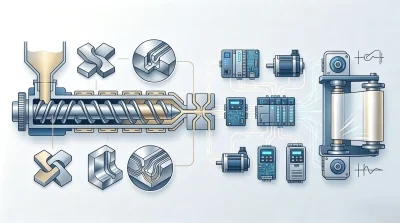
Exacting tolerances require premium raw materials. China's domestic supply network provides immediate access to specialized alloys. Screw and barrel assemblies are forged from bimetallic alloys to resist abrasive wear. T-dies and feedblocks are machined from premium chromium-moly steel with micro-mirror surface polishing to eliminate polymer degradation.
2. Embedded Automation and OEM Clusters
Manufacturing hubs cluster precision component suppliers close to assembly plants. Servo motors, programmable logic controllers (PLCs), and variable frequency drives (VFDs) are sourced directly from mature local OEM centers. This proximity trims logistical overhead, reduces transit times, and ensures seamless protocol integration.
Extrusion Precision and Engineering Capabilities
Cost reduction does not compromise mechanical tolerance. Advanced manufacturing facilities leverage strict quality management systems to produce extrusion systems that match global engineering standards.
The advanced 3-layer stretch film machine line incorporates proprietary co-extrusion feedblocks and spiral mandrel dies to achieve thickness variations below ±3%. For high-speed production, 5-layer stretch film machine systems utilize closed-loop auto-profiling die technology, maintaining gauge consistency at mechanical line speeds up to 250m/min. Continuous extrusion is supported by multi-zone heaters and high-torque parallel-shaft gearboxes to ensure stable polymer melting.
Modular Configurations and Process Automation
Fully Automatic Operational Workflow
The high-output fully automatic stretch film machine features a centralized touchscreen human-machine interface (HMI) that coordinates the entire production workflow:
- Automatic roll changing: Dual-axis or four-axis turret winders execute high-speed roll transfers without stopping the line.
- In-line recycling: Edge trim winders feed scrap back into the secondary extruder, ensuring zero material waste.
- Tension control: Closed-loop load cells monitor film tension to prevent roll telescoping during winding.
Semi-Automatic and Modular Systems
The semi-automatic stretch film machine provides a modular architectural alternative for short-run batches. It retains the exact same screw geometry and T-die precision as fully automated lines, but utilizes manual splice tables to reduce initial infrastructure costs.