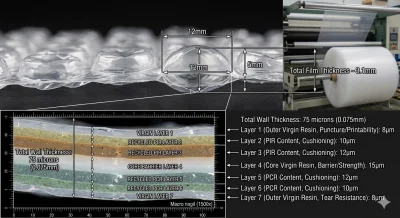
For procurement specialists in protective packaging, inconsistent film thickness isn't just a quality issue—it's a direct threat to profitability. Variations beyond ±5% tolerance lead to material waste, unreliable cushioning performance, and customer rejections. This precision gap becomes critical when incorporating recycled polymers, which introduce viscosity fluctuations that conventional single-layer extruders cannot control.
The engineering solution lies in a harmonized seven-layer co-extrusion architecture. Each independent extruder feeds a dedicated layer (typically A/B/C/D/C/B/A structure), allowing strategic placement of virgin and recycled materials. The core innovation is the integration of a centralized PLC with distributed thermal control. Each barrel and die zone maintains temperature within ±1°C, stabilizing polymer melt viscosity before merging. This is coupled with Automatic Gauge Control (AGC) using real-time beta-ray thickness sensors. The system creates a closed-loop where micro-adjustments to extruder RPMs and die lip actuators are made 100 times per second, actively compensating for material flow inconsistencies.
On the production floor, this translates to tangible ROI. The guaranteed ±3% thickness tolerance eliminates over-engineering—you use the minimum material required for specification. For a line running 500 kg/hour, this precision saves over 36 tons of resin monthly. The ≥99.5% bubble integrity rate, achieved through precisely calibrated air injection and nip roll pressure, virtually eliminates downtime from web breaks. Furthermore, the ability to consistently run with 50% post-industrial recycled content in inner layers without sacrificing surface quality or seal strength directly cuts raw material costs by 18-22%, a decisive competitive advantage in tender bids.
The technology's scalability defines its future. As e-commerce demands lighter yet stronger films, the platform's data-logging capability enables predictive adjustment for new polymer blends. The next evolution integrates AI-driven rheology models, where the PLC anticipates viscosity shifts based on recycled feedstock lot analysis, proactively adjusting thermal profiles before the film exits the die. This isn't just a machine; it's a precision asset that de-risks your supply chain, future-proofs your operation against volatile virgin resin prices, and delivers the consistent quality that builds brand trust in every shipped product.