Technological advancements in the plastic extrusion sector have redefined the capabilities of the modern stretch film making machine. Selecting between semi-automatic and fully automatic configurations is a strategic decision that directly dictates production throughput, film consistency, and overall operational scalability.
Precision Control and Process Integration
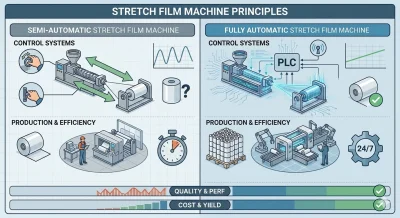
The fundamental difference lies in the control systems. A semi-automatic stretch film making machine typically requires manual adjustments for extrusion temperature, film gauge, and winding tension. These machines rely heavily on operator skill to maintain consistent quality.
In contrast, a fully automatic stretch film making machine utilizes advanced closed-loop feedback systems. Sensors monitor melt pressure and take-up speed in real-time, allowing the system to automatically adjust parameters to achieve thickness tolerances within ±1 micron. This automation ensures superior tensile strength and puncture resistance across every roll.
Production Throughput and Efficiency
Output capacity and labor requirements vary significantly between the two systems. Semi-automatic systems generally produce 80-100kg/h, making them suitable for small batches or specialized runs requiring frequent changes in film color or width.
Automatic machines are designed for high-volume, 24/7 operation, achieving continuous output rates of 320-600kg/h. These units feature automatic roll change, auto-core loading, and integrated edge trimming systems. By minimizing manual intervention, automatic lines significantly reduce per-unit labor costs and maximize total yield.
Maintenance and Industry 4.0 Readiness
While semi-automatic designs use simpler mechanics, the frequent manual handling of winding spindles and rollers often leads to accelerated wear. Automatic machines solve this by incorporating preventive diagnostics that monitor motor current and bearing temperatures to prevent unplanned downtime.
Modern automatic stretch film manufacturing systems also feature IoT connectivity and data logging. These adaptive algorithms optimize stretch ratios even when using recycled resins, ensuring the machine meets Industry 4.0 standards for smart manufacturing and material sustainability.