Operational Tips for Semi-Auto Stretch Film Extrusion Machine

2026-08-13

For packaging manufacturers and converters, the quality of stretch film is only as good as the machine that produces it. Yet many production teams still struggle with inconsistent gauge, poor clarity, frequent downtime, and premature equipment wear — problems that often trace back not to raw materials, but to how the extrusion line itself is operated and maintained. Understanding the correct operational discipline for a stretch film extrusion machine is essential for any facility that wants to reduce waste, extend equipment lifespan, and consistently deliver film that meets today's demanding packaging standards.

Common Challenges in Traditional Stretch Film Production

Many stretch film producers, especially those relying on older or poorly maintained equipment, encounter a recurring set of problems. Melt temperature fluctuations are among the most frequent culprits behind inconsistent resin flow and weakened tensile strength, since polymers like LLDPE require a tightly controlled thermal window to extrude properly. When extruders are started without adequate preheating, unmelted resin can damage the screw and compromise output from the very first roll.

Cooling performance is another persistent pain point. Without daily cleaning of the chill roll surface, microscopic contaminants accumulate and cause scratches, gel formation, or localized thickness variation — defects that are often invisible until the film is unwound at the customer's site. Similarly, an unstable internal water-cooling circuit can produce uneven temperatures across the roll width, undermining film clarity and gauge uniformity.

Beyond temperature and cooling, many facilities lack a systematic approach to T-die alignment and lip-gap calibration. Even minor misalignment translates directly into gauge variation, which increases material consumption and customer complaints. Winding-stage issues compound the problem: improper tension monitoring leads to telescoping rolls or film deformation, while manual paper core changes performed without proper safety interlocks put operators at risk. Finally, inconsistent lubrication schedules and uncalibrated sensors quietly erode uptime, turning what should be routine maintenance into unplanned production stoppages.

These challenges are not isolated incidents — they are systemic issues rooted in a lack of precise, repeatable operational control. This is precisely the gap that a well-engineered stretch film extrusion machine is designed to close.

The Role of Stretch Film in Modern Packaging and Logistics

Stretch film plays a foundational role in global supply chains. From pallet wrapping in distribution centers to securing goods during long-haul transport, stretch film protects products from moisture, dust, and physical damage while stabilizing loads for safer handling. As e-commerce and logistics volumes continue to grow, the demand for stretch film with higher puncture resistance, better cling performance, and greater load-holding force has intensified accordingly.

This shift in market expectations places new pressure further upstream, on the machinery used to manufacture the film itself. A stretch film extrusion machine that cannot maintain tight thermal and gauge control will struggle to produce film capable of meeting modern packaging specifications, regardless of the resin quality used. In other words, film performance is inseparable from extrusion equipment performance — which is why manufacturers increasingly evaluate their production lines not just on output volume, but on the precision and stability those lines can sustain over long production runs.

T-Die of Stretch Film Manufacturing Machine.jpg

How a Well-Designed Stretch Film Extrusion Machine Solves These Problems

A properly engineered semi-automatic stretch film extrusion machine addresses each of the challenges outlined above through targeted design and control features, rather than relying on manual guesswork.

Precision thermal management is built into the extrusion process through closed-loop temperature control that keeps the polymer melt within the 200–230°C range required for stable resin flow and strong tensile properties. A dedicated preheating phase, typically requiring at least 30 minutes of stabilization before production begins, ensures the extruder reaches target temperature uniformly and protects the screw from damage caused by unmelted resin.

Cooling system design is equally critical. A well-built machine features a chill roll with consistent surface quality and an internal water-cooling circuit engineered for stable flow rate and even temperature distribution across the entire roll width. Combined with a straightforward daily cleaning routine, this design minimizes the risk of gels, scratches, and gauge inconsistency, giving operators a reliable path to consistent film clarity.

T-die precision is another area where machine design directly determines output quality. High-precision T-dies allow for periodic alignment checks and fine control over die lip gaps, so gauge variation can be corrected before it becomes a costly material waste issue. Standardized purging protocols further protect the die from carbonization during material changes or shutdowns, extending the service life of this critical component.

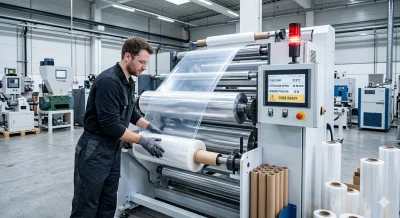
At the winding stage, an effective stretch film extrusion machine integrates real-time tension monitoring through the HMI, giving operators immediate visibility into roll formation and helping prevent telescoping or film deformation. Safety is addressed through an integrated alarm system that requires the cutting device to be properly reset before a manual paper core change can proceed, reducing operator risk during this frequently repeated task. Thoughtful ergonomic design at the winding station also supports proper core positioning, which helps prevent edge defects and ensures a clean start for every new roll.

Finally, systematic maintenance is built into the machine's architecture rather than left to chance. Accessible lubrication points for chains, bearings, and sliding parts support a consistent maintenance schedule, while optical sensors and meter counters are designed for easy cleaning and calibration — helping maintain precise roll lengths and minimizing unplanned downtime over the life of the equipment.

Why Operational Discipline and Machine Design Go Hand in Hand

It's worth emphasizing that even the best-engineered stretch film extrusion machine still depends on disciplined operation to perform at its full potential. Thermal stabilization periods, daily chill roll cleaning, regular die alignment checks, and scheduled lubrication are not optional extras — they are the operational habits that allow a well-designed machine to consistently deliver on its engineering promise. Facilities that combine precise equipment with consistent operational practices typically see measurable improvements in film clarity, gauge consistency, and overall equipment uptime, along with a meaningful reduction in material waste over time.

This is the standard we design toward. Our semi-automatic stretch film extrusion machines are built specifically to simplify the operational discipline described above — from stable thermal control and reliable chill roll cooling to precision T-die calibration and safety-integrated winding systems — so that production teams can achieve consistent, high-quality film output without relying on guesswork or constant manual intervention.

If your production line is dealing with gauge inconsistency, frequent downtime, or rising material waste, it may be time to evaluate whether your current equipment is holding your operation back. Our engineering team works directly with packaging manufacturers to specify the right stretch film extrusion machine configuration for their production volume, film specifications, and facility layout. Contact us today to discuss your production requirements, request detailed technical parameters, or schedule a consultation with our applications engineers — and see how the right machine can turn operational precision into a lasting competitive advantage.

Blog Cover

GET IN TOUCH NOW

*We respect your privacy. When you submit your contact information, we agree to only contact you in accordance with our Privacy Policy.