Automatic vs. Semi-Automatic Stretch Film Extrusion Machine: Long-Term Cost Comparison
2026-05-19
Choosing between an automatic stretch film machine and a semi-automatic stretch film extrusion line impacts long-term factory profitability. While initial costs differ, the true financial variance appears during multi-year operations. This technical analysis highlights the performance differences across labor, energy, waste, and maintenance.
Technical Core: Operational Differences
The primary divergence between these two systems lies in the level of automation and speed capabilities.
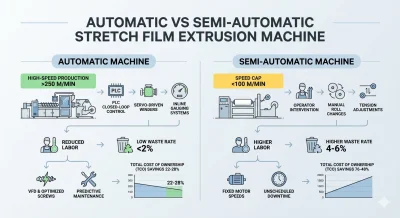
- Automatic Stretch Film Extrusion Machine: Features PLC-based closed-loop control, servo-driven winders, and inline gauging systems. It enables continuous, high-speed production exceeding 250 meters per minute.
- Semi-Automatic Stretch Film Extrusion Machine: Relies on operator intervention for roll changes, tension adjustments, and startup sequences. Maximum production speeds cap at 100 meters per minute.
Labor Efficiency and Operations
Automation level directly dictates the human workforce required per shift.
- Semi-Automatic Extrusion Lines: Require one dedicated operator per shift for core functions. They also need an additional technician for roll handling and re-threading. This system requires 6–9 full-time positions annually for 3-shift operations.
- Automatic Stretch Film Equipment: Allows one shared operator to manage three to four production lines simultaneously. This layout reduces labor to 0.5–1 full-time worker per shift, saving significant operating costs annually.
Production Stability and Material Waste
Material efficiency varies heavily between the two machine architectures.
Semi-Automatic Production
- Waste Rate: 4–6% of total material input.
- Cause: Frequent web breaks and scrap generation during speed ramps and manual roll changes.
Automatic Production
- Waste Rate: Below 2% consistently.
- Cause: Synchronized speed control and automatic tension management.
- Impact: Saves up to 150 metric tons of LLDPE/mLLDPE resin annually for a 5,000-ton capacity plant.
Energy Consumption and Carbon Output
Power efficiency heavily influences long-term manufacturing overhead.
- Fixed Motor Limitations: Semi-automatic lines often run at fixed motor speeds regardless of current load, increasing energy draw.
- Variable-Frequency Drives (VFDs): Automatic machines utilize VFDs and optimized screw designs. These systems match power draw to actual throughput, consuming 15–25% less kWh per kilogram of film.
Maintenance Planning and Machine Uptime
Mechanical complexity alters the downtime and maintenance structure of each line.
- Semi-Automatic Maintenance: Features simpler mechanics and lower parts costs. However, manual adjustments and emergency stops cause 8–12% unscheduled downtime.
- Automatic Maintenance: Uses predictive algorithms and self-diagnostic interfaces. These tools ensure machine uptime above 95%, adding 200–250 extra production hours per year.
10-Year Total Cost of Ownership (TCO)
Aggregated data shows that an automatic stretch film machine delivers a 22–28% lower TCO than a semi-automatic line over a ten-year horizon. The equipment financial break-even point typically occurs between month 18 and month 24. For factories exceeding 3,000 metric tons of annual output, full automation delivers the highest long-term manufacturing yield.