
Maintaining consistent stretch film width is critical in modern stretch film production. Width variations directly impact material utilization, roll quality, and overall production efficiency. In a stretch film line, precise width control requires tight coordination between extrusion stability, die performance, cooling conditions, and winding tension.
Extrusion Factors Affecting Film Width Stability
In cast stretch film extrusion, controlling final web width begins with stable melt delivery and uniform polymer distribution before the material reaches the cooling system. When molten polymer exits the T-die, the melt naturally undergoes neck-in, where the width of the polymer sheet decreases due to melt relaxation, surface tension, and transverse contraction.
The degree of neck-in depends on several factors, including polymer viscosity, melt temperature, die design, and line speed. If the extrusion process is imbalanced, excessive neck-in can reduce usable film width and increase edge trim waste.
A stable extrusion system is essential to maintain consistent film dimensions. The screw design, extrusion capacity, motor torque, and die flow characteristics must be matched to ensure uniform melt pressure and consistent output. Fluctuations in melt delivery create uneven thickness across the web, compromising winding quality and causing production instability.
Another common challenge in cast stretch film production is edge bead formation. Due to flow behavior near the die lips, thicker beads develop along both sides of the web. Excessive edge bead formation increases trimming waste and reduces material utilization. Optimized die flow channels and precise temperature control help minimize these variations and improve overall production efficiency.
T-Die Design and Temperature Control for Width Accuracy
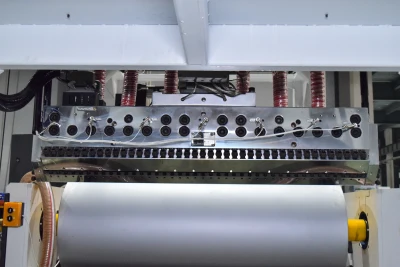
The T-die is a critical component affecting stretch film width and thickness uniformity in a stretch film line. A well-designed die delivers balanced polymer flow across the entire width, ensuring consistent melt distribution before the film enters the cooling stage.
Modern T-dies typically feature optimized internal flow channels and multi-zone heating systems to maintain stable temperatures across the die body. Uniform temperature control ensures consistent polymer viscosity from the center to the die edges, minimizing flow imbalances and stabilizing the extruded web.
Precise die temperature adjustment also improves edge conditions. Since polymer behavior changes with temperature fluctuations, maintaining a stable thermal profile ensures more consistent film dimensions during continuous operation.
Beyond die performance, the extrusion system must deliver stable melt output. Optimized screw designs, proper compression ratios, and reliable drive systems maintain steady extrusion pressure, critical for producing film with uniform width and thickness.
Cooling Performance and Film Width Preservation
After leaving the T-die, the molten polymer web must be rapidly and uniformly cooled to achieve stable film properties. The chill roll system plays a key role in controlling width because cooling conditions directly affect polymer shrinkage and dimensional stability.
An efficient cooling system improves contact between the film and the chill roll surface, ensuring uniform heat transfer across the web. Vacuum boxes are commonly used in advanced cast stretch film lines to enhance web contact, cooling consistency, and prevent air entrapment between the polymer web and the chill roll.
If cooling is insufficient or uneven, the film can experience additional thermal shrinkage, resulting in width fluctuations and poor thickness uniformity. Stable cooling maintains intended dimensions and ensures consistent mechanical performance.
Cooling speed, polymer formulation, and line tension must be carefully balanced. Excessive tension or improper cooling affects film orientation, shrinkage, and winding stability. Ultimately, width control requires seamless coordination across extrusion, cooling, and downstream systems.
Automated Process Control for Consistent Film Production
Our stretch film line integrates automated control systems to maintain stable production conditions. PLC-based automation enables operators to monitor and adjust key parameters, including extrusion temperature, motor speed, line speed, and winding tension.
Connecting production units through a centralized control system improves coordination among melt delivery, cooling performance, and winding operations. This minimizes manual adjustments and ensures consistent quality during long production runs.
Advanced production lines often feature automatic thickness gauging systems and closed-loop controls. These technologies provide real-time feedback, allowing the system to compensate for process variations and maintain uniform output quality.
Consistent width control directly improves roll formation. When film thickness and edge profiles remain stable, winding tension is distributed more evenly, preventing defects such as uneven roll hardness, telescoping, and surface irregularities.
Improving Material Utilization Through Better Width Management
Precise stretch film width control is critical to optimizing production efficiency and material utilization in stretch film manufacturing. Excessive edge trimming increases resin consumption and reduces overall yield. Optimizing die performance, extrusion stability, cooling efficiency, and automated process control minimizes trim scrap while maintaining consistent film specifications across production runs.
Our stretch film lines feature precision extrusion systems, optimized T-die designs, efficient cooling units, and intelligent controls to deliver stable width management and reliable long-term operation. By combining precise melt distribution with controlled cooling and process automation, our cast stretch film lines maximize material utilization, ensure consistent quality, and optimize production efficiency to meet operational targets.