Why High-Volume Packaging Manufacturers Should Shift to In-House Bubble Film Extrusion Machine
2026-05-15
External sourcing of protective packaging often introduces inconsistent gauge control, volatile material properties, and critical supply chain bottlenecks. Transitioning to an on-site, in-house bubble film extrusion machine addresses these inefficiencies. It establishes absolute technical control over material specifications, production schedules, and structural film quality.
Multi-Layer Co-Extrusion and Equipment Configurations
Modern bubble film manufacturing lines scale from entry-level single-pass systems to advanced multi-layer co-extrusion architectures. Each configuration serves specific mechanical and structural performance criteria:
- 2-layer bubble film extrusion machine: Engineered in low-speed, medium-speed, and high-speed configurations. These systems feature precise gauge control for film thicknesses from 20 to 120 microns, preventing material over-specification.
- 3–5-layer bubble film extrusion machine: Developed for medium-to-high speed manufacturing. Multi-layer co-extrusion technology blends virgin polymers, regrind materials, and functional barriers in a single pass to maximize air retention and puncture resistance.
- 7-layer high-speed bubble film extrusion machine: Positioned at the apex of in-house manufacturing capabilities, achieving throughputs above 600 kg/h. This multi-layer architecture improves film burst strength by up to 40% compared to standard three-layer structures.
Line Speed, Automation, and Film Customization
High-speed air bubble film machine models and 2-layer medium-speed bubble film machine solutions operate reliably within a 40 to 80 m/min range. Integrated quick-changeover features allow for rapid adjustments to film width, bubble height, and material layer ratios on a single production line.
Advanced automation features—including remote diagnostics, automated die head adjustments, and energy-efficient AC drives—minimize mechanical downtime and lower the total cost of ownership. This structural flexibility supports the on-demand production of diverse packaging specifications, from thin anti-static electronic wraps to heavy-duty automotive cushioning.
Operational Yields and Material Efficiency
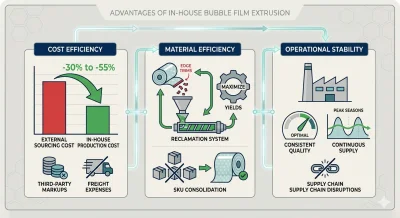
Transitioning away from external vendors directly removes third-party markups and freight expenses, generating an immediate material cost reduction of 30% to 55%.
- Closed-Loop Recycling: Integrated reclamation systems feed edge trims directly back into production to maximize raw polymer yields.
- SKU Consolidation: A single versatile extrusion line replaces multiple supplier SKUs, drastically reducing facility floor space and inventory overhead.
- Supply Stabilization: Continuous on-site manufacturing ensures consistent film quality and mitigates supply chain disruptions during peak operational seasons.