How Stretch Film Extrusion Machine Support 24/7 Production
2026-09-04
Stretch film is widely used in logistics, warehousing, e-commerce, and industrial packaging to stabilize palletized goods and protect products during handling and transportation. As packaging demand increases, manufacturers need equipment capable of maintaining stable production over extended operating periods. A reliable stretch film extrusion machine provides an important foundation for this type of continuous manufacturing.
24/7 production is not simply about running a machine at maximum speed. Stable extrusion, temperature control, cooling, winding, process monitoring, and preventive maintenance all affect production continuity. A properly configured extrusion line can reduce unnecessary interruptions while maintaining consistent stretch film quality.
Common Challenges in Continuous Stretch Film Production
Long production cycles place higher demands on extrusion equipment. Variations in temperature, melt pressure, cooling conditions, and winding tension can affect film thickness, appearance, and mechanical properties. Maintaining stable process conditions is therefore important for manufacturers operating extended production schedules.
Manual roll changes can also interrupt production. Conventional winding systems may require operators to intervene when finished rolls are removed and new rolls are started. Automated winding and changeover systems can reduce manual operations and shorten non-production time.
Temperature stability is another important factor. Polymer materials must be heated and plasticized within an appropriate processing range. Temperature fluctuations in the barrel or die can contribute to variations in film thickness and surface quality. Multi-zone temperature control allows different sections of the extrusion process to be monitored and adjusted independently.
Winding tension also affects finished roll quality. Excessive or unstable tension may result in loose rolls, uneven edges, or deformation. Stable tension control helps produce rolls with more consistent winding density and edge alignment.
How a Stretch Film Extrusion Machine Supports Continuous Production
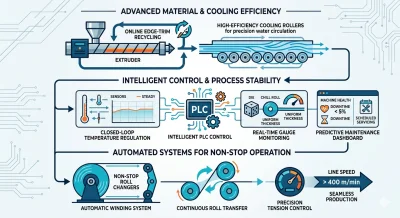
A modern stretch film extrusion machine integrates extrusion, cooling, traction, and winding systems into a coordinated production line. The stability of each section contributes to overall production performance.
Automated Winding Reduces Production Interruptions
Automated winding technology can reduce manual intervention during roll changes. Depending on the machine configuration, automatic changeover or multi-position winding systems can shorten transitions between finished rolls and help maintain a more consistent production rhythm.
Servo-driven winding systems can also provide more precise tension control. Stable winding tension supports consistent roll formation and makes finished rolls easier to handle, store, and use in downstream packaging operations.
Actual winding speed and changeover performance depend on film width, thickness, roll specifications, and machine configuration. These parameters should therefore be selected according to the intended production requirements.
PLC Control Improves Process Consistency
A PLC control system can centrally manage key parameters such as extrusion temperature, line speed, winding tension, and other operating conditions. An HMI allows operators to monitor production status and adjust settings when necessary.
During extended production runs, continuous monitoring can help operators identify abnormal conditions earlier. Recipe management can also simplify setup when producing different film specifications.
Automation does not eliminate the need for skilled operation and maintenance. Raw material properties, equipment condition, process settings, and product specifications can all influence final film quality.
Multi-Zone Temperature Control Supports Stable Extrusion
Temperature control directly affects polymer plasticization and melt stability. A multi-zone heating system allows different barrel sections to be controlled according to material and process requirements.
Stable melt conditions can help maintain consistent film thickness and surface quality. Die temperature control is also important because temperature variations around the die can influence film uniformity.
The achievable film thickness tolerance depends on several factors, including raw material, screw design, die configuration, cooling conditions, line speed, and process parameters. Temperature control therefore needs to work together with the complete extrusion system.
Efficient Cooling Supports Film Formation
After extrusion, molten polymer must be cooled and formed under controlled conditions. Cooling rolls and chilled-water circulation systems help remove heat and stabilize the film during forming.
Stable cooling conditions can contribute to consistent transparency, surface appearance, and dimensional characteristics. Cooling capacity should match the extrusion output, film width, and operating speed.
For extended production, maintaining stable cooling-water temperature and circulation is particularly important. Regular inspection of pumps, piping, cooling units, and related components can help maintain reliable operating conditions.

Multi-Layer Coextrusion for Different Applications
Multi-layer coextrusion allows different material layers to perform specific functions within the same stretch film structure. Depending on the formulation, individual layers can contribute to stretch performance, puncture resistance, tear resistance, cling properties, or other requirements.
This flexibility allows manufacturers to develop stretch film for different packaging conditions. Pallet wrapping may emphasize stretch performance and load retention, while heavy-duty applications may require greater resistance to puncture and tearing.
Multi-layer production can also distribute materials according to their functional requirements instead of relying only on increased overall film thickness. The appropriate structure depends on resin selection, film thickness, layer ratio, and final application. Material-saving results should be evaluated using actual production data.
Edge Trim Recovery and Material Efficiency
Film production may generate edge trim when the finished width is narrower than the extruded web. An edge trim recovery system can collect and process suitable material for reuse when permitted by the formulation and product requirements.
Reuse depends on material type, contamination, processing history, and finished-product quality requirements. Edge trim recovery should therefore be considered a way to improve material utilization and reduce avoidable waste rather than eliminate all production waste.
Better material management can also help manufacturers monitor resin consumption and control production costs during long operating cycles.
24/7 Production Requires More Than Automation
A stretch film extrusion machine provides the equipment foundation for continuous production, but reliable long-term operation also depends on production management.
Stable raw materials, controlled process parameters, regular inspections, preventive maintenance, and operator training all contribute to production stability. Manufacturers can establish process settings for different film specifications and schedule maintenance according to operating hours and component conditions.
Regular inspection of heating, cooling, transmission, winding, and electrical systems can help identify potential problems before they cause significant production interruptions.
For this reason, continuous production should be evaluated by overall equipment reliability and process stability rather than maximum extrusion speed alone.
Reliable Stretch Film Extrusion Solutions for Continuous Production
For manufacturers planning long-running stretch film production, choosing the right stretch film extrusion machine requires more than comparing maximum output or line speed. Film width, thickness range, required production capacity, layer structure, winding configuration, temperature control, cooling system, PLC functions, material recovery, and maintenance requirements should all be considered together. The equipment should be configured according to the actual film specifications and operating conditions to maintain stable production and consistent product quality.
With a focus on practical production requirements, our stretch film extrusion machine integrates stable extrusion, automated winding, temperature control, efficient cooling, and intelligent process management to support manufacturers seeking reliable and efficient continuous production. Whether producing standard pallet wrapping film or multi-layer stretch film for demanding packaging applications, our equipment can be configured to match different production requirements and provide a dependable solution for long-term manufacturing.