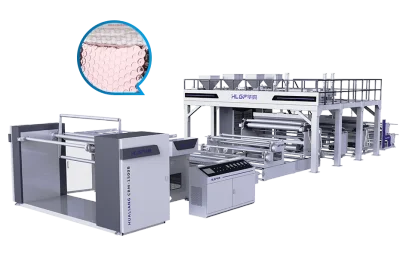
Built on Trust: Inside a South Korean Client’s Journey of Continuous Bubble Film Extrusion Machines Reorders
2026-06-29
For global flexible packaging manufacturers, machinery reliability isn’t measured by a single successful installation, but by the confidence to reorder year after year. In 2019, a prominent industrial packaging leader in South Korea faced a critical decision: upgrade their existing European production lines or find a more cost-effective, high-precision alternative. They chose our advanced multi-layer bubble film extrusion technology. Today, that single purchase has evolved into a thriving multi-year partnership, with the client expanding their fleet annually. By seamlessly integrating our core co-extrusion lines with advanced downstream bubble film bag making machines, they achieved an exceptional 22% reduction in Total Cost of Ownership (TCO) and slashed raw material waste by 40%—all while maintaining flawless bubble cell consistency.
Timeline of Capacity Scaling: The Path of Trust (2019–2026)
2019: The Foundation of First-Year Technical Trust
The partnership was initiated in 2019 when the South Korean client sought to upgrade their manufacturing plant to meet strict domestic standards for protective packaging. They deployed our first core multi-layer co-extrusion bubble film machine.
- Operational Goal: Eliminate thickness variations and achieve perfect cell height uniformity.
- Result: The initial equipment established a new internal benchmark for operational stability, delivering flawless extrusion quality from week one and laying the foundation for a multi-year partnership.
2020–2025: Continuous Fleet Expansion and Automation Integration
As market demand for e-commerce protective packaging surged across East Asia, the client bypassed alternative global suppliers and opted for systematic, annual expansions using our machinery:
- Horizontal Scaling: The client added multiple high-output multi-layer bubble film extrusion units every single year to maximize daily tonnage.
- Vertical Integration: To streamline downstream processing, the client integrated our high-speed bubble film bag making machine, converting raw extruded rolls into ready-to-ship protective mailers and custom bags in a single, continuous automation loop.
- Current Plant Status: Today, the client operates a highly automated fleet of multi-equipment units, dominated by our smart-controlled multi-layer co-extrusion lines.
Core Technical Specifications Matrix
To assist plant engineers and procurement officers in evaluating our technical capabilities, the table below outlines the exact engineering parameters governing our standard and high-output multi-layer bubble film extrusion lines.
Engineering Breakdown: Why Our Bubble Film Extrusion Technology Excels
The South Korean client's strict return-on-investment (ROI) metrics validate three primary mechanical and electrical innovations engineered into our extrusion lines:
Precision Extrusion via Independent Drive Systems
Traditional bubble film machines often utilize a unified or simplified gear-train drive system to control the forming cylinder and the takeoff rollers. This design can introduce minute mechanical backlash, leading to flat spots on the individual air bubbles.
We implement fully independent AC servo drive systems paired with high-precision helical planetary reducers for the extruder screws, forming die, and dual-axis turret winders. Eliminating mechanical transmission links prevents structural micro-vibrations. This ensures a perfectly uniform bubble profile, flawless cell height consistency, and structural integrity across the entire web width.
Material Optimization via Advanced Gauge Control
Raw material costs represent up to 70% of the long-term operational expenses in packaging manufacturing. Fluctuations in film gauge force operators to over-index material usage to guarantee minimum strength requirements.
Our lines feature an Advanced Automatic Gauge Control (AGC) loop integrated into our dual-lip high-efficiency air rings and internal bubble cooling (IBC) systems. The system constantly reads film thickness tolerances via non-contact sensors and dynamically adjusts localized cooling zones. This minimizes gauge variation down to ≤ ± 3%, allowing the South Korean client to thin-gauge their products and reduce raw material waste by up to 40% without sacrificing drop-test or puncture-resistance ratings.
Heavy-Duty Engineering for Continuous Longevity
Industrial facilities in South Korea operate on continuous 24/7/365 production schedules where unscheduled downtime can cost thousands of dollars per hour.
The extruder screws and barrels are manufactured from premium SACM-645 bimetallic alloy, treated with ion-nitriding and tungsten carbide coatings to resist the abrasive wear of recycled plastics and additives. Frame structures utilize heavy-gauge structural steel treated with stress-relieving thermal processing to prevent structural warping over decades of operation. This ensures smooth, uninterrupted daily production cycles with mean time between failures (MTBF) exceeding industry standards.
Downstream Integration: Seamless Automation with Bag Making
A core component of our client's annual capacity scaling was the transition from selling raw bubble film rolls to supplying high-margin, value-added products like protective bubble mailers and custom bags.
To facilitate this, our High-Speed Bubble Film Bag Making Machine was integrated directly into their workflow. The machine features inline thermal lamination modules capable of bonding PE bubble film to Kraft paper, metallic bopp, or co-extruded poly films without the use of solvent-based adhesives.
Utilizing synchronized motion-control microprocessors, the sealing and cutting profiles are executed with millisecond accuracy. This ensures zero-stretch edge seals even at production speeds exceeding 150 bags per minute. Furthermore, trimmed edges are automatically extracted via a high-pressure venturi vacuum system, channeling waste straight into an inline granulator for immediate closed-loop recycling back into the primary extruder.
Economic Validation: Total Cost of Ownership (TCO) Reimagined
For competitive manufacturing landscapes like South Korea, choosing an equipment partner involves looking closely at lifecycle economics. Many factory managers assume European machinery represents the gold standard for high-end polymer processing. However, our ongoing partnership proves a different paradigm:
- 22% Lower TCO: By optimizing energy consumption via copper-induction heating bands, reducing maintenance frequency with bimetallic wear components, and offering cost-efficient replacement parts, the overall cost of operating our fleet over a 5-year cycle is 22% lower than European alternatives.
- Rapid Commissioning: Our standardized modular electrical wiring and pre-tested mechanical configurations allowed the South Korean engineering team to complete installation, calibration, and commercial-grade output within 7 days of customs clearance.
- Supply Chain Security: Operating a standardized, single-source fleet allows the client to keep fewer spare parts in inventory, cross-train machine operators effortlessly, and implement sweeping software updates across all lines simultaneously via remote PLC gateways.
Maximizing B2B Plant Efficiency: The Smart Factory Advantage
As industrial manufacturing enters the Industry 4.0 era, our equipment fleet provides operators with deep data transparency. Every machine shipped to our clients features an integrated Siemens TIA Portal PLC or OMRON Sysmac platform linked to an industrial touchscreen HMI.
- Real-Time KPI Tracking: Production managers can monitor real-time extrusion pressure, melt temperature, screw RPM, linear line speed, and totalized energy consumption (kW/kg of produced film).
- Predictive Maintenance Arrays: Integrated vibration sensors on main gearboxes and temperature alerts on motor bearings warn operators of potential wear well before an unexpected failure occurs.
- Remote Technical Diagnostics: Through secure, encrypted VPN gateways, our corporate engineering team can troubleshoot code, calibrate PID loops, and assist onsite maintenance technicians in South Korea or anywhere worldwide, minimizing the need for physical service visits.
The track record of our South Korean client demonstrates that consistent annual fleet expansions are driven by engineering precision, material savings, and dependable daily operation. If your manufacturing business is looking to reduce operational overhead, eliminate product defects, or transition toward automated multi-layer bubble film packaging production, we offer field-proven machinery tailored to your exact throughput requirements.