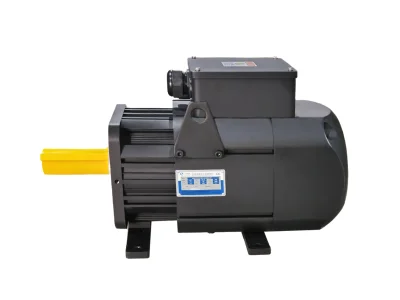
In modern bubble film production machinery, torque precision directly affects film thickness uniformity, bubble stability, material consumption, and overall production efficiency. PMSM (Permanent Magnet Synchronous Motor) technology is widely used in high-performance extrusion and winding systems due to its ability to deliver up to ±1% torque accuracy under dynamic operating conditions.
A key technology enabling this performance is Field-Oriented Control (FOC). FOC converts stator current into two independent components: torque-producing current (Iq) and flux-producing current (Id). This decoupled control method allows precise and real-time torque regulation, significantly improving responsiveness and stability compared to traditional control systems. In bubble film extrusion lines, this ensures stable screw rotation, consistent melt flow, and uniform film formation during continuous operation.
High-resolution encoder feedback plays a critical role in closed-loop control. With resolutions typically reaching 16-bit or higher, encoders provide precise rotor position and speed data to the controller. This enables accurate synchronization between multiple drive units in multi-layer bubble film machines, including 3-layer, 5-layer, and 7-layer co-extrusion systems. As a result, layer alignment is improved, bonding strength is stabilized, and film quality consistency is enhanced across the entire web width.
To maintain stable torque output in real production environments, PMSM systems integrate multiple compensation mechanisms. Temperature compensation adjusts control parameters as motor windings heat up during long production cycles, preventing torque drift. Magnetic saturation control ensures linear torque response under high load conditions by dynamically adjusting current references. These functions are essential for maintaining stable performance during high-speed extrusion and continuous operation.
In addition, disturbance observer algorithms are used to detect and compensate for external load variations. In bubble film production, changes in polymer melt viscosity, pressure fluctuations, and mechanical wear can all impact torque stability. The system automatically adjusts motor output to maintain constant screw speed and consistent haul-off tension, ensuring uniform bubble formation and stable film thickness.
Overall, PMSM-based torque control technology significantly improves bubble film production performance. It reduces material waste, enhances energy efficiency, increases production stability, and ensures consistent product quality even under high-speed and multi-layer extrusion conditions. As bubble film manufacturing moves toward higher precision and automation, PMSM systems have become a core component of advanced extrusion and winding solutions.