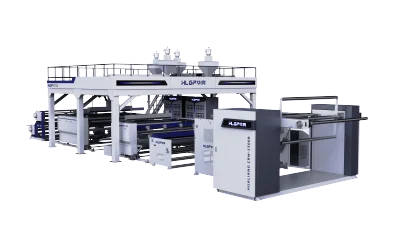
Bubble film machines produce air bubble film through extrusion and lamination. They are generally classified into high-speed, middle-speed and low-speed types, differing in output, automation, stability, and energy efficiency.
High-speed bubble film machines, available in 3-layer, 5-layer, and 7-layer configurations, are designed for continuous, large-scale production. They use high-performance extruders, precision gear pumps, and efficient cooling systems to maintain stable operation at high throughput. Integrated PLC controls with touchscreen interfaces allow precise management of temperature, layer thickness, and winding tension, ensuring consistent bubble structure, uniform film strength, and minimal material waste. These machines are optimized for sustained high output, consistent multi-layer film quality, and reduced cost per unit at scale.
Low-speed bubble film machines, available in 2-layer, 3-layer, and 7-layer variants, focus on stability, flexibility, and energy efficiency. Their extrusion systems are engineered for consistent bubble formation and film clarity at lower speeds. The machines are durable and user-friendly, allowing fast adjustments and product changeovers. They consume less energy per cycle, occupy a smaller footprint, and maintain stable output with reduced process fluctuations, making them ideal for variable production conditions.
The primary differences lie in production capacity, automation, process stability, and energy use. High-speed machines excel in output and automation, while low-speed machines provide stable, flexible, and efficient operation. Both rely on precise extrusion and layer control to ensure reliable performance across industrial applications.