Why Factories are Shifting to Intelligent Bubble Film Extrusion Machine
2026-09-07
Efficiency and precision are the two things that actually determine profitability in protective packaging, and they're also the two things that traditional, manually operated production lines struggle to deliver consistently. Material waste, inconsistent bubble quality, and high energy consumption aren't isolated problems — they're symptoms of the same root issue, which is that a line running on manual adjustment and reactive maintenance simply can't hold the tolerances that modern packaging buyers now expect. That's the gap intelligent bubble film extrusion technology was built to close.
Applications Most Affected by Production Inefficiencies
Much of the variability on a conventional bubble film extrusion line comes from relying on manual observation and periodic adjustments. Screw speed, die gap, cooling airflow, and other parameters may need to be adjusted as conditions change, allowing small deviations to persist until they affect bubble shape, size, film thickness, or clarity. Without continuous monitoring of melt temperature and pressure, developing issues can be harder to detect early, while reactive maintenance can increase the risk of unplanned downtime.
Limited process feedback can also lead operators to run a slightly higher film gauge as a safety margin, increasing resin consumption over time. Changeovers between different bubble specifications may require additional manual adjustment and verification, adding setup time to each production run. Energy consumption can also be less responsive to actual output when major drives and heating systems rely on relatively fixed operating settings.
Where Production Inefficiencies Have the Biggest Impact
These inefficiencies don't affect every operation the same way — they hit hardest where product mix, quality requirements, or scale amplify the cost of every inconsistency.
Multi-SKU contract fillers and personal care manufacturers running frequent product changeovers feel the changeover penalty most directly. Every time packaging specifications shift, manual recalibration adds setup time that a high-mix production schedule simply can't absorb without falling behind.
Precision medical device and pharmaceutical packaging lines depend on both thickness consistency and traceable production data to satisfy quality audits, and a manual line's natural variation in layer thickness — along with the absence of detailed production records — makes it difficult to demonstrate the consistency these audits require.
Large industrial equipment manufacturing facilities running multiple production lines in parallel face a different kind of exposure: when each line operates independently with no shared visibility into its condition, a single unit's slow response to a developing fault can quietly drag down the output of the whole facility before anyone notices.

Intelligent Process Control Across the Machine Lineup
Bringing intelligent control into the extrusion process changes this picture across the full range of configurations, from 2-layer machines through complex multi-layer high-speed systems. Rather than relying on periodic manual checks, these systems coordinate extrusion parameters, monitor melt conditions continuously, and hold bubble formation steady in a way manual adjustment can't consistently match — and that improvement in process stability also reduces the disruption that comes with shifting between product specifications, since the line spends less time drifting out of tolerance between runs in the first place.
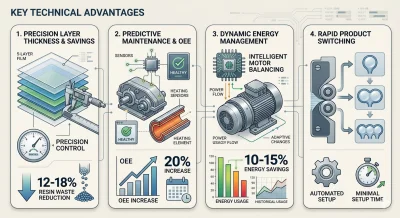
Thickness control benefits the most directly from this shift. Where manual lines lean on over-gauging as a safety margin, intelligent systems hold layer thickness to tighter, more consistent tolerances, which reduces unnecessary resin use without sacrificing the strength or protection the film needs to deliver. For precision medical device and pharmaceutical packaging, that consistency does double duty — it keeps film performance uniform batch to batch, and it gives quality teams the kind of dependable, trackable output that supports the traceability their audits demand.
Maintenance also shifts from a reactive posture to something closer to anticipation. Continuous condition monitoring makes it possible to notice early signs of wear in components like heating elements or gearboxes well before they cause a failure, which lets maintenance be scheduled around production instead of interrupting it. For a facility running several production lines at once, this is what keeps one unit's developing issue from becoming everyone's downtime problem — each line can be brought in for attention on its own timeline instead of waiting for something to break.
Energy use becomes more responsive rather than staying fixed regardless of output. Modern motor technology adjusts power draw in line with what the process actually needs at any given moment, so energy consumption tracks real production activity instead of running at a constant baseline whether the line is at full output or idling between adjustments. Over the course of continuous, high-volume operation, that kind of responsiveness adds up to a meaningful reduction in overall energy cost compared to conventional equipment running on fixed power settings.
Intelligent Extrusion for Modern Packaging Production
These advantages are available across different bubble film extrusion machine configurations, from 2-layer systems for straightforward production needs to advanced multi-layer, high-speed lines for more demanding applications. This allows manufacturers to match layer structure, production capacity, and automation level to their actual requirements rather than choosing between process control and production flexibility.
For contract fillers managing frequent changeovers, medical and pharmaceutical packagers requiring consistent output, and manufacturers operating multiple lines, intelligent extrusion can provide greater control over production stability, material use, and equipment performance. If your current line still relies heavily on manual adjustment and reactive maintenance, choosing the right bubble film extrusion machine can be a practical step toward more consistent and efficient production.