The Economic Advantage of In-house Production Using a Bubble Film Extrusion Machine
2026-09-07
Buying protective packaging from an outside supplier feels simple right up until the moment it isn't. Lead times slip, minimum order quantities force bulk purchases that sit in a warehouse for months, and the film specification itself stays fixed at whatever the supplier happens to offer. Bringing that production in-house with a bubble film extrusion machine turns packaging from a line item you negotiate every quarter into a process you actually control, and the economics of that shift are usually bigger than they first appear.
What Outside Procurement Quietly Costs a Business
The challenges of relying entirely on external film suppliers rarely come from a single major problem. More often, they accumulate through smaller operational constraints. Delivery schedules are less directly under your control, so delays or changes in a supplier's production and logistics schedule can affect your own production and shipping plans. Holding additional inventory can provide a buffer, but it also ties up warehouse space and working capital in finished film before it is needed.
There can also be limitations when film specifications need to change. External suppliers may focus on a defined range of standard gauges, widths, and formulations, making it less convenient to adjust film properties for specific applications or changing customer requirements. When purchasing is concentrated among a small number of suppliers, changes in resin costs and supplier pricing can also have a more direct impact on packaging costs, with limited opportunity to optimize the production process internally.
Specialty requirements can add another layer of complexity. Films with anti-static properties, weather resistance, or recycled resin content may be available from specialist suppliers, but availability, minimum order quantities, lead times, and pricing can vary considerably. For manufacturers that regularly need different film specifications, these constraints can make external procurement less flexible than producing film in-house.
Where These Procurement Limitations Hit Hardest
These constraints don't affect every business the same way — they're most damaging in a handful of specific packaging contexts.
Semiconductor and precision electronics packaging requires anti-static protection at a level that generic, off-the-shelf bubble film usually can't guarantee, since standardized external supply rarely matches the specific static-control tolerances a component line needs.
Outdoor building materials and garden tool packaging sits exposed to sun and temperature swings for extended periods before it's ever unpacked, and general-purpose film purchased externally is rarely formulated with the UV resistance that exposure actually calls for, leading to premature brittleness and cracking.
Small-batch private-label contract packagers deal with frequent product changeovers and mixed order volumes, and external suppliers' minimum order quantities and fixed lead times make it difficult to match packaging supply to a production schedule that shifts from week to week.
Building the Right Production Capability for the Application
Bringing extrusion in-house works because the technology scales to match what a business actually needs to produce, rather than forcing every application through the same fixed specification. Foundational 2-layer low- and medium-speed systems are engineered for consistent output of standard cushioning film, giving smaller or newer operations a stable, low-complexity entry point into localized manufacturing. Where volume is the priority, 2-layer high-speed machines maximize linear output for standard film structures, meaningfully reducing production cycle time per unit while holding structural integrity.
For applications that need more than a standard structure can deliver, 3 to 5 layer extrusion systems function as the workhorse of a serious in-house operation. High-speed variants in this range are built for mass output, while medium-speed models are built for meticulous control over layer composition — and that control is what makes it possible to integrate functional additives like anti-static agents, UV inhibitors, and recycled resin content without compromising the film's protective performance. This is exactly the capability that solves the semiconductor packaging problem described above, since anti-static properties can be engineered into the film formulation directly rather than sourced as a specialty product from a third party, and it's the same capability that lets outdoor building material and garden tool packaging get a UV-stabilized formulation built for its actual exposure conditions instead of a generic film pulled off a supplier's standard catalog.
At the top end, 7-layer high-speed technology produces complex, multi-functional film in a single pass, with dedicated layers handling sealing, structural reinforcement, and specialized barrier properties. This level of engineering serves high-performance packaging requirements that a simpler structure can't meet in one production step.
The Measurable Gains of Controlling the Process Directly
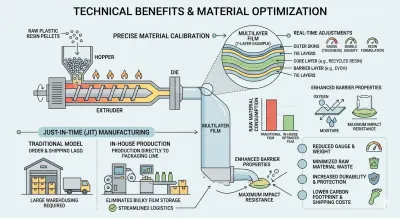
Beyond matching machine configuration to application, running production in-house delivers a set of technical and economic advantages that external procurement structurally can't offer. Precise material calibration lets operators adjust film gauge, bubble density, and resin formulation in real time, which reduces raw material consumption — the primary driver of total packaging cost — while still maintaining the impact resistance the application requires. Just-in-time manufacturing aligns film output directly with a business's own packaging schedule, eliminating the need to warehouse large volumes of finished film purely to buffer against supplier lead times; this is precisely what resolves the scheduling mismatch that small-batch private-label packagers run into with external vendors, since production can flex week to week instead of being locked to a supplier's minimum order cycle. Multilayer engineering also produces thinner, structurally stronger film than single-layer alternatives, which reduces total shipping weight and the associated carbon footprint without sacrificing the level of protection a product needs.
Engineering Packaging Into a Competitive Asset
Taken together, these advantages shift protective packaging from a recurring external purchase into a technical capability a business owns and controls directly. Instead of negotiating specifications, absorbing supplier volatility, and warehousing finished film that doesn't move, an in-house line lets a business calibrate exactly the film it needs, produce it on its own schedule, and adjust formulation as products and requirements change.
This is exactly the range we've engineered our bubble film extrusion machines to cover — from foundational 2-layer low- and medium-speed systems for businesses taking their first step into localized manufacturing, through high-output 2-layer lines, all the way up to 3-5 layer workhorse systems and 7-layer high-speed platforms built for the most demanding multi-functional film structures. Whichever configuration fits your production volume and application, the underlying goal is the same: give you direct control over gauge, bubble density, and resin formulation instead of leaving those decisions to a supplier's standard catalog. If your business is still buying bubble film by the truckload and hoping the spec holds up, talk to us about sizing a bubble film extrusion machine to your actual production volume — it's the more direct way to bring supply chain resilience, material performance, and total delivered cost back under your own control.