Labor-Saving Automation in Modern Bubble Film Extrusion Machine
2026-09-07
Labor efficiency is becoming an important consideration for manufacturers operating bubble film production lines. Traditional production often requires operators to monitor extrusion conditions, adjust settings, change rolls, manage edge trim, and check perforation during production. When product specifications change frequently, these repetitive tasks can take up additional working time and make production more dependent on operator experience.
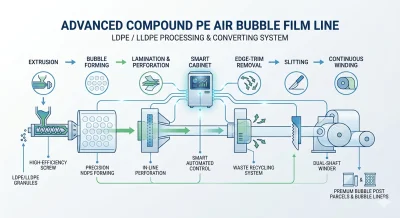
A modern bubble film extrusion machine can automate many of these routine operations through integrated extrusion control, bubble forming, perforation, trimming, and rewinding systems. The purpose is not to remove operators from the production process, but to reduce repetitive manual work and make daily production easier to manage.
Where Traditional Bubble Film Production Requires More Labor
Manual work is particularly noticeable during roll changes, specification adjustments, perforation setup, and trim handling.
When a finished roll reaches its target size, operators may need to stop the line, remove the roll, prepare a new core, and restart production. Frequent roll changes can therefore increase non-production time, especially when several specifications are produced during the same shift.
Perforation adjustment can also require operator attention. Different packaging formats may require different perforation spacing, and incorrect settings can affect how easily the film separates during use. On equipment with limited automation, operators may need to manually adjust and verify the perforation position when changing specifications.
Edge trim is another repetitive task. Material removed during trimming needs to be collected and managed throughout production. Automating this process can reduce manual handling and help keep the film path and working area organized.
These requirements become more significant for manufacturers producing small batches or multiple film specifications. More frequent changeovers generally mean more setup, adjustment, and quality-checking work.
Applications Where Labor Efficiency Matters
Small and medium-sized packaging converters often handle multiple customer orders with different film widths, roll sizes, or perforation requirements. Frequent changes can increase operator workload and reduce the time available for other production tasks.
Contract packaging operations may face similar challenges because customer requirements can change from one order to another. A production line that simplifies routine adjustments can make these changes easier to manage.
E-commerce fulfillment and return-processing operations can also involve a wide range of packaging formats. Consistent perforation and film dimensions are useful when protective packaging materials are prepared in larger volumes, while simplified operation can reduce the training burden for new operators.
Cold-chain and fresh-produce packaging centers may operate across multiple shifts and experience changing production workloads. Automated roll handling, trim collection, and process control can help reduce repetitive tasks during busy periods or shifts with fewer experienced personnel.

How Automation Reduces Labor Input
A modern bubble film extrusion machine integrates several production functions into a coordinated system, allowing operators to focus more on monitoring and quality control instead of continuously making manual adjustments.
Centralized Intelligent Control
A centralized control system allows key production parameters to be monitored and adjusted through a common interface. Depending on the machine configuration, this may include extrusion temperature, production speed, bubble forming conditions, perforation, trimming, and rewinding.
This approach can make production procedures more repeatable and reduce unnecessary operator intervention during normal operation.
Efficient LDPE and LLDPE Extrusion
Bubble film commonly uses polyethylene materials such as LDPE and LLDPE, depending on the required film structure and application.
A properly designed extrusion system helps maintain stable melting and extrusion conditions for the selected material formulation. Consistent extrusion provides an important foundation for controlling film thickness and bubble formation.
Consistent Bubble Forming
Bubble forming directly affects bubble size, bubble height, film thickness, and finished-film appearance. Changes in cooling conditions, extrusion output, air pressure, or other process parameters can influence these characteristics.
Modern process control can help maintain more stable operating conditions and reduce the need for frequent manual adjustments. This is particularly useful for longer production runs where consistent bubble structure and film quality are required.
Automatic Perforation
An automatic perforation system can reduce the amount of manual measuring and adjustment required when producing perforated bubble film.
After the appropriate production settings are selected, the system can maintain the required perforation operation during production. This helps improve repeatability and makes specification changes easier to manage.
Automatic Trim Collection
Automatic trim collection gathers edge material generated during film trimming, reducing the need for operators to handle trim continuously during production.
Collected trim can then be managed according to the manufacturer's material-handling procedures. If trim is reused, the suitability depends on the material type, cleanliness, formulation, and the manufacturer's recycling process.
Servo-Driven Trimming and Rewinding
Servo-driven trimming and rewinding systems provide controlled movement and tension during the finishing process. Stable winding conditions help maintain consistent roll formation and make the production process easier to manage.
Depending on the machine configuration, automated roll handling can also simplify roll changes and reduce the amount of manual work associated with finished-roll preparation.
Automation Across Different Machine Configurations
Different manufacturers have different production requirements, so automation should be matched to the selected machine configuration.
A two-layer bubble film extrusion machine can be suitable for conventional protective packaging applications, while three-layer and five-layer configurations provide greater flexibility for different material combinations and layer structures. Seven-layer systems can be considered when more complex multilayer production is required.
The specific automation functions can vary between configurations. Manufacturers should therefore evaluate film width, layer structure, output, perforation requirements, roll specifications, and desired level of automation before choosing equipment.
From Manual Work to More Efficient Production
The value of automation is not limited to reducing the number of manual operations. By integrating process control, perforation, trimming, trim collection, and rewinding, a bubble film extrusion line can provide a more structured production workflow.
Operators can spend more time monitoring production conditions, checking finished-film quality, preparing materials, and responding to exceptions. For manufacturers handling frequent changes or longer production runs, reducing repetitive work can also make daily production management more efficient.
The right level of automation ultimately depends on the application, production volume, product specifications, and available workforce.
Built for Modern Bubble Film Production
Labor-saving automation provides a practical way to improve how bubble film production is organized. Rather than relying heavily on manual adjustment for every stage, manufacturers can use integrated equipment to reduce repetitive work while maintaining better control over key production processes.
Our bubble film extrusion machines are available in different layer configurations, including two-layer, three-layer, five-layer, and seven-layer systems, with automation options covering extrusion control, bubble forming, perforation, trimming, trim collection, and rewinding according to the selected model.
If you are looking to reduce operator workload and improve production consistency, our bubble film extrusion machine solutions can be configured around your actual film specifications, output requirements, and automation needs. Contact our team to discuss the right configuration for your bubble film production line.