How to Reduce Per-Roll Cost in Mass Bubble Film Production
2026-09-16
Maximizing profitability in mass bubble film production depends less on running machines faster and more on controlling what actually drives per-roll cost: raw material waste and energy consumption. Traditional single-layer extrusion lines were not designed with either of these in mind. Inconsistent bubble geometry, high start-up scrap, and uneven thermal management all quietly add cost to every roll that leaves the line, even when the equipment appears to be running normally. A bubble film extrusion machine built around multi-layer co-extrusion and energy-conscious process control addresses these inefficiencies at the source rather than compensating for them after the fact.
Where Traditional Production Lines Lose Money
Single-layer lines typically rely on one resin formulation to deliver every property the finished film needs, from cushioning strength to seal integrity. Without the ability to separate these functions across layers, manufacturers are often forced to run thicker film than the application actually requires, simply to guarantee performance. That excess gauge translates directly into higher resin consumption per roll.
Start-up and changeover scrap add a second layer of cost. On lines without responsive thickness feedback, gauge drift can go undetected until a finished roll is inspected, by which point an entire production run may already be out of tolerance. Thermal inconsistency compounds the problem: barrel and cooling roll temperatures that drift outside their process window affect bubble formation and film stability, which in turn increases the likelihood of rejected material. None of these issues appear as a single large expense. Instead, they accumulate gradually across a production run, and over high-volume operations the difference becomes substantial.
Where Bubble Film Production Costs Matter Most
These cost pressures are most visible wherever bubble film is consumed in large, continuous volumes rather than smaller custom batches. Appliance manufacturers packaging finished units at the end of a production line need consistent cushioning performance across thousands of identical packages, so any inconsistency in film thickness or bubble uniformity is magnified across the full run. Construction hardware exporters shipping palletized goods in bulk depend on predictable material costs to keep export pricing competitive, which makes resin efficiency a direct factor in margin. High-speed beverage and bottled water filling operations, where secondary packaging must keep pace with continuous line speeds, need bubble film that performs reliably without slowing down changeovers or introducing scrap into an otherwise efficient process. In each of these settings, the cost of the film itself is inseparable from the efficiency of the machine that produces it.
Reducing Raw Material Cost Through Multi-Layer Co-Extrusion
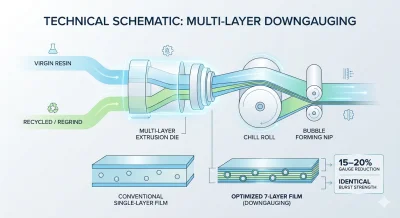
A multi-layer bubble film extrusion machine allows resin to be distributed according to function rather than using a single formulation throughout the film. Outer layers can be optimized for seal strength and surface clarity, while core layers can incorporate a higher proportion of recycled or lower-cost resin without compromising overall performance. This layered approach makes it possible to reduce total gauge while maintaining the cushioning and burst strength the application requires, which lowers resin consumption on every roll produced.
For appliance manufacturers running high volumes of standardized packaging, this translates into a lower material cost per unit without changing the protective performance customers expect. For construction hardware exporters, the ability to incorporate recycled content into core layers offers an additional lever for controlling landed cost on bulk shipments, particularly on routes where resin pricing fluctuates. Precise layer-ratio control also supports compliance with recognized material standards, which matters for exporters who need documented consistency across production batches.
Cutting Scrap Through Responsive Thickness Control
Gauge variation is one of the most direct paths to unnecessary cost, because film that runs heavier than specification wastes resin even when it never becomes scrap. A bubble film extrusion machine equipped with automated thickness monitoring and closed-loop control keeps gauge within a tight, verifiable tolerance throughout the run rather than relying on periodic manual checks. When deviations do occur, the system can correct them in-line, before they propagate into a full roll of out-of-tolerance material.
This responsiveness is particularly valuable for high-speed beverage and filling-line customers, where production cannot be paused for lengthy quality checks without disrupting throughput. Maintaining consistent bubble concentricity and tension at speed reduces the volume of rejected material and keeps changeovers from generating disproportionate waste. Over the course of a shift, the difference between a line that drifts and one that self-corrects can represent a meaningful share of total material cost.
Matching Screw and Die Design to Resin Behavior
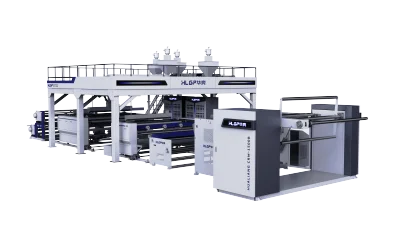
Cost efficiency is not only about layer structure and thickness control; it also depends on whether the extrusion system itself is matched to the resin being processed. Running melt-sensitive or recycled-content resins through a screw and die designed for a different material profile increases the risk of gel formation, uneven melt flow, and unplanned downtime, all of which reduce effective output. Our bubble film extrusion machines are available across high, medium, and low-speed configurations with layer counts ranging from two to seven, allowing screw geometry and die design to be matched to the specific resin blend and output requirement of each production line rather than forcing every application through a single generic setup.
This flexibility matters most for manufacturers working with a range of resin sources, including recycled or regrind material, where consistent melt behavior cannot always be assumed. Selecting equipment configured for the resin actually being used, rather than adapting production around equipment limitations, helps avoid the downtime and material loss that come with mismatched processing conditions.
Lowering Utility Cost Through Smarter Thermal Management
Energy consumption is the other major variable in per-roll cost, particularly for continuous high-volume production. Barrel heating and chill roll temperature must be maintained within a defined process window, and inefficient thermal control forces the system to work harder than necessary to hold that window. Centralized thermal management, paired with permanent magnet synchronous motors on the extrusion drive, reduces power consumption compared with older asynchronous motor configurations while maintaining stable output across extended runs.
For manufacturers running multiple shifts or continuous production schedules, even modest reductions in energy use compound significantly over time. Combined with more stable thermal profiles, this also reduces mechanical wear on heating and cooling components, supporting longer intervals between maintenance and fewer unplanned interruptions to production. Facilities operating around the clock, such as high-volume appliance or beverage packaging lines, benefit the most from this stability, since unplanned downtime on a continuously running line carries a much higher cost than the same interruption on a line that already runs intermittently.
Our bubble film extrusion machines are engineered to address per-roll cost from multiple directions at once, rather than treating material efficiency, scrap reduction, and energy consumption as separate problems. Multi-layer co-extrusion allows resin to be used where it delivers the most value, closed-loop thickness control keeps material waste to a minimum, and configurable screw, die, and thermal systems ensure the machine matches the resin and output requirements of the application it serves. For manufacturers producing bubble film at scale, this combination provides a practical, measurable path to lowering production cost without compromising the protective performance the finished film needs to deliver.