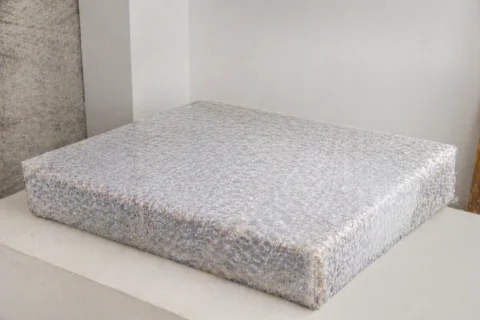
High-gloss wooden lacquer boards are widely used in premium furniture, interior decoration, cabinet manufacturing, and architectural applications where surface appearance and dimensional stability are critical. Unlike ordinary wood panels, lacquer-coated boards require strict protection during storage and transportation because even minor environmental changes can affect the final visual quality.
The core materials used in many lacquer boards, including medium-density fiberboard (MDF) and particle board, contain wood fibers and compressed particles that naturally absorb moisture from the surrounding environment. When exposed to fluctuating humidity levels, these substrates may experience moisture absorption, expansion, and internal stress changes. This issue becomes more significant during long-distance transportation, seasonal storage, or warehouse conditions without precise climate control.
Although the lacquer coating provides a decorative and protective surface layer, it cannot completely prevent moisture migration through board edges, cutting areas, or microscopic coating imperfections. Once moisture penetrates into the substrate, dimensional changes may gradually affect the entire panel structure, creating risks for manufacturers, distributors, and end users.
Moisture-Related Risks During Lacquer Board Storage and Logistics
The hygroscopic characteristics of MDF and particle board create several challenges during storage and transportation. These engineered wood materials are designed for structural stability under controlled conditions, but prolonged exposure to high humidity environments can negatively influence their physical properties.
Moisture absorption is one of the most common concerns. When wooden panels absorb water vapor from the surrounding air, the internal fibers can swell unevenly. This uneven expansion may cause dimensional variations, edge deformation, and difficulty during later assembly processes.
Traditional packaging methods, such as simple plastic wrapping or basic protective sheets, often provide limited moisture resistance. These materials may protect against dust and surface scratches but cannot effectively reduce water vapor transmission over extended periods. As a result, packaged panels may still be affected by warehouse humidity, container condensation, and climate differences during international transportation.
Humidity fluctuations can also accelerate surface defects. High-value lacquer boards with mirror-like finishes are particularly sensitive because even small structural changes beneath the coating can become visible. Potential issues include panel warping, edge lifting, coating separation, and fine surface cracks caused by internal stress.
Therefore, packaging materials for premium lacquer boards must provide not only physical protection but also a stable moisture barrier capable of reducing environmental impact.
Advanced Bubble Film Technology for Lacquer Board Protection
A modern bubble film manufacturing machine enables manufacturers to produce customized protective packaging materials designed for moisture-sensitive products such as high-gloss lacquer boards. Through multi-layer polyethylene extrusion technology, bubble film can combine cushioning performance with improved moisture barrier characteristics.
One of the key advantages of advanced bubble film structures is their ability to reduce water vapor transmission. Multi-layer polyethylene films create a more effective barrier system by combining different polymer layers with optimized thickness distribution. This structure helps slow down moisture migration between the external environment and the packaged wooden panel.
Compared with conventional protective films, engineered bubble film provides a three-dimensional cushioning structure. The air-filled bubble layer absorbs external impact energy during handling, loading, and transportation. This reduces the risk of scratches, pressure marks, and surface damage on delicate lacquer finishes.
At the same time, the closed-cell bubble structure creates additional separation between the board surface and external conditions. This helps reduce direct contact with humid air while maintaining a lightweight packaging solution suitable for large panel applications.
For manufacturers of premium furniture components and decorative boards, this combination of moisture resistance and impact protection provides a practical method to maintain product consistency throughout the supply chain.
Bubble Film Manufacturing Machine Configurations for Different Protection Requirements
Different lacquer board applications require different levels of packaging performance. The selection of a suitable bubble film manufacturing machine depends on transportation distance, storage duration, product value, and environmental conditions.
For domestic transportation and short-term warehouse storage, a 2-layer bubble film machine can provide an efficient packaging solution. This configuration produces a reliable protective layer consisting of polyethylene film and bubble cushioning structures. It is suitable for standard furniture panels, interior boards, and general distribution environments where moderate moisture protection is required.
For international export shipments and extended storage periods, a 3-layer to 5-layer bubble film machine provides enhanced barrier performance. Multi-layer extrusion technology allows manufacturers to combine different polyethylene materials into functional layers. The outer layers can improve mechanical strength and puncture resistance, while inner layers can be optimized for flexibility and moisture protection.
This structure is especially valuable for container transportation, where products may experience significant temperature and humidity changes between different regions. By producing thicker and more stable protective films, manufacturers can reduce packaging-related quality risks during long-distance logistics.
For large-scale production and high-value lacquer board applications, a 7-layer bubble film machine provides advanced material flexibility. Through precise layer distribution control, manufacturers can optimize each layer according to performance requirements. Recycled polymer materials can also be incorporated into selected core layers while maintaining protective performance in the outer functional layers.
Modern extrusion systems equipped with automatic thickness control and online monitoring technology help maintain consistent film quality during continuous production. Advanced configurations can achieve precise thickness management, supporting stable bubble formation and uniform protection performance across large production volumes.
| Bubble Film Machine Configuration | Application Scenario | Main Protection Features | Suitable Lacquer Board Requirements |
|---|---|---|---|
| 2-Layer Bubble Film Machine | Domestic transportation and short-term storage | Basic moisture barrier and cushioning protection | Standard furniture panels and general distribution |
| 3–5 Layer Bubble Film Machine | Export transportation and long-term storage | Enhanced moisture resistance, stronger structure, better puncture protection | High-value lacquer boards requiring extended protection |
| 7-Layer Bubble Film Machine | Large-scale production and premium board applications | Advanced layer control, material optimization, stable film quality | Luxury lacquer boards with strict quality and packaging requirements |
Flexible Manufacturing for Customized Lacquer Board Packaging
One major advantage of producing bubble film in-house is the ability to adjust packaging specifications according to different product requirements. Lacquer boards vary in size, surface treatment, transportation distance, and protection standards, making customized packaging increasingly important.
A bubble film manufacturing machine allows manufacturers to control film width, thickness, bubble size, and layer structure based on specific applications. Large furniture panels may require wider protective film with stronger cushioning capability, while smaller decorative boards may benefit from lightweight packaging that reduces material consumption.
This flexibility helps furniture manufacturers, packaging suppliers, and logistics companies improve inventory efficiency by producing protective materials according to actual demand rather than relying on fixed external supplies.
Maintaining Premium Lacquer Board Quality Through Advanced Packaging Production
The storage and transportation of high-gloss wooden lacquer boards require more than simple surface protection. Because MDF and particle board substrates are sensitive to moisture variations, effective packaging must control environmental influences while preventing physical damage.
Advanced bubble film technology provides a practical approach by combining polyethylene moisture barriers with cushioning structures. From short-distance distribution to international export logistics, different bubble film machine configurations enable manufacturers to select suitable protection levels according to their operational requirements.
With a complete range of bubble film manufacturing machines from 2-layer to 7-layer configurations, our equipment provides flexible production capabilities for companies requiring reliable, customized packaging materials. Through precise extrusion technology, stable layer control, and efficient manufacturing performance, these machines help protect lacquer boards from production lines to final installation while maintaining their original appearance and structural quality.