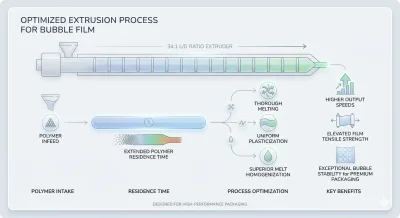
In high-speed protective packaging production, conventional bubble film making machines utilizing standard 28:1 or 30:1 L/D (Length-to-Diameter) ratios frequently encounter operational bottlenecks. These shorter plasticization systems often fail to deliver sufficient thermal energy and mechanical shearing, resulting in incomplete polymer melting, erratic melt viscosity, and localized temperature fluctuations. By upgrading to an advanced 34:1 L/D ratio plasticization system, manufacturers can significantly extend the polymer residence time inside the barrel. This extension ensures absolute molecular homogenization and uniform melt quality, which are critical for stable, high-throughput bubble film making machine.
Technical Mechanics of the 34:1 L/D Plasticization Advantage
Comprehensive Polymer Homogenization
The extended physical length of the 34:1 L/D screw configuration substantially increases the residence time of the resin within the heating zones, allowing for a more thorough application of thermal and mechanical work. This prolonged processing window completely eliminates unmelted solid pellets and thermal gradients within the melt stream, yielding a perfectly homogeneous polymer matrix with uniform viscosity. Consequently, this precise material preparation eliminates structural defects such as "fish eyes" and gel specks, both of which are primary causes of localized thinning and bubble wall rupture during downstream air injection.
Advanced Shear and Temperature Regulation
- Controlled Shear Heat Generation: The optimized geometric design of the 34:1 screw profile dampens excessive shear stress, preventing localized overheating and subsequent thermal degradation of sensitive polymers during high-rpm operations.
- Superior Additive and Recycled Material Dispersion: The extended mixing sections facilitate an exceptionally uniform distribution of masterbatches, slip agents, and functional additives across LDPE, LLDPE, or high-percentage recycled resin formulations.
- Low-Temperature Extrusion Stability: For 2-layer medium and low-speed manufacturing configurations, the system generates sufficient pumping pressure at lower melt temperatures, which significantly enhances bubble stability right after the die lip.
Quantifiable Performance and Output Metrics
Accelerated Take-Off and Production Speeds
Integrating the 34:1 L/D ratio plasticization system into multi-layer co-extrusion lines directly overcomes the throughput limitations inherent in shorter extrusion systems. For high-speed 3-layer, 5-layer, and 7-layer bubble film making machines, this technology delivers a 15% to 20% increase in take-off speeds without compromising film gauge consistency across the entire web width.
Enhanced Mechanical Strength and Material Savings
- 12% Improvement in Tensile Properties: The uniform plasticization process yields cross-linked molecular alignment, enhancing both the tensile strength and elongation metrics of the bubble film by up to 12%.
- Strategic Film Downgauging: The elevated structural integrity allows for the production of thinner bubble walls that still surpass stringent puncture and impact resistance standards, enabling substantial raw material savings per roll.
Operational Waste and Downtime Reduction
By maintaining a perfectly stable bubble geometry and uniform linear pressure, the 34:1 L/D extruder reduces film breakage and thickness variations. This exceptional process stability lowers production scrap rates by up to 50% and dramatically minimizes the machine downtime typically required for constant operator adjustments.
Multi-Configuration Machine Compatibility
The 34:1 L/D plasticization system is engineered for seamless integration across a versatile range of bubble film making machine architectures:
- High-Speed Co-Extrusion Lines: Specially optimized to handle the complex, differential rheological properties of diverse resins used in high-barrier 3, 5, and 7-layer protective films.
- Standard Medium & Low-Speed Lines: Engineered to stabilize standard 2-layer bubble wrap production by maintaining linear pressure control at reduced operational speeds.
- Circular Economy Adaptability: Purpose-built to process post-consumer recycled (PCR) plastics smoothly, ensuring that varying melt flow indexes (MFI) do not disrupt continuous film formation.